
分析 2009 年至 2017 年在英格兰和威尔士与人类隐孢子虫病爆发相关的隐孢子虫 spp. 和 gp60 亚型。
Analysis of the Cryptosporidium spp. and gp60 subtypes linked to human outbreaks of cryptosporidiosis in England and Wales, 2009 to 2017.
机构信息
Cryptosporidium Reference Unit, Public Health Wales Microbiology and Health Protection, Singleton Hospital, Swansea, SA2 8QA, UK.
Swansea University Medical School, Swansea University, Grove Building, Singleton Park, Swansea, SA2 8PP, UK.
出版信息
Parasit Vectors. 2019 Mar 12;12(1):95. doi: 10.1186/s13071-019-3354-6.
BACKGROUND
Cryptosporidium spp. are important causes of gastroenteritis that can be transmitted from humans and animals. We elucidated the distribution of species and gp60 subtypes in human outbreaks classified by transmission vehicle.
METHODS
We used a combined database of national outbreak surveillance and reference unit data to analyse outbreaks by setting, vehicle, season, and linkage with suspected sources.
RESULTS
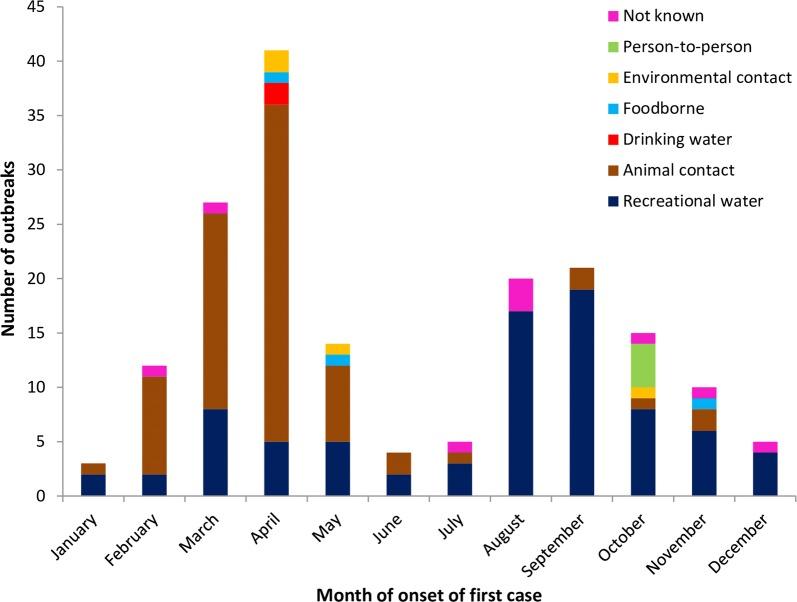
A total of 178 outbreaks involving 4031 laboratory confirmed cases were identified; 82 (46%) outbreaks involved recreational waters, 74 (42%) animal contact, 4 (2%) environmental contact, 4 (2%) person-to-person spread, 3 (2%) food, 2 (1%) drinking water supplies, and 9 (5%) were of unknown source. The infecting Cryptosporidium sp. was identified in 131 (74%) outbreaks; 69 were C. parvum, 60 C. hominis, and in two outbreaks cases were infected with either species. Animal contact, environmental contact, and food-borne outbreaks were exclusively C. parvum and were mainly in first half of the year. Recreational water outbreaks were predominantly C. hominis and were mainly in the second half of the year. Outbreaks attributed to person-to-person spread were exclusively C. hominis and all occurred in October. Both C. parvum and C. hominis caused drinking waterborne outbreaks. Gp60 subtypes were identified from patients in 48 C. parvum and 38 C. hominis outbreaks, revealing more subtypes among C. parvum (n = 14) than C. hominis (n = 7) outbreaks. Cryptosporidium hominis IbA10G2 predominated (30 outbreaks). Of C. parvum subtypes, IIaA15G2R1 predominated (17 outbreaks), followed by IIaA17G1R1 (12 outbreaks), IIaA19G1R1 (four outbreaks), and other subtypes caused three or fewer outbreaks each. Linkage between cases and suspected sources by gp60 subtype was established in nine animal contact, three swimming pool, and one drinking water outbreak.
CONCLUSIONS
The public health benefit of identifying infecting species and subtypes was twofold: (i) identifying and strengthening epidemiologic links between cases; and (ii) indicating possible exposures and sources to inform outbreak management. Gp60 subtype refined the epidemiological investigations, but a multilocus genotyping scheme would provide further benefit. Characterisation of Cryptosporidium spp. and subtypes needs to shift from predominantly supporting outbreak investigations to becoming nationally systematic.
背景
隐孢子虫是一种重要的食源性致病菌,可以通过人类和动物传播。本研究旨在阐明不同传播途径所致人类隐孢子虫病暴发的虫种和 gp60 亚型分布特征。
方法
我们采用全国暴发监测数据库和参考单位数据相结合的方法,对不同场所、传播途径、季节和与疑似传染源的关系进行暴发分析。
结果
共确定 178 起暴发事件,涉及 4031 例实验室确诊病例;82 起(46%)与娱乐用水有关,74 起(42%)与动物接触有关,4 起(2%)与环境接触有关,4 起(2%)与人际传播有关,3 起(2%)与食物有关,2 起(1%)与饮用水供应有关,9 起(5%)暴发源不明。在 131 起(74%)暴发事件中鉴定出感染性隐孢子虫;69 起为小隐孢子虫,60 起为人隐孢子虫,2 起同时感染这两种隐孢子虫。动物接触、环境接触和食源性暴发均为小隐孢子虫,主要发生在上半年。与娱乐用水有关的暴发主要为人隐孢子虫,主要发生在下半年。人际传播所致暴发均为人隐孢子虫,均发生在 10 月。小隐孢子虫和人隐孢子虫均可引起饮用水传播的暴发。从 48 起小隐孢子虫和 38 起人隐孢子虫暴发病例中鉴定出 gp60 亚型,小隐孢子虫暴发中发现的亚型(n=14)多于人隐孢子虫暴发(n=7)。小隐孢子虫 IbA10G2 型占优势(30 起暴发)。小隐孢子虫 IIaA15G2R1 型占优势(17 起暴发),其次为 IIaA17G1R1(12 起暴发)、IIaA19G1R1(4 起暴发),其他亚型各引起 3 起或 3 起以下暴发。通过 gp60 亚型在 9 起动物接触、3 起泳池和 1 起饮用水暴发中确定了病例与疑似传染源之间的联系。
结论
确定感染虫种和亚型对公共卫生的意义有两点:(i)确定和加强病例之间的流行病学联系;(ii)确定可能的暴露源和来源,以指导暴发管理。gp60 亚型细化了流行病学调查,但多基因座基因分型方案将提供更大的益处。隐孢子虫的特征需要从主要支持暴发调查转变为全国性系统调查。


 Zotero 插件