
静脉注射利多卡因和右美托咪定预防术后导尿管相关膀胱不适的比较:一项随机对照试验。
Comparison of intravenous lidocaine and dexmedetomidine infusion for prevention of postoperative catheter-related bladder discomfort: a randomized controlled trial.
机构信息
Department of Anesthesiology, West China Second Hospital of Sichuan University, Key Laboratory of Birth Defects and Related Diseases of Women and Children, No.20, Section 3, Renmin Nanlu, Chengdu, China.
出版信息
BMC Anesthesiol. 2019 Mar 18;19(1):37. doi: 10.1186/s12871-019-0708-8.
BACKGROUND
Catheter-related bladder discomfort (CRBD) frequently occurs during recovery in patients who undergo intra-operative urinary catheterization. We conducted this study to compare the effect of intravenous lidocaine and dexmedetomidine infusion for preventing CRBD.
METHODS
120 patients undergoing elective open abdominal hysterectomy or hysteromyomectomy requiring urinary bladder catheterization were randomly allocated into three groups of 40 each. Group L received a 2 mg/kg lidocaine bolus followed by infusion of 1.5 mg/kg/h; Group D received a 0.5 μg/kg dexmedetomidine bolus followed by infusion of 0.4 μg/kg/h; Group C received a bolus and infusion of normal saline of equivalent volume. The incidence and different severity (mild, moderate, and severe) of CRBD were assessed on arrival in the postanaesthesia care unit at 0, 1, 2, and 6 h postoperatively.
RESULTS
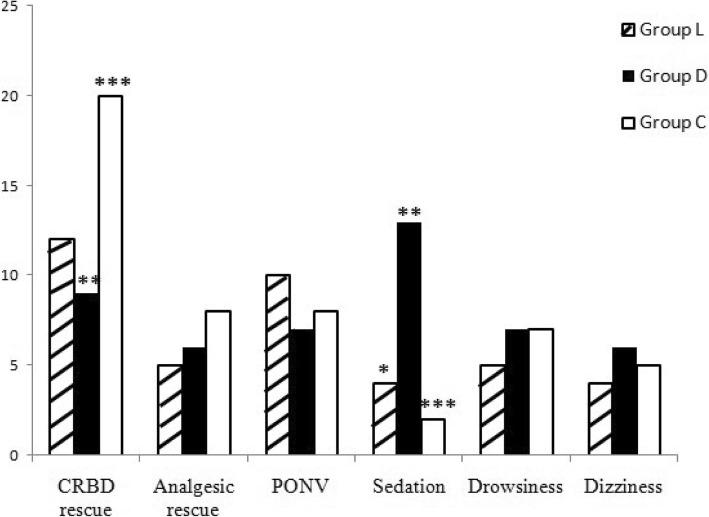
The incidence of CRBD was significantly lower in Group L and Group D compared with Group C at 0, 1, and 2 h. However, there was no significant difference among the three groups regarding the different severity of CRBD at all time points. The requirement of rescue tramadol for CRBD was lower in group L and group D than in group C. The incidence of sedation was significantly higher in Group D compared to Group L and Group C, though no difference in other adverse effects was observed.
CONCLUSIONS
Intravenous lidocaine and dexmedetomidine infusion reduced the incidence of CRBD as well as the additional tramadol requirement for CRBD, but had no effect on the different severity of CRBD.
TRIAL REGISTRATION
ChiCTR-INR-16009162 . Registered on 5 September 2016.
背景
术中留置导尿管的患者在恢复过程中常发生导管相关膀胱不适(CRBD)。我们进行这项研究是为了比较静脉注射利多卡因和右美托咪定输注预防 CRBD 的效果。
方法
120 例行择期开腹子宫切除术或子宫肌瘤切除术需留置导尿管的患者,随机分为每组 40 例的三组。L 组给予 2mg/kg 利多卡因负荷量,然后以 1.5mg/kg/h 的速度输注;D 组给予 0.5μg/kg 右美托咪定负荷量,然后以 0.4μg/kg/h 的速度输注;C 组给予等量生理盐水的负荷量和输注。在术后麻醉后恢复室(PACU)到达时(术后 0、1、2 和 6 小时)评估 CRBD 的发生率和不同严重程度(轻度、中度和重度)。
结果
与 C 组相比,L 组和 D 组在 0、1 和 2 小时时 CRBD 的发生率显著降低。然而,三组在所有时间点的 CRBD 不同严重程度方面均无显著差异。L 组和 D 组对 CRBD 进行解救性曲马多治疗的需求低于 C 组。D 组的镇静发生率明显高于 L 组和 C 组,但未观察到其他不良反应的差异。
结论
静脉注射利多卡因和右美托咪定输注可降低 CRBD 的发生率以及 CRBD 对额外曲马多的需求,但对 CRBD 的不同严重程度没有影响。
试验注册
ChiCTR-INR-16009162。注册于 2016 年 9 月 5 日。

 Zotero 插件