
神经元钙传感器-1在心脏和神经组织中的新作用:一篇综述短文
Emerging Roles of Neuronal Ca Sensor-1 in Cardiac and Neuronal Tissues: A Mini Review.
作者信息
Nakamura Tomoe Y, Nakao Shu, Wakabayashi Shigeo
机构信息
Department of Molecular Physiology, National Cerebral and Cardiovascular Center Research Institute, Suita, Japan.
Department of Biomedical Sciences, College of Life Sciences, Ritsumeikan University, Kusatsu, Japan.
出版信息
Front Mol Neurosci. 2019 Mar 4;12:56. doi: 10.3389/fnmol.2019.00056. eCollection 2019.
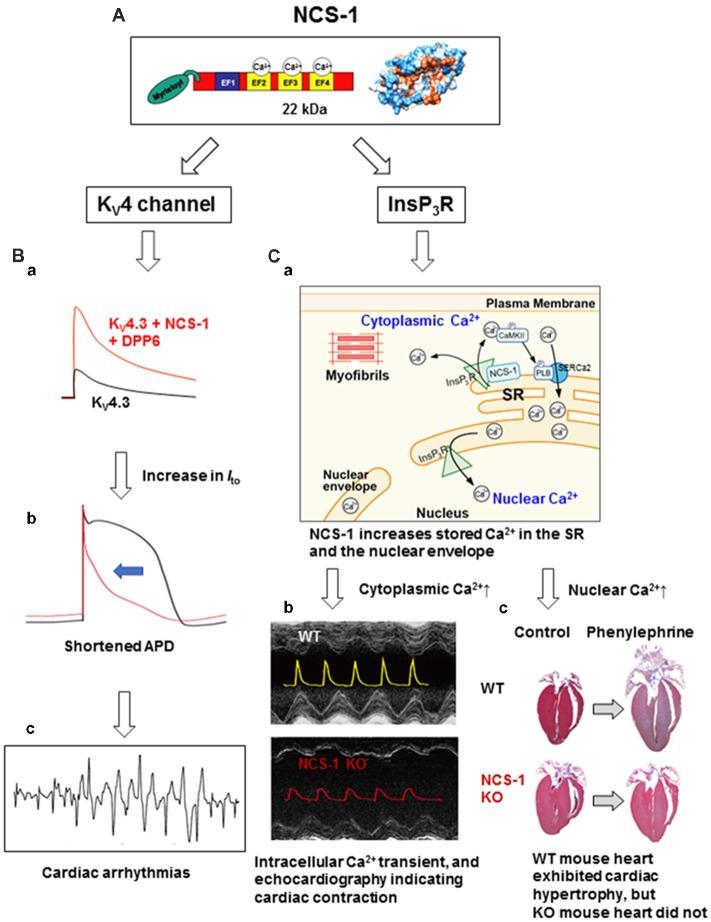
The EF-hand calcium (Ca)-binding protein, neuronal Ca sensor-1 (NCS-1/frequenin), is predominantly expressed in neuronal tissues and plays a crucial role in neuronal functions, including synaptic transmission and plasticity. NCS-1 has diverse functional roles, as elucidated in the past 15 years, which include the regulation of phosphatidylinositol 4-kinase IIIβ (PI-4K-β) and several ion channels such as voltage-gated K and Ca channels, the D2 dopamine receptors, and inositol 1,4,5-trisphosphate receptors (InsPRs). Functional analyses demonstrated that NCS-1 enhances exocytosis and neuronal survival after injury, as well as promotes learning and memory in mice. NCS-1 is also expressed in the heart including the Purkinje fibers (PFs) of the conduction system. NCS-1 interacts with K4 K channels together with dipeptidyl peptidase-like protein-6 (DPP-6), and this macromolecule then composes the transient outward current in PFs and contributes to the repolarization of PF action potential, thus being responsible for idiopathic arrhythmia. Moreover, NCS-1 expression was reported to be significantly high at the immature stage and at hypertrophy in adults. That report demonstrated that NCS-1 positively regulates cardiac contraction in immature hearts by increasing intracellular Ca signals through interaction with InsPRs. With the related signals, NCS-1 activates nuclear Ca signals, which would be a mechanism underlying hormone-induced cardiac hypertrophy. Furthermore, NCS-1 contributes to stress tolerance in cardiomyocytes by activating mitochondrial detoxification pathways, with a key role in Ca-dependent pathways. In this review, we will discuss recent findings supporting the functional significance of NCS-1 in the brain and heart and will address possible underlying molecular mechanisms.
EF 手型钙(Ca)结合蛋白——神经元钙传感器 1(NCS-1/频率蛋白)主要在神经组织中表达,在神经元功能中发挥关键作用,包括突触传递和可塑性。在过去 15 年中已阐明,NCS-1 具有多种功能作用,其中包括对磷脂酰肌醇 4-激酶 IIIβ(PI-4K-β)以及几种离子通道(如电压门控钾通道和钙通道)、D2 多巴胺受体和肌醇 1,4,5-三磷酸受体(InsPRs)的调节。功能分析表明,NCS-1 可增强损伤后的胞吐作用和神经元存活,还能促进小鼠的学习和记忆。NCS-1 也在心脏中表达,包括传导系统的浦肯野纤维(PFs)。NCS-1 与二肽基肽酶样蛋白 6(DPP-6)一起与 K4 钾通道相互作用,然后这个大分子构成 PF 中的瞬时外向电流,并有助于 PF 动作电位的复极化,从而导致特发性心律失常。此外,据报道 NCS-1 在未成熟阶段和成人肥大时表达显著升高。该报道表明,NCS-1 通过与 InsPRs 相互作用增加细胞内钙信号,从而正向调节未成熟心脏的心脏收缩。通过相关信号传递过程,NCS-1 激活核钙信号,这可能是激素诱导心脏肥大的潜在机制。此外,NCS-1 通过激活线粒体解毒途径对心肌细胞的应激耐受性有贡献,在钙依赖性途径中起关键作用。在本综述中,我们将讨论支持 NCS-1 在大脑和心脏中功能意义的最新研究发现,并探讨可能的潜在分子机制。
 Zotero 插件