
自发性超重拉布拉多猎犬对食物摄入的代谢灵活性指标。
Indication of metabolic inflexibility to food intake in spontaneously overweight Labrador Retriever dogs.
作者信息
Söder Josefin, Wernersson Sara, Dicksved Johan, Hagman Ragnvi, Östman Johnny R, Moazzami Ali A, Höglund Katja
机构信息
Department of Anatomy, Physiology and Biochemistry, Faculty of Veterinary Medicine and Animal Science, Swedish University of Agricultural Sciences, Box 7011, 75007, Uppsala, Sweden.
Department of Animal Nutrition and Management, Faculty of Veterinary Medicine and Animal Science, Swedish University of Agricultural Sciences, Box 7024, 75007, Uppsala, Sweden.
出版信息
BMC Vet Res. 2019 Mar 20;15(1):96. doi: 10.1186/s12917-019-1845-5.
BACKGROUND
Obesity in dogs is an increasing problem associated with morbidity, shortened life span and poor life quality. Overweight dogs exhibit postprandial hyperlipidaemia, highlighting the need to identify potential dysregulations in lipid metabolism. This study investigated metabolites related to lipid metabolism (i.e. acylcarnitines and taurine) and phospholipids in a feed-challenge test and aimed to identify metabolic variations in spontaneously overweight dogs. Twenty-eight healthy male Labrador Retriever dogs were included, 12 of which were classified as lean (body condition score (BCS) 4-5 on a 9-point scale) and 16 as overweight (BCS 6-8). After overnight fasting (14-17 h), fasting blood samples were collected and dogs were fed a high-fat meal followed by postprandial blood sample collection hourly for 4 h. Liquid chromatography-time of flight mass spectrometry (LC-TOFMS) was used to identify plasma metabolites and phospholipids. Multivariate models, mixed model repeated measures and linear regression analyses were used for data interpretation.
RESULTS
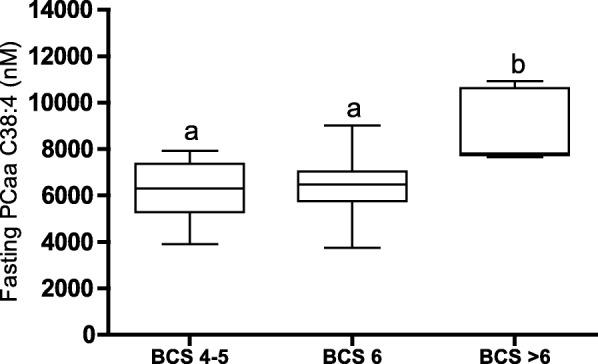
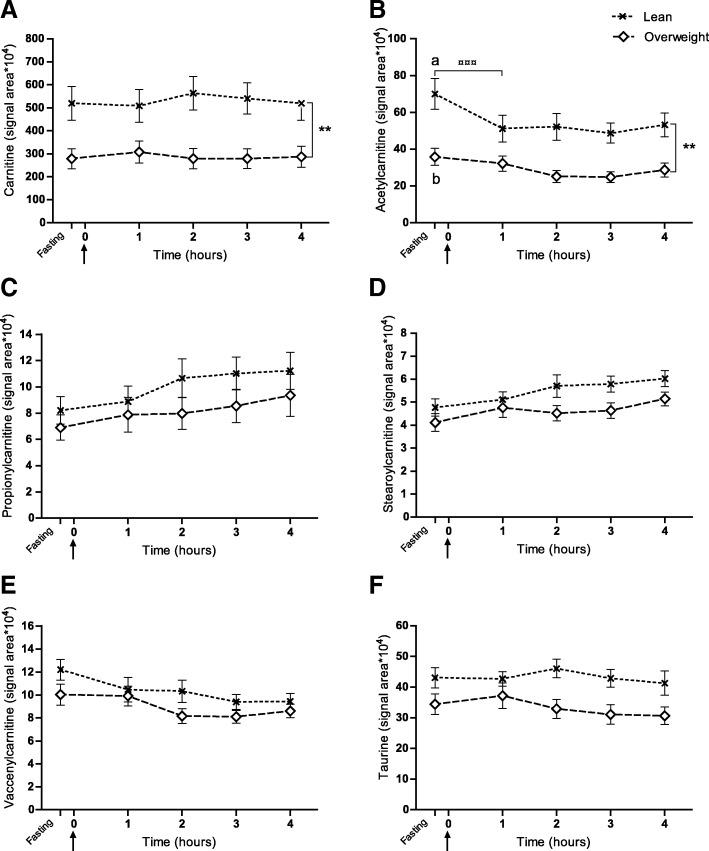
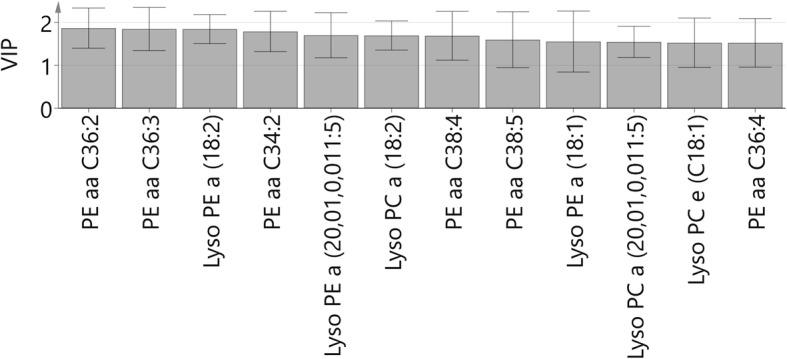
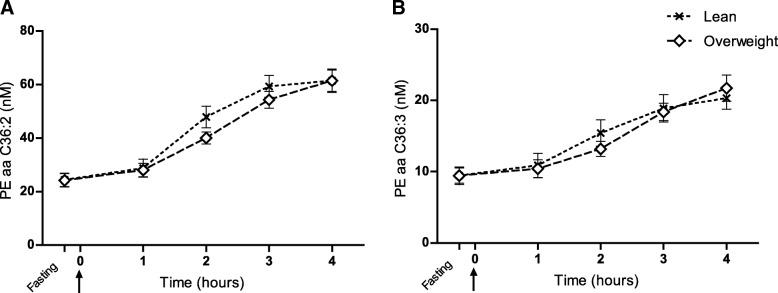
In all dogs, propionylcarnitine, stearoylcarnitine and nine phospholipids increased in response to food intake, while vaccenylcarnitine decreased (P ≤ 0.005 for all). Overall, carnitine and acetylcarnitine signal areas in the feed-challenge test were lower in overweight dogs (P ≤ 0.004). Notably, fasting plasma acetylcarnitine was lower in overweight dogs than in lean dogs (P = 0.001) and it did not change in response to feeding. The latter finding was in contrast to the decreased acetylcarnitine signal area found in lean dogs at one hour postprandially (P < 0.0001). One fasting phosphatidylcholine (PCaa C38:4) was higher in prominently overweight dogs (BCS > 6) than in lean dogs (P < 0.05).
CONCLUSIONS
Plasma carnitine status was overall lower in spontaneously overweight dogs than in lean dogs in this cohort of healthy Labrador Retriever dogs, indicating a potential carnitine insufficiency in the overweight group. The acetylcarnitine response in overweight dogs indicated decreased fatty acid oxidation at fasting and metabolic inflexibility to food intake. Further studies on metabolic inflexibility and its potential role in the metabolism of overweight dogs are warranted.
背景
犬类肥胖问题日益严重,与发病率增加、寿命缩短及生活质量下降相关。超重犬表现出餐后高脂血症,这凸显了识别脂质代谢潜在失调的必要性。本研究在饲料激发试验中调查了与脂质代谢相关的代谢物(即酰基肉碱和牛磺酸)及磷脂,旨在识别自发性超重犬的代谢变化。纳入了28只健康雄性拉布拉多猎犬,其中12只被归类为瘦犬(体况评分(BCS)在9分制中为4 - 5分),16只为超重犬(BCS 6 - 8分)。过夜禁食(14 - 17小时)后,采集空腹血样,给犬喂食高脂餐,随后每小时采集餐后血样,共采集4小时。采用液相色谱 - 飞行时间质谱(LC - TOFMS)鉴定血浆代谢物和磷脂。使用多变量模型、混合模型重复测量和线性回归分析进行数据解读。
结果
在所有犬中,丙酰肉碱、硬脂酰肉碱和9种磷脂随食物摄入增加,而反式十八碳烯酰肉碱减少(所有P≤0.005)。总体而言,超重犬在饲料激发试验中的肉碱和乙酰肉碱信号面积较低(P≤0.004)。值得注意的是,超重犬空腹血浆乙酰肉碱低于瘦犬(P = 0.001),且进食后无变化。后一发现与瘦犬餐后1小时乙酰肉碱信号面积降低形成对比(P < 0.0001)。一种空腹磷脂酰胆碱(PCaa C38:4)在显著超重犬(BCS > 6)中高于瘦犬(P < 0.05)。
结论
在这组健康拉布拉多猎犬中,自发性超重犬的血浆肉碱水平总体低于瘦犬,表明超重组可能存在肉碱不足。超重犬的乙酰肉碱反应表明空腹时脂肪酸氧化减少且对食物摄入的代谢灵活性降低。有必要进一步研究代谢灵活性及其在超重犬代谢中的潜在作用。
 Zotero 插件