
胶质母细胞瘤的纵向异质性:复发肿瘤与原发肿瘤中的移动靶标。
Longitudinal heterogeneity in glioblastoma: moving targets in recurrent versus primary tumors.
机构信息
Division of Clinical Neurooncology, Department of Neurology, University Hospital Bonn, 53127, Bonn, Germany.
Stem Cell Pathologies, Institute for Reconstructive Neurobiology, University of Bonn, 53127, Bonn, Germany.
出版信息
J Transl Med. 2019 Mar 20;17(1):96. doi: 10.1186/s12967-019-1846-y.
BACKGROUND
Molecularly targeted therapies using receptor inhibitors, small molecules or monoclonal antibodies are routinely applied in oncology. Verification of target expression should be mandatory prior to initiation of therapy, yet, determining the expression status is most challenging in recurrent glioblastoma (GBM) where most patients are not eligible for second-line surgery. Because very little is known on the consistency of expression along the clinical course we here explored common drug targets in paired primary vs. recurrent GBM tissue samples.
METHODS
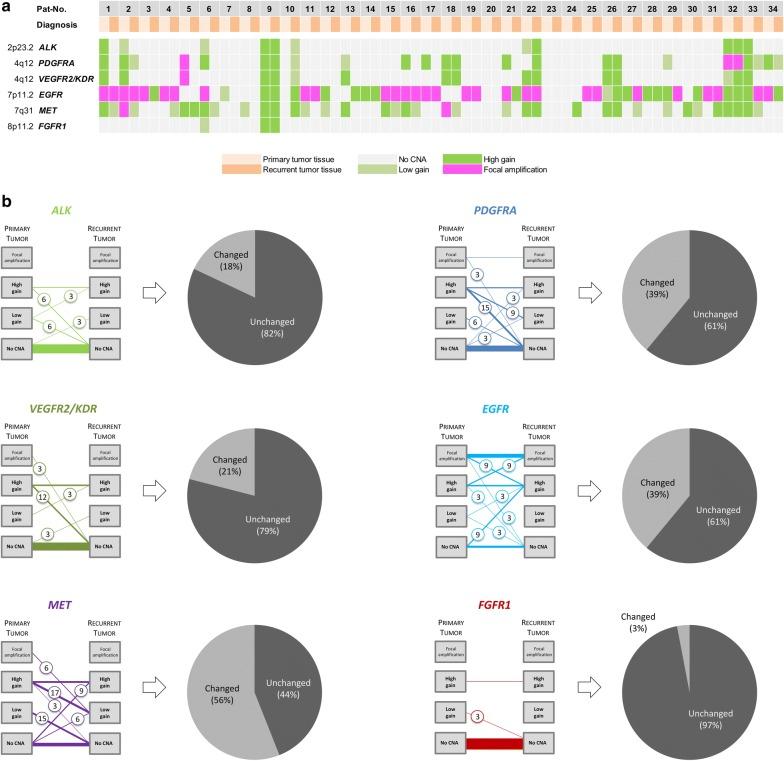
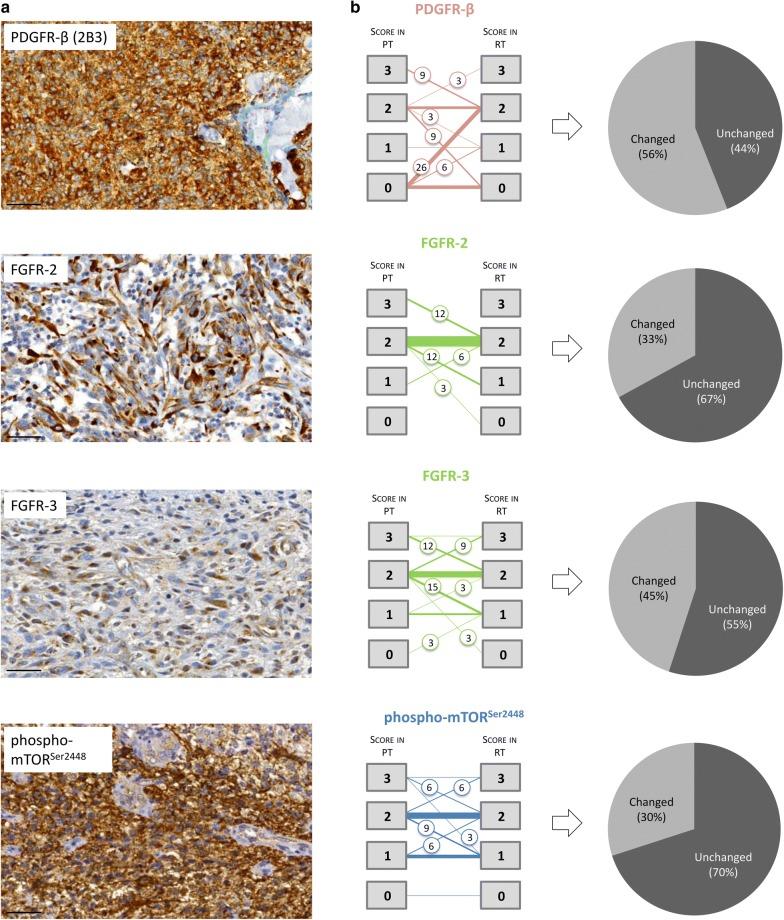
Paired surgical tissue samples were derived from a homogeneously treated cohort of 34 GBM patients. All patients received radiotherapy and temozolomide chemotherapy. Verification of common drug targets included immunohistological analysis of PDGFR-β, FGFR-2, FGFR-3, and mTOR-pathway component (phospho-mTOR) as well as molecular, MLPA-based analysis of specific copy number aberrations at the gene loci of ALK, PDGFRA, VEGFR2/KDR, EGFR, MET, and FGFR1.
RESULTS
Paired tumor tissue exhibited significant changes of expression in 9 of the 10 investigated druggable targets (90%). Only one target (FGFR1) was found "unchanged", since dissimilar expression was observed in only one of the 34 paired tumor tissue samples. All other targets were variably expressed with an 18-56% discordance rate between primary and recurrent tissue.
CONCLUSIONS
The high incidence of dissimilar target expression status in clinical samples from primary vs. recurrent GBM suggests clinically relevant heterogeneity along the course of disease. Molecular target expression, as determined at primary diagnosis, may not necessarily present rational treatment clues for the clinical care of recurrent GBM. Further studies need to analyze the therapeutic impact of longitudinal heterogeneity in GBM.
背景
在肿瘤学中,通常使用受体抑制剂、小分子或单克隆抗体等分子靶向疗法。在开始治疗之前,必须对靶标表达进行验证,但在大多数患者不符合二线手术条件的复发性胶质母细胞瘤(GBM)中,确定表达状态极具挑战性。由于沿临床病程表达的一致性知之甚少,我们在此探讨了配对原发性与复发性 GBM 组织样本中常见的药物靶点。
方法
来自 34 名 GBM 患者的同质治疗队列中获得了配对的手术组织样本。所有患者均接受了放疗和替莫唑胺化疗。常见药物靶点的验证包括 PDGFR-β、FGFR-2、FGFR-3 和 mTOR 通路成分(磷酸化-mTOR)的免疫组织化学分析,以及 ALK、PDGFRA、VEGFR2/KDR、EGFR、MET 和 FGFR1 基因座的特定拷贝数异常的 MLPA 分析。
结果
配对肿瘤组织中 10 个可用药靶中的 9 个(90%)表达发生显著变化。只有一个靶标(FGFR1)被发现“未改变”,因为在 34 对配对肿瘤组织样本中仅在一个样本中观察到不同的表达。所有其他靶标均以 18-56%的不一致率表达,在原发性和复发性组织之间。
结论
原发性和复发性 GBM 临床样本中靶标表达状态的高度不一致性表明疾病过程中存在临床相关的异质性。在原发性诊断时确定的分子靶标表达不一定为复发性 GBM 的临床治疗提供合理的治疗线索。需要进一步研究来分析 GBM 中纵向异质性的治疗影响。
 Zotero 插件