
黏膜单纯疱疹病毒感染的免疫控制机制:理性疫苗设计指南。
Mechanisms of Immune Control of Mucosal HSV Infection: A Guide to Rational Vaccine Design.
机构信息
Centre for Virus Research, The Westmead Institute for Medical Research, Sydney, NSW, Australia.
Sydney Medical School, The University of Sydney, Sydney, NSW, Australia.
出版信息
Front Immunol. 2019 Mar 6;10:373. doi: 10.3389/fimmu.2019.00373. eCollection 2019.
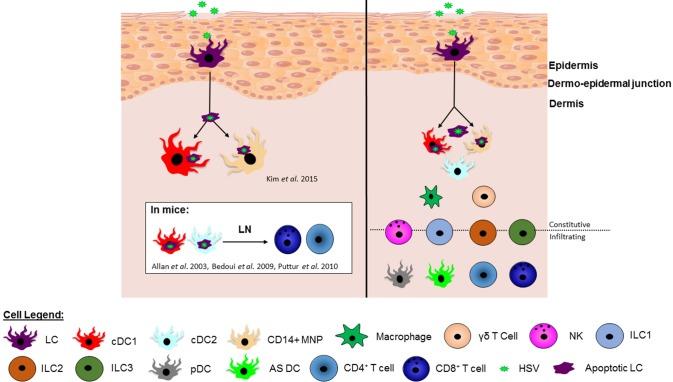
Herpes Simplex Virus (HSV) is a highly prevalent sexually transmitted infection that aside from causing cold sores and genital lesions, causes complications in the immunocompromised and has facilitated a large proportion of HIV acquisition globally. Despite decades of research, there is no prophylactic HSV vaccine ready for use in humans, leaving many questioning whether a prophylactic vaccine is an achievable goal. A previous HSV vaccine trial did have partial success in decreasing acquisition of HSV2-promising evidence that vaccines can prevent acquisition. However, there is still an incomplete understanding of the immune response pathways elicited by HSV after initial mucosal infection and how best to replicate these responses with a vaccine, such that acquisition and colonization of the dorsal root ganglia could be prevented. Another factor to consider in the rational design of an HSV vaccine is adjuvant choice. Understanding the immune responses elicited by different adjuvants and whether lasting humoral and cell-mediated responses are induced is important, especially when studies of past trial vaccines found that a sufficiently protective cell-mediated response was lacking. In this review, we discuss what is known of the immune control involved in initial herpes lesions and reactivation, including the importance of CD4 and CD8 T cells, and the interplay between innate and adaptive immunity in response to primary infection, specifically focusing on the viral relay involved. Additionally, a summary of previous and current vaccine trials, including the components used, immune responses elicited and the feasibility of prophylactic vaccines looking forward, will also be discussed.
单纯疱疹病毒(HSV)是一种高度流行的性传播感染,除了引起唇疱疹和生殖器病变外,还会在免疫功能低下者中引起并发症,并在全球范围内促成了很大一部分 HIV 的获得。尽管经过几十年的研究,仍然没有预防性 HSV 疫苗可供人类使用,这让许多人质疑预防性疫苗是否可以实现。之前的 HSV 疫苗试验在减少 HSV2 的获得方面取得了部分成功——这是疫苗可以预防获得的有希望的证据。然而,人们对 HSV 最初在黏膜感染后引发的免疫反应途径以及如何用疫苗复制这些反应仍不完全了解,以防止背根神经节的获得和定植。在合理设计 HSV 疫苗时,另一个需要考虑的因素是佐剂的选择。了解不同佐剂引发的免疫反应,以及是否诱导了持久的体液和细胞介导的反应是很重要的,尤其是当过去的试验疫苗研究发现缺乏足够的保护性细胞介导反应时。在这篇综述中,我们讨论了已知的与初始疱疹病变和再激活相关的免疫控制,包括 CD4 和 CD8 T 细胞的重要性,以及固有免疫和适应性免疫在初次感染中的相互作用,特别是重点关注涉及的病毒传递。此外,还将讨论以前和当前的疫苗试验的总结,包括使用的成分、引发的免疫反应以及预防性疫苗的可行性展望。
 Zotero 插件