
AUGMENT:来那度胺联合利妥昔单抗与安慰剂联合利妥昔单抗治疗复发或难治性惰性淋巴瘤的 III 期研究。
AUGMENT: A Phase III Study of Lenalidomide Plus Rituximab Versus Placebo Plus Rituximab in Relapsed or Refractory Indolent Lymphoma.
机构信息
1 Weill Cornell Medicine and New York Presbyterian Hospital, New York, NY.
2 Charles University, General Hospital, Prague, Czech Republic.
出版信息
J Clin Oncol. 2019 May 10;37(14):1188-1199. doi: 10.1200/JCO.19.00010. Epub 2019 Mar 21.
PURPOSE
Patients with indolent non-Hodgkin lymphoma typically respond well to first-line immunochemotherapy. At relapse, single-agent rituximab is commonly administered. Data suggest the immunomodulatory agent lenalidomide could increase the activity of rituximab.
METHODS
A phase III, multicenter, randomized trial of lenalidomide plus rituximab versus placebo plus rituximab was conducted in patients with relapsed and/or refractory follicular or marginal zone lymphoma. Patients received lenalidomide or placebo for 12 cycles plus rituximab once per week for 4 weeks in cycle 1 and day 1 of cycles 2 through 5. The primary end point was progression-free survival per independent radiology review.
RESULTS
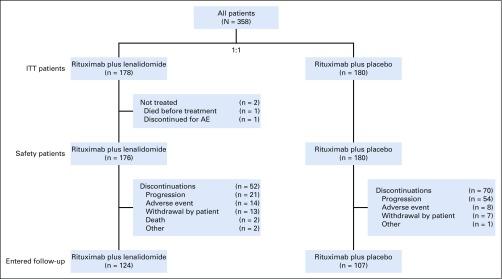
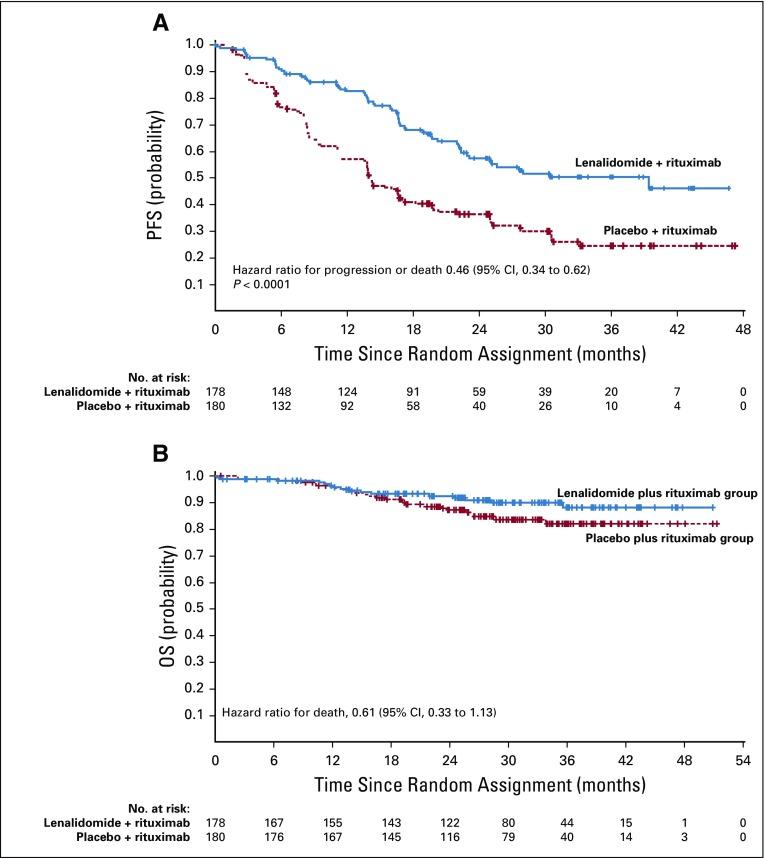
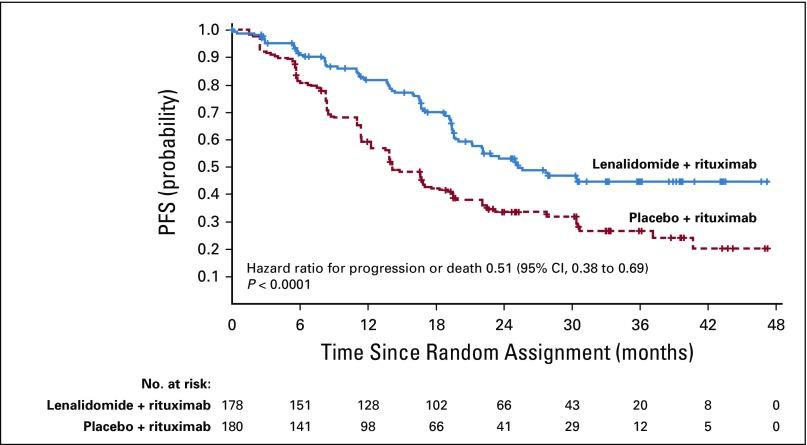
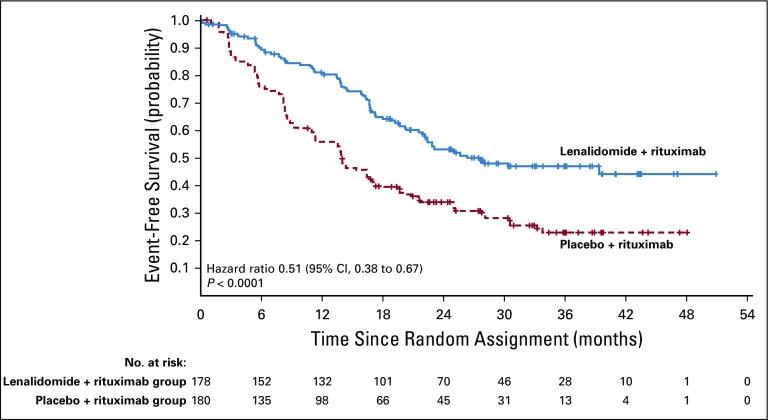
A total of 358 patients were randomly assigned to lenalidomide plus rituximab (n = 178) or placebo plus rituximab (n = 180). Infections (63% 49%), neutropenia (58% 23%), and cutaneous reactions (32% 12%) were more common with lenalidomide plus rituximab. Grade 3 or 4 neutropenia (50% 13%) and leukopenia (7% 2%) were higher with lenalidomide plus rituximab; no other grade 3 or 4 adverse event differed by 5% or more between groups. Progression-free survival was significantly improved for lenalidomide plus rituximab versus placebo plus rituximab, with a hazard ratio of 0.46 (95% CI, 0.34 to 0.62; < .001) and median duration of 39.4 months (95% CI, 22.9 months to not reached) versus 14.1 months (95% CI, 11.4 to 16.7 months), respectively.
CONCLUSION
Lenalidomide improved efficacy of rituximab in patients with recurrent indolent lymphoma, with an acceptable safety profile.
目的
惰性非霍奇金淋巴瘤患者通常对一线免疫化疗反应良好。复发时,通常给予单药利妥昔单抗。数据表明免疫调节药物来那度胺可能会增加利妥昔单抗的活性。
方法
一项多中心、III 期临床试验,比较来那度胺联合利妥昔单抗与安慰剂联合利妥昔单抗治疗复发和/或难治性滤泡性或边缘区淋巴瘤患者。患者接受来那度胺或安慰剂治疗 12 个周期,联合利妥昔单抗在第 1 周期的第 1 周和第 2 至 5 周期的第 1 天使用 4 周。主要终点为独立影像学评估的无进展生存期。
结果
共有 358 例患者被随机分配至来那度胺联合利妥昔单抗组(n = 178)或安慰剂联合利妥昔单抗组(n = 180)。来那度胺联合利妥昔单抗组更常见感染(63% 比 49%)、中性粒细胞减少症(58% 比 23%)和皮肤反应(32% 比 12%)。来那度胺联合利妥昔单抗组的 3 或 4 级中性粒细胞减少症(50% 比 13%)和白细胞减少症(7% 比 2%)发生率更高;两组之间其他 3 或 4 级不良事件发生率相差不超过 5%。来那度胺联合利妥昔单抗与安慰剂联合利妥昔单抗相比,无进展生存期显著改善,风险比为 0.46(95%CI,0.34 至 0.62;<0.001),中位持续时间分别为 39.4 个月(95%CI,22.9 个月至未达到)和 14.1 个月(95%CI,11.4 至 16.7 个月)。
结论
来那度胺改善了复发性惰性淋巴瘤患者利妥昔单抗的疗效,安全性可接受。



 Zotero 插件