
阿尔茨海默病脑中神经突的不同层的顺序形成。
Sequential formation of different layers of dystrophic neurites in Alzheimer's brains.
机构信息
Department of Neuroscience, University of Connecticut Health, Farmington, CT, 06032, USA.
Department of Pathology, Case Western University School of Medicine, Cleveland, OH, 44106, USA.
出版信息
Mol Psychiatry. 2019 Sep;24(9):1369-1382. doi: 10.1038/s41380-019-0396-2. Epub 2019 Mar 21.
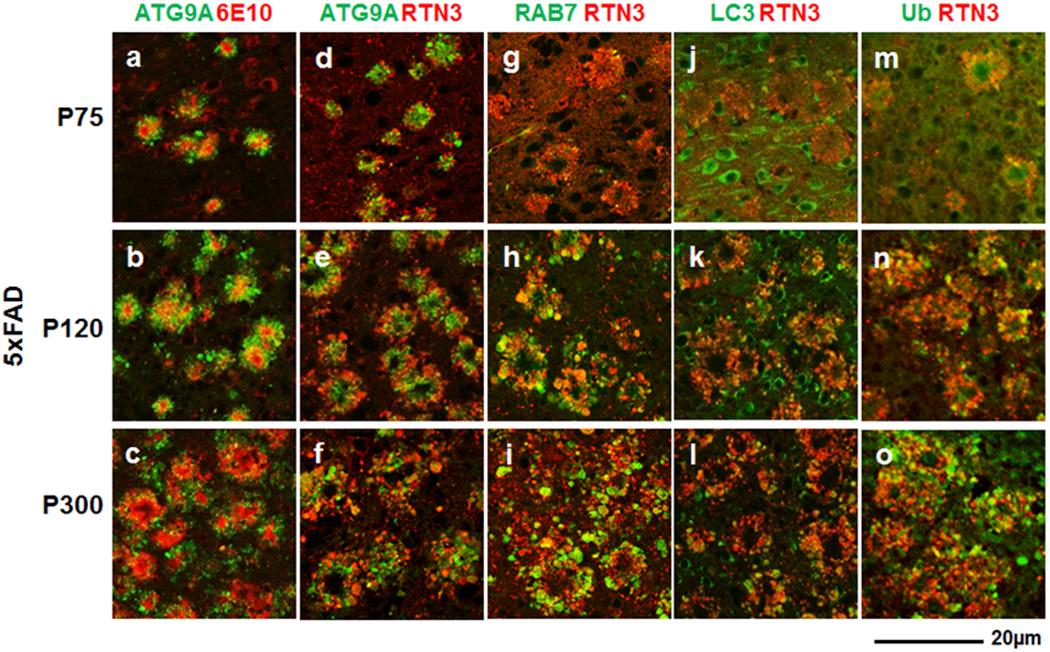
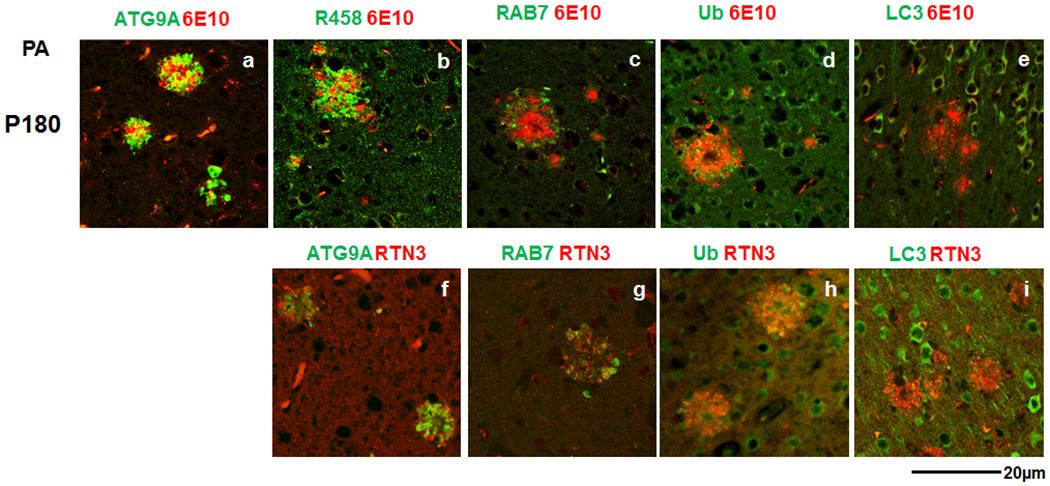
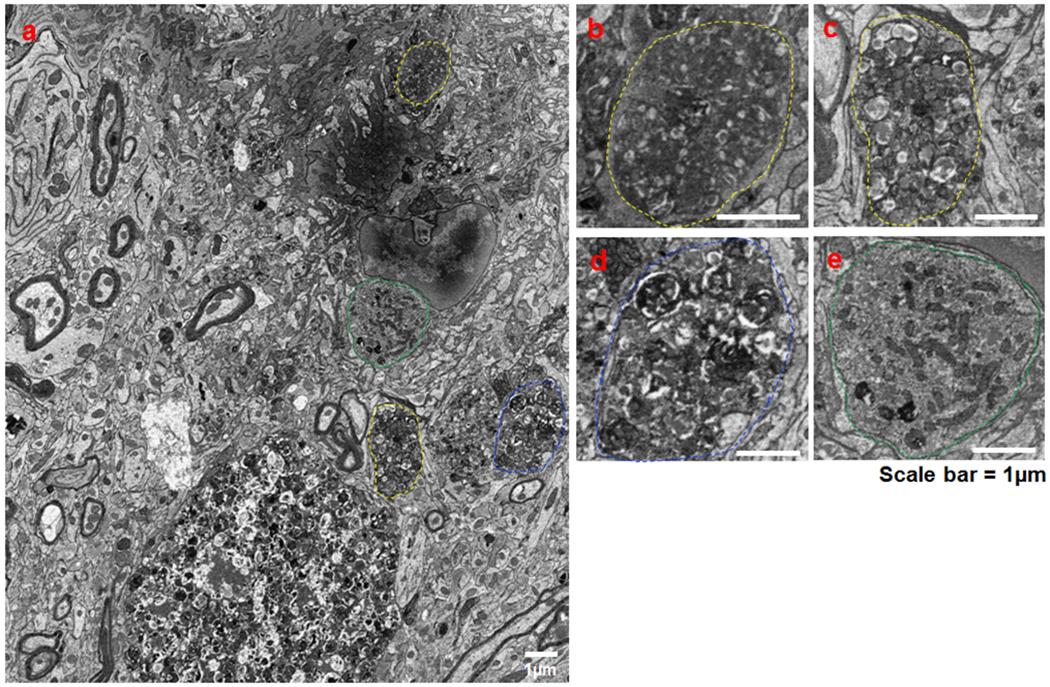
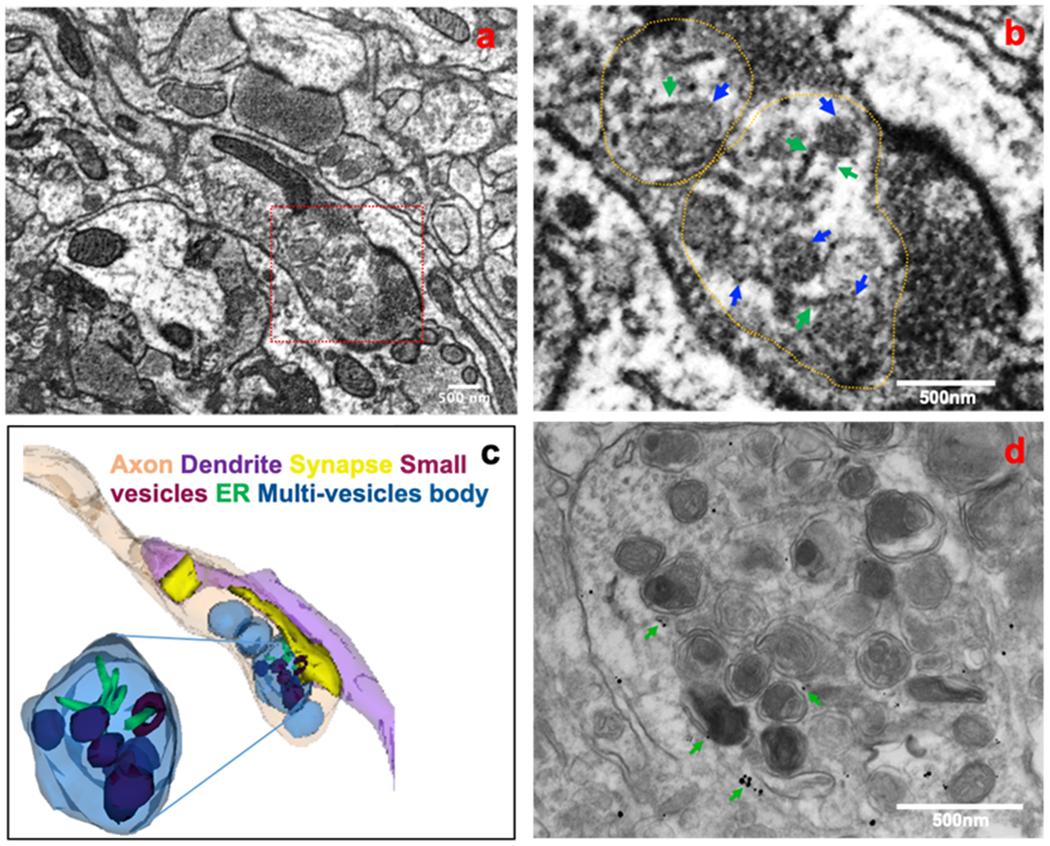
Alzheimer's disease (AD) is characterized by the presence of neuritic plaques in which dystrophic neurites (DNs) are typical constituents. We recently showed that DNs labeled by antibodies to the tubular endoplasmic reticulum (ER) protein reticulon-3 (RTN3) are enriched with clustered tubular ER. However, multi-vesicle bodies are also found in DNs, suggesting that different populations of DNs exist in brains of AD patients. To understand how different DNs evolve to surround core amyloid plaques, we monitored the growth of DNs in AD mouse brains (5xFAD and APP/PS1ΔE9 mice) by multiple approaches, including two-dimensional and three-dimensional (3D) electron microscopy (EM). We discovered that a pre-autophagosome protein ATG9A was enriched in DNs when a plaque was just beginning to develop. ATG9A-positive DNs were often closer to the core amyloid plaque, whereas RTN3 immunoreactive DNs were mostly located in the outer layers of ATG9A-positive DNs. Proteins such as RAB7 and LC3 appeared in DNs at later stages during plaque growth, likely accumulated as a part of large autophagy vesicles, and were distributed relatively furthest from the core amyloid plaque. Reconstructing the 3D structure of different morphologies of DNs revealed that DNs in AD mouse brains were constituted in three layers that are distinct by enriching different types of vesicles, as validated by immune-EM methods. Collectively, our results provide the first evidence that DNs evolve from dysfunctions of pre-autophagosomes, tubular ER, mature autophagosomes, and the ubiquitin proteasome system during plaque growth.
阿尔茨海默病(AD)的特征是存在神经纤维缠结(DN),其中神经突是典型的组成部分。我们最近发现,用针对管状内质网(ER)蛋白 reticulon-3(RTN3)的抗体标记的 DN 富含聚集的管状 ER。然而,多泡体也存在于 DN 中,这表明 AD 患者大脑中的不同 DN 群体存在。为了了解不同的 DN 如何围绕核心淀粉样斑块进化,我们通过多种方法监测 AD 小鼠大脑(5xFAD 和 APP/PS1ΔE9 小鼠)中 DN 的生长,包括二维和三维(3D)电子显微镜(EM)。我们发现,当斑块刚刚开始发育时,自噬体前体蛋白 ATG9A 在 DN 中富集。ATG9A 阳性的 DN 通常更接近核心淀粉样斑块,而 RTN3 免疫反应性的 DN 大多位于 ATG9A 阳性的 DN 的外层。在斑块生长过程中,ATG9A 阳性的 DN 中,诸如 RAB7 和 LC3 等蛋白出现在较晚的阶段,可能作为大自噬囊泡的一部分积累,并分布在远离核心淀粉样斑块的相对较远的位置。重建不同形态的 DN 的 3D 结构表明,AD 小鼠大脑中的 DN 由三层组成,通过富集不同类型的囊泡来区分,这通过免疫 EM 方法得到了验证。总之,我们的结果首次提供了证据表明,DN 是在斑块生长过程中自噬体前体、管状 ER、成熟自噬体和泛素蛋白酶体系统的功能障碍进化而来的。



 Zotero 插件