
细胞分裂过程中植物微管相关蛋白的磷酸化作用
Phosphorylation of Plant Microtubule-Associated Proteins During Cell Division.
作者信息
Vavrdová Tereza, ˇSamaj Jozef, Komis George
机构信息
Department of Cell Biology, Centre of the Region Haná for Biotechnological and Agricultural Research, Faculty of Science, Palacký University Olomouc, Olomouc, Czechia.
出版信息
Front Plant Sci. 2019 Mar 11;10:238. doi: 10.3389/fpls.2019.00238. eCollection 2019.
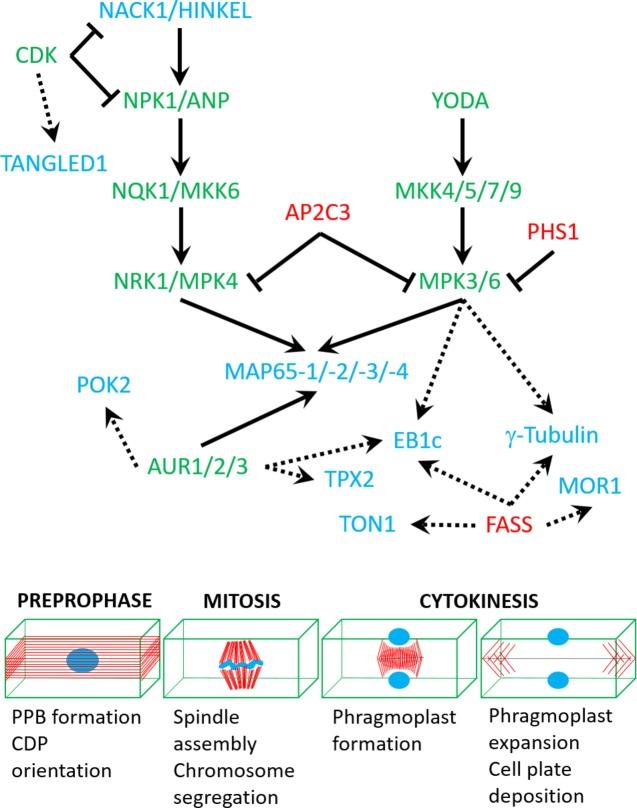
Progression of mitosis and cytokinesis depends on the reorganization of cytoskeleton, with microtubules driving the segregation of chromosomes and their partitioning to two daughter cells. In dividing plant cells, microtubules undergo global reorganization throughout mitosis and cytokinesis, and with the aid of various microtubule-associated proteins (MAPs), they form unique systems such as the preprophase band (PPB), the acentrosomal mitotic spindle, and the phragmoplast. Such proteins include nucleators of microtubule formation, plus end binding proteins involved in the regulation of microtubule dynamics, crosslinking proteins underlying microtubule bundle formation and members of the kinesin superfamily with microtubule-dependent motor activities. The coordinated function of such proteins not only drives the continuous remodeling of microtubules during mitosis and cytokinesis but also assists the positioning of the PPB, the mitotic spindle, and the phragmoplast, affecting tissue patterning by controlling cell division plane (CDP) orientation. The affinity and the function of such proteins is variably regulated by reversible phosphorylation of serine and threonine residues within the microtubule binding domain through a number of protein kinases and phosphatases which are differentially involved throughout cell division. The purpose of the present review is to provide an overview of the function of protein kinases and protein phosphatases involved in cell division regulation and to identify cytoskeletal substrates relevant to the progression of mitosis and cytokinesis and the regulation of CDP orientation.
有丝分裂和胞质分裂的进行依赖于细胞骨架的重组,其中微管驱动染色体的分离并将其分配到两个子细胞中。在分裂的植物细胞中,微管在整个有丝分裂和胞质分裂过程中经历整体重组,并在各种微管相关蛋白(MAPs)的帮助下,形成独特的系统,如前期带(PPB)、无中心体有丝分裂纺锤体和成膜体。这些蛋白质包括微管形成的成核剂、参与微管动力学调节的正端结合蛋白、微管束形成的交联蛋白以及具有微管依赖性运动活性的驱动蛋白超家族成员。这些蛋白质的协同功能不仅在有丝分裂和胞质分裂期间驱动微管的持续重塑,还协助前期带、有丝分裂纺锤体和成膜体的定位,通过控制细胞分裂平面(CDP)的方向影响组织模式。这些蛋白质的亲和力和功能通过微管结合域内丝氨酸和苏氨酸残基的可逆磷酸化,由多种在整个细胞分裂过程中差异参与的蛋白激酶和磷酸酶进行可变调节。本综述的目的是概述参与细胞分裂调节的蛋白激酶和蛋白磷酸酶的功能,并确定与有丝分裂和胞质分裂进程以及细胞分裂平面方向调节相关的细胞骨架底物。

 Zotero 插件