
多节段腰椎后路融合手术后上相邻节段退变的危险因素。
Risk factors for upper adjacent segment degeneration after multi-level posterior lumbar spinal fusion surgery.
作者信息
Ma Zhaoxin, Huang Shilei, Sun Jianguang, Li Feng, Sun Jianhao, Pi Guofu
机构信息
Department of Orthopaedics, The First Affiliated Hospital of Zhengzhou University, No.1 Jianshe East Road, Zhengzhou, 450052, Henan, China.
出版信息
J Orthop Surg Res. 2019 Mar 28;14(1):89. doi: 10.1186/s13018-019-1126-9.
BACKGROUND
Posterior lumbar spinal fusion has been widely used in degenerative lumbar stenosis, but adjacent segment degeneration (ASD) was common. Researchers have found many risk factors for ASD after one or two levels of surgery, but few clinical studies focused on multi-level surgery. The purpose of this study was to clarify risk factors for upper ASD after multi-level posterior lumbar spinal fusion.
METHODS
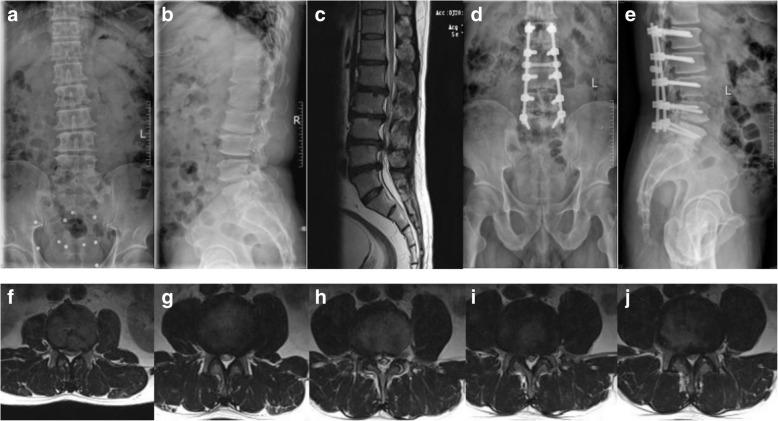
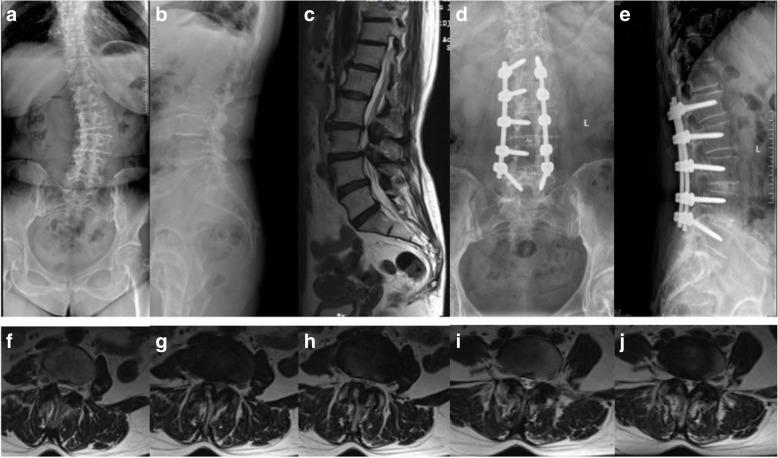
A retrospective study was performed on the clinical data of 71 patients with degenerative lumbar stenosis who underwent multi-level (at least 3 levels) posterior lumbar spinal fusion from January 2013 to December 2016. Two groups were divided according to lamina and posterior ligamentous complex (PLC) maintenance of proximal fixed vertebrae in surgery. In the 22 patients of group A, the proximal fixed vertebral lamina and PLC were not resected, and in the 49 patients of group B, the proximal fixed vertebral lamina and PLC were resected completely. Age, sex, body mass index (BMI), number of fixed vertebrae and fused levels, spinopelvic parameters, coronal Cobb angle, and modified Pfirrmann grading system were measured for each patient. A Cox proportional hazards model was used to analyze risk factors for upper ASD.
RESULTS
No symptomatic ASD was found during the follow-up period. Patients who underwent proximal fixed vertebral lamina and PLC resection had a significantly higher percentage of radiographic ASD (P = 0.042). The Cox proportional hazards model showed that age, sex, BMI, preoperative lumbar lordosis, sacral slope, pelvic tilt, coronal Cobb angle, number of fixed vertebrae, and interbody fusion levels had no significant differences for radiographic ASD. But a preoperative modified Pfirrmann grade higher than 3, a high degree of preoperative pelvic incidence, and more decompressed levels had statistical significance (P = 0.024, 0.041, and 0.008, respectively).
CONCLUSIONS
A preoperative modified Pfirrmann grade higher than 3, a high degree of preoperative pelvic incidence, and more decompressed levels might be risk factors for upper radiographic ASD after multi-level posterior lumbar spinal fusion surgery.
背景
腰椎后路融合术已广泛应用于退行性腰椎管狭窄症,但相邻节段退变(ASD)较为常见。研究人员已经发现了一或两个节段手术后ASD的许多危险因素,但很少有临床研究关注多节段手术。本研究的目的是阐明多节段腰椎后路融合术后上位ASD的危险因素。
方法
对2013年1月至2016年12月期间接受多节段(至少3个节段)腰椎后路融合术的71例退行性腰椎管狭窄症患者的临床资料进行回顾性研究。根据手术中近端固定椎体的椎板和后韧带复合体(PLC)的保留情况分为两组。A组22例患者,近端固定椎体的椎板和PLC未切除;B组49例患者,近端固定椎体的椎板和PLC被完全切除。测量每位患者的年龄、性别、体重指数(BMI)、固定椎体数量和融合节段、脊柱骨盆参数、冠状面Cobb角和改良Pfirrmann分级系统。采用Cox比例风险模型分析上位ASD的危险因素。
结果
随访期间未发现有症状的ASD。接受近端固定椎体椎板和PLC切除的患者影像学ASD的发生率明显更高(P = 0.042)。Cox比例风险模型显示,年龄、性别、BMI、术前腰椎前凸、骶骨斜率、骨盆倾斜度、冠状面Cobb角、固定椎体数量和椎间融合节段在影像学ASD方面无显著差异。但术前改良Pfirrmann分级高于3级、术前骨盆入射角较大以及减压节段较多具有统计学意义(分别为P = 0.024、0.041和0.008)。
结论
术前改良Pfirrmann分级高于3级、术前骨盆入射角较大以及减压节段较多可能是多节段腰椎后路融合术后上位影像学ASD的危险因素。
 Zotero 插件