
在运动转诊计划中实施基于加速度计的活动监测器和关联的门户网站的可接受性和可行性:可行性随机对照试验
Acceptability and Feasibility of Implementing Accelorometry-Based Activity Monitors and a Linked Web Portal in an Exercise Referral Scheme: Feasibility Randomized Controlled Trial.
作者信息
Hawkins Jemma, Charles Joanna M, Edwards Michelle, Hallingberg Britt, McConnon Linda, Edwards Rhiannon Tudor, Jago Russell, Kelson Mark, Morgan Kelly, Murphy Simon, Oliver Emily J, Simpson Sharon A, Moore Graham
机构信息
Centre for the Development and Evaluation of Complex Interventions for Public Health Improvement, School of Social Sciences, Cardiff University, Cardiff, United Kingdom.
Centre for Health Economics and Medicines Evaluation, Bangor University, Bangor, United Kingdom.
出版信息
J Med Internet Res. 2019 Mar 29;21(3):e12374. doi: 10.2196/12374.
BACKGROUND
Exercise referral schemes (ERSs) are recommended for patients with health conditions or risk factors. Evidence points to the initial effectiveness and cost-effectiveness of such schemes for increasing physical activity, but effects often diminish over time. Techniques such as goal setting, self-monitoring, and personalized feedback may support motivation for physical activity and maintenance of effects. Wearable technologies could provide an opportunity to integrate motivational techniques into exercise schemes. However, little is known about acceptability to exercise referral populations or implementation feasibility within exercise referral services.
OBJECTIVE
To determine the feasibility and acceptability of implementing an activity-monitoring device within the Welsh National ERS to inform a decision on whether and how to proceed to an effectiveness trial.
METHODS
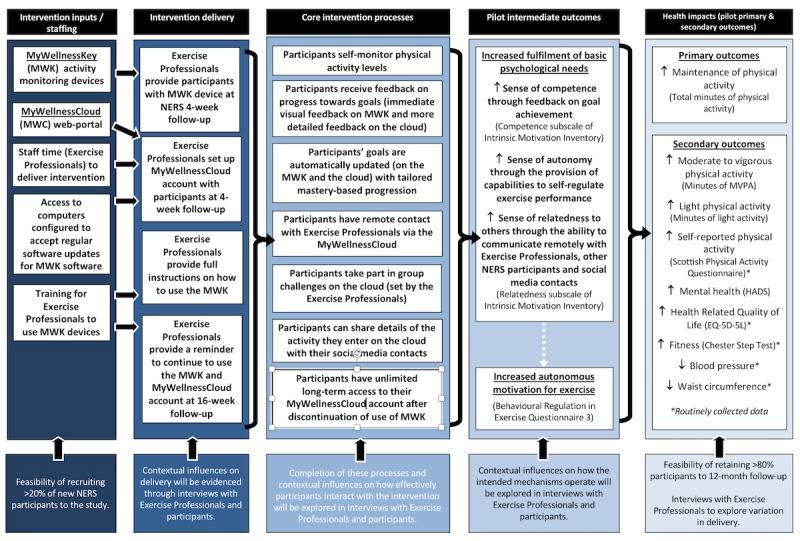
We conducted a feasability randomized controlled trial with embedded mixed-methods process evaluation and an exploratory economic analysis. Adults (N=156) were randomized to intervention (plus usual practice; n=88) or usual practice only (n=68). Usual practice was a 16-week structured exercise program. The intervention group additionally received an accelerometry-based activity monitor (MyWellnessKey) and associated Web platform (MyWellnessCloud). The primary outcomes were predefined progression criteria assessing acceptability and feasibility of the intervention and proposed evaluation. Postal questionnaires were completed at baseline (time 0:T0), 16 weeks (T1), and 12 months after T0 (T2). Routine data were accessed at the same time-points. A subsample of intervention participants and scheme staff were interviewed following the initiation of intervention delivery and at T2.
RESULTS
Participants were on average aged 56.6 (SD 16.3) years and mostly female (101/156, 64.7%) and white (150/156, 96.2%). Only 2 of 5 progression criteria were met; recruitment and randomization methods were acceptable to participants, and contamination was low. However, recruitment and retention rates (11.3% and 67.3%, respectively) fell substantially short of target criteria (20% and 80%, respectively), and disproportionally recruited from the least deprived quintile. Only 57.4% of intervention participants reported receipt of the intervention (below the 80% progression threshold). Less than half reported the intervention to be acceptable at T2. Participant and staff interviews revealed barriers to intervention delivery and engagement related to the device design as well as context-specific technological challenges, all of which made it difficult to integrate the technology into the service. Routinely collected health economic measures had substantial missing data, suggesting that other methods for collecting these should be used in future.
CONCLUSIONS
To our knowledge, this is the first study to evaluate short- and long-term feasibility and acceptability of integrating wearable technologies into community-based ERSs. The findings highlight device- and context-specific barriers to doing this in routine practice, with typical exercise referral populations. Key criteria for progression to a full-scale evaluation were not met.
TRIAL REGISTRATION
ISRCTN Registry ISRCTN85785652; http://www.isrctn.com/ISRCTN85785652.
背景
运动转诊计划(ERSs)适用于患有健康问题或存在风险因素的患者。有证据表明此类计划在增加身体活动方面具有初步有效性和成本效益,但效果通常会随着时间的推移而减弱。目标设定、自我监测和个性化反馈等技术可能有助于激发身体活动的动机并维持效果。可穿戴技术可为将激励技术融入运动计划提供契机。然而,对于运动转诊人群对此的接受度以及在运动转诊服务中的实施可行性知之甚少。
目的
确定在威尔士国家ERS中实施活动监测设备的可行性和可接受性,以便就是否以及如何进行有效性试验做出决策。
方法
我们进行了一项可行性随机对照试验,并嵌入了混合方法过程评估和探索性经济分析。成年人(N = 156)被随机分为干预组(加常规治疗;n = 88)或仅接受常规治疗组(n = 68)。常规治疗是一个为期16周的结构化运动计划。干预组还额外获得了一个基于加速度计的活动监测器(MyWellnessKey)和相关的网络平台(MyWellnessCloud)。主要结局是预定义的进展标准,用于评估干预措施和拟议评估的可接受性和可行性。在基线(时间0:T0)、16周(T1)和T0后12个月(T2)完成邮寄问卷调查。在相同时间点获取常规数据。在干预开始后和T2时,对干预参与者和计划工作人员的一个子样本进行了访谈。
结果
参与者的平均年龄为56.6(标准差16.3)岁,大多数为女性(101/156,64.7%)和白人(150/156,96.2%)。5个进展标准中仅满足2个;招募和随机化方法为参与者所接受,且污染率较低。然而,招募率和保留率(分别为11.3%和67.3%)大幅低于目标标准(分别为20%和80%),并且不成比例地从最不贫困的五分之一人群中招募。只有57.4%的干预参与者报告收到了干预措施(低于80%的进展阈值)。不到一半的人报告在T2时该干预措施是可接受的。参与者和工作人员的访谈揭示了与设备设计以及特定背景下的技术挑战相关的干预实施和参与障碍,所有这些都使得难以将该技术融入服务中。常规收集的卫生经济指标有大量缺失数据,这表明未来应采用其他方法来收集这些数据。
结论
据我们所知,这是第一项评估将可穿戴技术融入基于社区的ERS的短期和长期可行性及可接受性的研究。研究结果突出了在常规实践中针对典型运动转诊人群进行此项工作时特定于设备和背景的障碍。未满足进行全面评估的关键标准。
试验注册
ISRCTN注册库ISRCTN85785652;http://www.isrctn.com/ISRCTN85785652

 Zotero 插件