
通过双 sgRNA CRISPR/Cas9 介导的基因编辑,对隐性营养不良性大疱性表皮松解症进行临床相关校正。
Clinically Relevant Correction of Recessive Dystrophic Epidermolysis Bullosa by Dual sgRNA CRISPR/Cas9-Mediated Gene Editing.
机构信息
Department of Biomedical Engineering, Carlos III University (UC3M), Madrid, Spain; Centro de Investigación Biomédica en Red en Enfermedades Raras (CIBERER) U714, Madrid, Spain; Fundación Instituto de Investigación Sanitaria de la Fundación Jiménez Díaz, Madrid, Spain.
Centro de Investigación Biomédica en Red en Enfermedades Raras (CIBERER) U714, Madrid, Spain; Fundación Instituto de Investigación Sanitaria de la Fundación Jiménez Díaz, Madrid, Spain.
出版信息
Mol Ther. 2019 May 8;27(5):986-998. doi: 10.1016/j.ymthe.2019.03.007. Epub 2019 Mar 15.
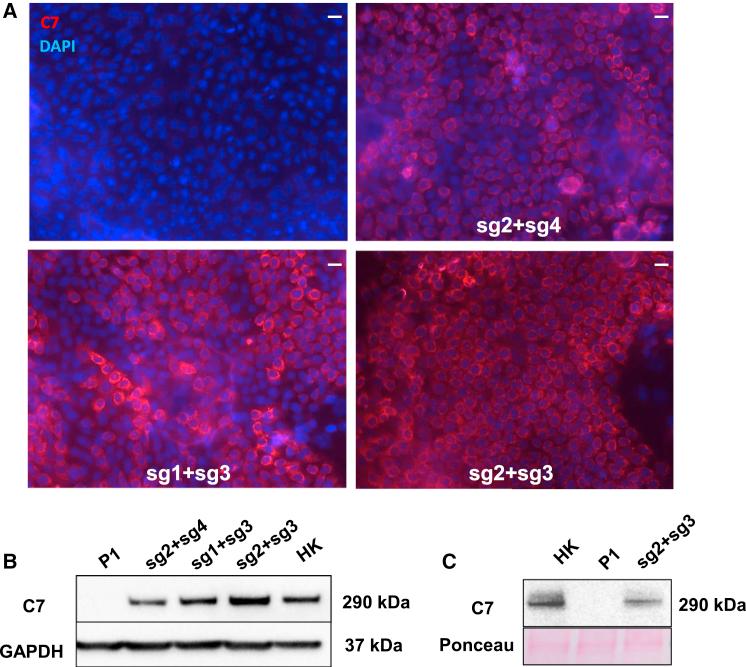
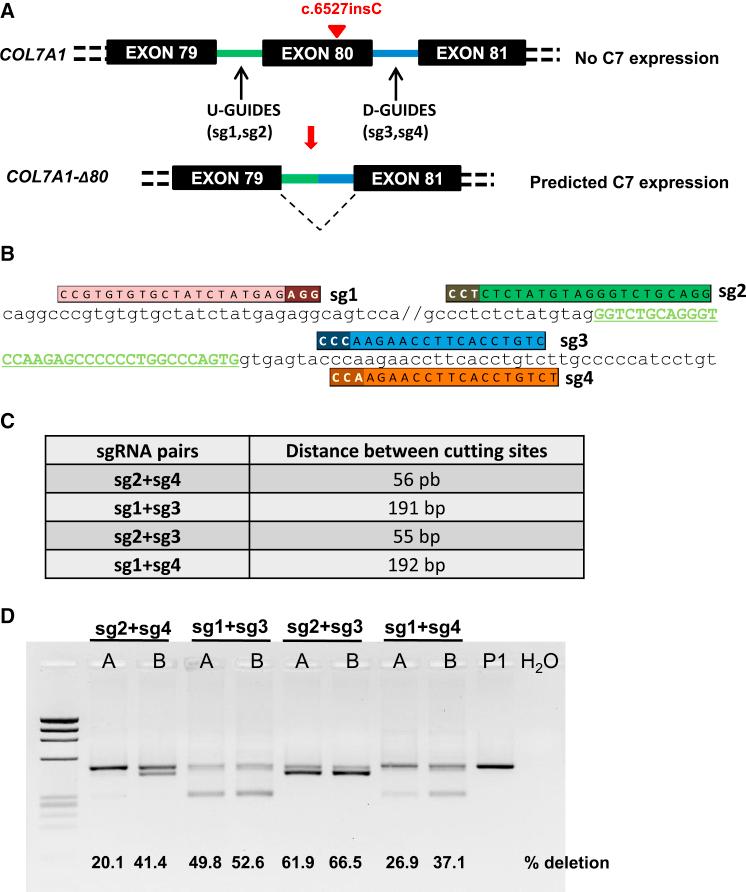
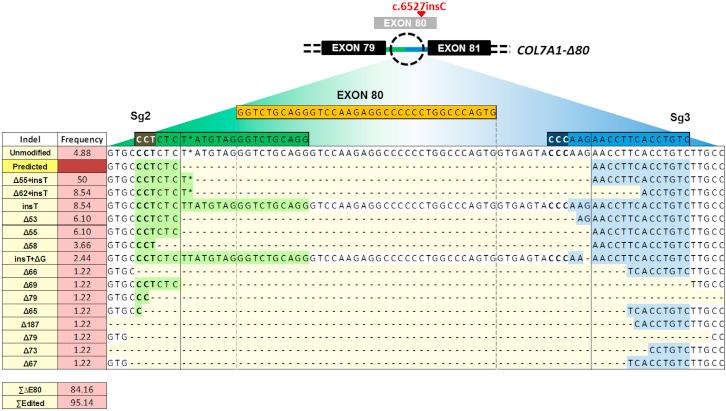
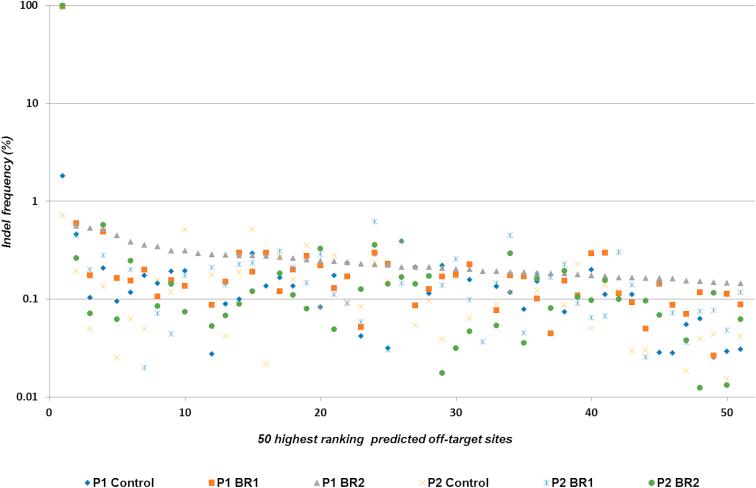
Gene editing constitutes a novel approach for precisely correcting disease-causing gene mutations. Frameshift mutations in COL7A1 causing recessive dystrophic epidermolysis bullosa are amenable to open reading frame restoration by non-homologous end joining repair-based approaches. Efficient targeted deletion of faulty COL7A1 exons in polyclonal patient keratinocytes would enable the translation of this therapeutic strategy to the clinic. In this study, using a dual single-guide RNA (sgRNA)-guided Cas9 nuclease delivered as a ribonucleoprotein complex through electroporation, we have achieved very efficient targeted deletion of COL7A1 exon 80 in recessive dystrophic epidermolysis bullosa (RDEB) patient keratinocytes carrying a highly prevalent frameshift mutation. This ex vivo non-viral approach rendered a large proportion of corrected cells producing a functional collagen VII variant. The effective targeting of the epidermal stem cell population enabled long-term regeneration of a properly adhesive skin upon grafting onto immunodeficient mice. A safety assessment by next-generation sequencing (NGS) analysis of potential off-target sites did not reveal any unintended nuclease activity. Our strategy could potentially be extended to a large number of COL7A1 mutation-bearing exons within the long collagenous domain of this gene, opening the way to precision medicine for RDEB.
基因编辑为精确纠正致病基因突变提供了一种新方法。导致隐性营养不良性大疱性表皮松解症的 COL7A1 基因框移突变可通过非同源末端连接修复为基础的方法进行开放阅读框修复。在多克隆患者角质形成细胞中高效靶向缺失有缺陷的 COL7A1 外显子,将使这一治疗策略能够在临床上应用。在这项研究中,我们通过电穿孔将双单链引导 RNA (sgRNA) 引导的 Cas9 核酸酶作为核糖核蛋白复合物递送至细胞,实现了在携带高度流行框移突变的隐性营养不良性大疱性表皮松解症 (RDEB) 患者角质形成细胞中非常高效地靶向缺失 COL7A1 外显子 80。这种体外非病毒方法使很大比例的校正细胞产生了具有功能的 VII 型胶原变体。靶向表皮干细胞群体的有效方法,使得在免疫缺陷小鼠上移植后能够长期再生具有适当黏附性的皮肤。通过下一代测序 (NGS) 分析潜在的脱靶位点进行安全性评估,未发现任何非预期的核酸酶活性。我们的策略有可能扩展到该基因长胶原结构域内的大量 COL7A1 突变外显子,为 RDEB 的精准医学开辟了道路。

 Zotero 插件