
真菌群落测序与分析应用于真菌致病过程中下呼吸道真菌群落分析。
Mycobiome Sequencing and Analysis Applied to Fungal Community Profiling of the Lower Respiratory Tract During Fungal Pathogenesis.
作者信息
McTaggart Lisa R, Copeland Julia K, Surendra Anuradha, Wang Pauline W, Husain Shahid, Coburn Bryan, Guttman David S, Kus Julianne V
机构信息
Public Health Ontario, Toronto, ON, Canada.
Centre for the Analysis of Genome Evolution and Function, University of Toronto, Toronto, ON, Canada.
出版信息
Front Microbiol. 2019 Mar 15;10:512. doi: 10.3389/fmicb.2019.00512. eCollection 2019.
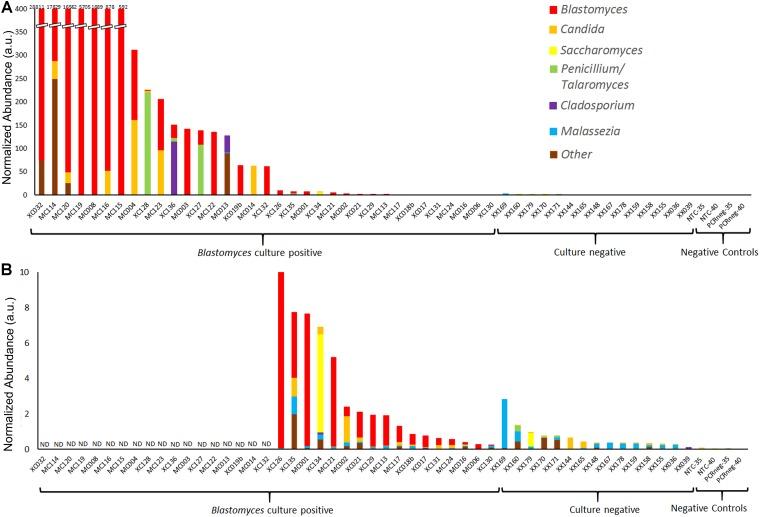
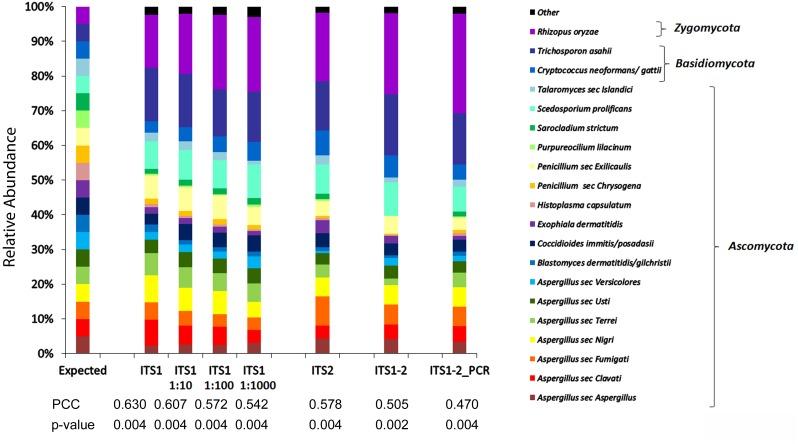
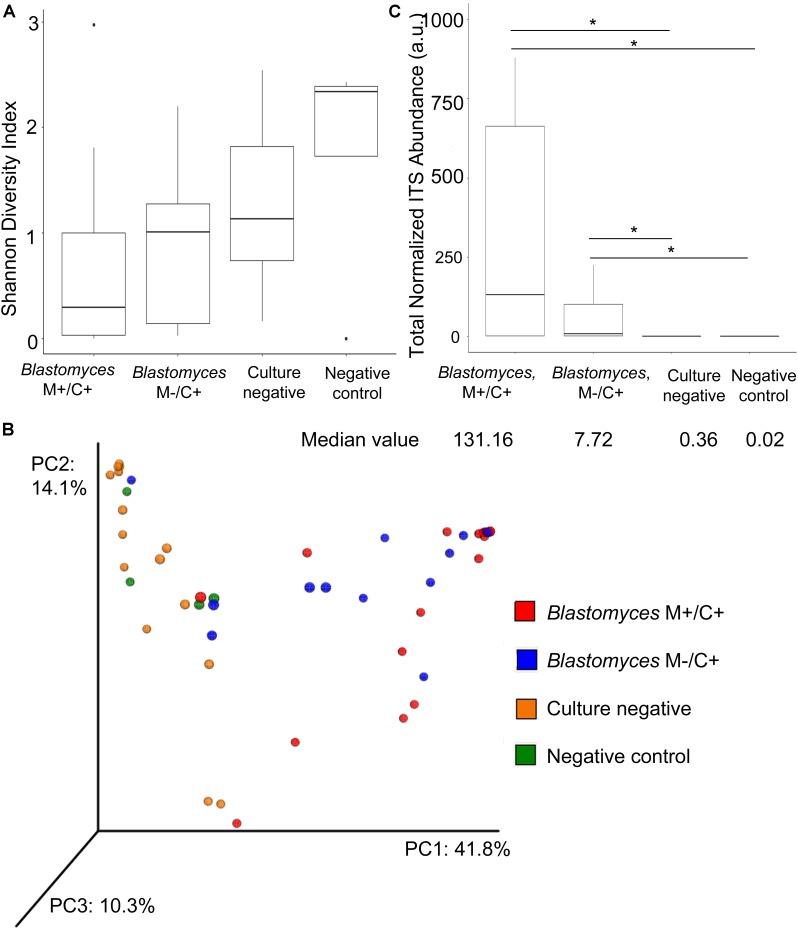
Invasive fungal infections are an increasingly important cause of human morbidity and mortality. We generated a next-generation sequencing (NGS)-based method designed to detect a wide range of fungi and applied it to analysis of the fungal microbiome (mycobiome) of the lung during fungal infection. Internal transcribed spacer 1 (ITS1) amplicon sequencing and a custom analysis pipeline detected 96% of species from three mock communities comprised of potential fungal lung pathogens with good recapitulation of the expected species distributions (Pearson correlation coefficients = 0.63, = 0.004; = 0.71, < 0.001; = 0.62, = 0.002). We used this pipeline to analyze mycobiomes of bronchoalveolar lavage (BAL) specimens classified as culture-negative ( = 50) or culture-positive ( = 39) for , the causative agent of North America blastomycosis. Detected in 91.4% of the culture-positive samples, dominated (>50% relative abundance) the mycobiome in 68.6% of these culture-positive samples but was absent in culture-negative samples. To overcome any bias in relative abundance due to between-sample variation in fungal biomass, an abundance-weighting calculation was used to normalize the data by accounting for sample-specific PCR cycle number and PCR product concentration data utilized during sample preparation. After normalization, there was a statistically significant greater overall abundance of ITS1 amplicon in the -culture-positive samples versus culture-negative samples. Moreover, the normalization revealed a greater biomass of yeast and environmental fungi in several -culture-positive samples than in the culture-negative samples. Successful detection of , , , and in 6 additional culture-positive BALs by ITS1 amplicon sequencing demonstrates the ability of this method to detect a broad range of fungi from clinical specimens, suggesting that it may be a potentially useful adjunct to traditional fungal microbiological testing for the diagnosis of respiratory mycoses.
侵袭性真菌感染正日益成为人类发病和死亡的重要原因。我们开发了一种基于二代测序(NGS)的方法,旨在检测多种真菌,并将其应用于真菌感染期间肺部真菌微生物组(真菌群落)的分析。内部转录间隔区1(ITS1)扩增子测序和定制分析流程从由潜在肺部真菌病原体组成的三个模拟群落中检测到了96%的物种,很好地重现了预期的物种分布(皮尔逊相关系数 = 0.63, = 0.004; = 0.71, < 0.001; = 0.62, = 0.002)。我们使用该流程分析了支气管肺泡灌洗(BAL)标本的真菌群落,这些标本根据北美芽生菌病病原体的培养结果分为培养阴性( = 50)或培养阳性( = 39)。在91.4%的培养阳性样本中检测到了该病原体,在这些培养阳性样本的68.6%中该病原体在真菌群落中占主导地位(相对丰度>50%),但在培养阴性样本中未检测到。为了克服由于样本间真菌生物量差异导致的相对丰度偏差,采用了丰度加权计算,通过考虑样本制备过程中使用的样本特异性PCR循环数和PCR产物浓度数据对数据进行归一化。归一化后,与培养阴性样本相比,培养阳性样本中ITS1扩增子的总体丰度在统计学上显著更高。此外,归一化显示,在几个培养阳性样本中,酵母和环境真菌的生物量比培养阴性样本中的更大。通过ITS1扩增子测序在另外6个培养阳性的BAL样本中成功检测到了该病原体、、和,证明了该方法能够从临床标本中检测多种真菌,表明它可能是传统真菌微生物检测在诊断呼吸道真菌病方面的潜在有用辅助手段。

 Zotero 插件