
在有或没有融合的肺癌细胞中表达 C 端 ALK、RET 或 ROS1。
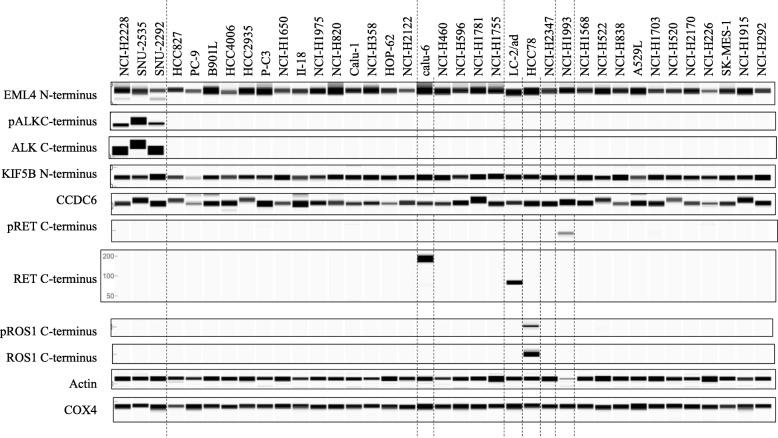
Expression of C-terminal ALK, RET, or ROS1 in lung cancer cells with or without fusion.
机构信息
Product Research Department, Kamakura Research Laboratories, Chugai Pharmaceutical Co., Ltd., 200 Kajiwara, Kamakura, Kanagawa, 247-8530, Japan.
出版信息
BMC Cancer. 2019 Apr 3;19(1):301. doi: 10.1186/s12885-019-5527-2.
BACKGROUND
Genetic alterations, including mutation of epidermal growth factor receptor or v-Ki-ras2 kirsten rat sarcoma viral oncogene homolog and fusion of anaplastic lymphoma kinase (ALK), RET proto-oncogene (RET), or v-ros UR2 sarcoma virus oncogene homolog 1 (ROS1), occur in non-small cell lung cancers, and these oncogenic drivers are important biomarkers for targeted therapies. A useful technique to screen for these fusions is the detection of native carboxy-terminal (C-terminal) protein by immunohistochemistry; however, the effects of other genetic alterations on C-terminal expression is not fully understood. In this study, we evaluated whether C-terminal expression is specifically elevated by fusion with or without typical genetic alterations of lung cancer.
METHODS
In 37 human lung cancer cell lines and four tissue specimens, protein and mRNA levels were measured by capillary western blotting and reverse transcription-PCR, respectively.
RESULTS
Compared with the median of all 37 cell lines, mRNA levels at the C-terminus of all five of the fusion-positive cell lines tested (three ALK, one RET, and one ROS1) were elevated at least 2000-, 300-, or 2000-fold, respectively, and high C-terminal protein expression was detected. In an ALK fusion-positive tissue specimen, the mRNA and protein levels of C-terminal ALK were also markedly elevated. Meanwhile, in one of 36 RET fusion-negative cell lines, RET mRNA levels at the C-terminus were elevated at least 500-fold compared with the median of all 37 cell lines, and high C-terminal protein expression was detected despite the absence of RET fusion.
CONCLUSIONS
This study of 37 cell lines and four tissue specimens shows the detection of C-terminal ALK or ROS1 proteins could be a comprehensive method to determine ALK or ROS1 fusion, whereas not only the detection of C-terminal RET protein but also other methods would be needed to determine RET fusion.
背景
非小细胞肺癌中存在基因改变,包括表皮生长因子受体突变或 v-Ki-ras2 Kirsten 大鼠肉瘤病毒致癌基因同源物和间变性淋巴瘤激酶(ALK)、RET 原癌基因(RET)或 v-rosUR2 肉瘤病毒致癌基因同源物 1(ROS1)的融合,这些致癌驱动因子是非小细胞肺癌的重要生物标志物,用于靶向治疗。检测天然羧基末端(C 末端)蛋白的免疫组织化学是筛选这些融合的有用技术;然而,其他基因改变对 C 末端表达的影响尚不完全清楚。在这项研究中,我们评估了融合是否会特异性地导致 C 末端表达升高,而不考虑肺癌的典型遗传改变。
方法
在 37 个人肺癌细胞系和 4 个组织标本中,通过毛细管 Western 印迹和逆转录-PCR 分别测量蛋白和 mRNA 水平。
结果
与 37 个细胞系的中位数相比,检测到的 5 个融合阳性细胞系(3 个 ALK、1 个 RET 和 1 个 ROS1)的 C 末端的 mRNA 水平分别升高了至少 2000 倍、300 倍或 2000 倍,并且检测到高 C 末端蛋白表达。在一个 ALK 融合阳性的组织标本中,C 末端 ALK 的 mRNA 和蛋白水平也显著升高。同时,在 36 个 RET 融合阴性细胞系中的一个中,C 末端的 RET mRNA 水平比所有 37 个细胞系的中位数升高了至少 500 倍,尽管没有 RET 融合,但检测到高 C 末端蛋白表达。
结论
这项对 37 个细胞系和 4 个组织标本的研究表明,检测 C 末端 ALK 或 ROS1 蛋白可能是确定 ALK 或 ROS1 融合的综合方法,而不仅仅是检测 C 末端 RET 蛋白,还需要其他方法来确定 RET 融合。


 Zotero 插件