
原发皮肤黑色素瘤中预后 31 基因表达谱检测的前瞻性验证。
Prospective validation of the prognostic 31-gene expression profiling test in primary cutaneous melanoma.
机构信息
Department of Surgery, Saint Louis University, St. Louis, Missouri.
Department of Dermatology, Saint Louis University, St. Louis, Missouri.
出版信息
Cancer Med. 2019 May;8(5):2205-2212. doi: 10.1002/cam4.2128. Epub 2019 Apr 5.
BACKGROUND
Gene expression profiling (GEP) has been integrated into cancer treatment decision-making in multiple neoplasms. We prospectively evaluated the prognostic utility of the 31-GEP test (DecisionDx-Melanoma, Castle Biosciences, Inc) in cutaneous melanoma (CM) patients undergoing sentinel node biopsy (SNB).
METHODS
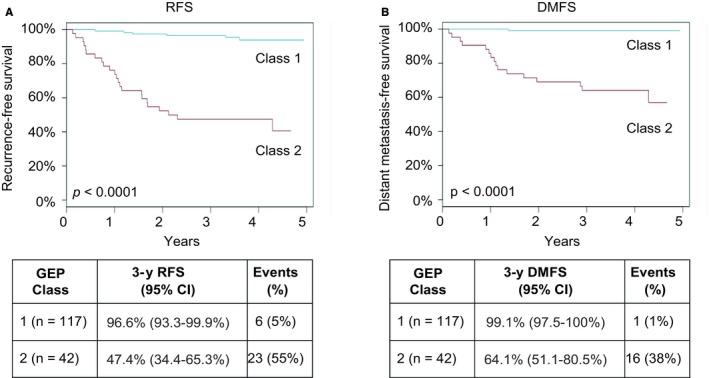
One hundred fifty-nine patients (age 26-88) diagnosed with melanoma between 01/2013 and 8/2015 underwent SNB and concurrent GEP testing. GEP results were reported as low-risk Class 1 (subclasses 1A and 1B) or high-risk Class 2 (subclasses 2A and 2B). Statistical analyses were performed with chi-square analysis, t tests, log-rank tests, and Cox proportional hazard models. Recurrence-free survival (RFS) and distant metastasis-free survival (DMFS) were estimated using Kaplan-Meier method.
RESULTS
Median follow-up was 44.9 months for event-free cases. Median Breslow thickness was 1.4 mm (0.2-15.0 mm). There were 117 Class 1 and 42 Class 2 patients. Gender, age, Breslow thickness, ulceration, SNB positivity, and AJCC stage were significantly associated with GEP classification (P < 0.05 for all). Recurrence and distant metastasis rates were 5% and 1% for Class 1 patients compared with 55% and 36% for Class 2 patients. Sensitivities of Class 2 and SNB for recurrence were 79% and 34%, respectively. Of 10 SNB-positive/Class 2 patients, 9 recurred. By multivariate analysis, only SNB result and GEP class were statistically associated with both RFS (P = 0.008 and 0.0001) and DMFS (P = 0.019 and 0.001).
CONCLUSIONS
Gene expression profiling Class 2 result and SNB positivity were independently associated with recurrence and distant metastasis in primary CM patients. GEP testing may have additive prognostic utility in initial staging work-up of these patients.
背景
基因表达谱(GEP)已被整合到多种肿瘤的癌症治疗决策中。我们前瞻性地评估了 31-GEP 测试(DecisionDx-Melanoma,Castle Biosciences,Inc)在接受前哨淋巴结活检(SNB)的皮肤黑色素瘤(CM)患者中的预后效用。
方法
159 名(年龄 26-88 岁)于 2013 年 1 月至 2015 年 8 月期间诊断为黑色素瘤的患者接受了 SNB 和同时进行的 GEP 检测。GEP 结果报告为低风险 1 类(亚类 1A 和 1B)或高风险 2 类(亚类 2A 和 2B)。使用卡方检验、t 检验、对数秩检验和 Cox 比例风险模型进行统计分析。使用 Kaplan-Meier 方法估计无复发生存率(RFS)和远处无转移生存率(DMFS)。
结果
无事件病例的中位随访时间为 44.9 个月。中位 Breslow 厚度为 1.4 毫米(0.2-15.0 毫米)。有 117 名 1 类患者和 42 名 2 类患者。性别、年龄、Breslow 厚度、溃疡、SNB 阳性和 AJCC 分期与 GEP 分类显著相关(所有 P<0.05)。1 类患者的复发和远处转移率分别为 5%和 1%,而 2 类患者分别为 55%和 36%。2 类和 SNB 对复发的敏感性分别为 79%和 34%。10 名 SNB 阳性/2 类患者中,9 名复发。多变量分析显示,只有 SNB 结果和 GEP 分类与 RFS(P=0.008 和 0.0001)和 DMFS(P=0.019 和 0.001)均相关。
结论
GEP 分类 2 类结果和 SNB 阳性与原发性 CM 患者的复发和远处转移独立相关。在这些患者的初始分期评估中,GEP 检测可能具有附加的预后效用。
 Zotero 插件