
将 WhatsApp 嵌入常规戒烟服务中:一项随机对照研究对戒烟率的影响。
WhatsApp embedded in routine service delivery for smoking cessation: effects on abstinence rates in a randomized controlled study.
机构信息
Ege University Faculty of Medicine, Department of Medical Education, Izmir, Turkey.
Adnan Menderes University Faculty of Medicine, Department of Public Health, Aydin, Turkey.
出版信息
BMC Public Health. 2019 Apr 8;19(1):387. doi: 10.1186/s12889-019-6727-z.
BACKGROUND
The demand for smoking cessation services has risen in Turkey, as smokers planning to quit reached 35% in 2012. Communication technologies are used globally to support quitters, yet their integration to health services is rare. This study aims to evaluate the effect of support messages through WhatsApp application added to the usual care of a university hospital cessation unit, as compared to usual care alone, on abstinence rates at first month.
METHODS
A randomized controlled intervention study was conducted with 132 patients applying to Ege University Hospital's Department of Public Health Smoking Cessation Clinic, between March and July 2017. Intervention content was prepared and 60 WhatsApp messages about having a plan of action and preventing relapse were developed through expert panels. These messages lasted for 3 months and follow-ups continued for 6 months. The primary outcome was abstinence rate at 1st month post target quit day. As secondary outcomes; the continuous abstinence rates at 3rd and 6th months, number of follow-ups, change in weight and continuity of medication were evaluated. Intention-to-treat analysis was used.
RESULTS
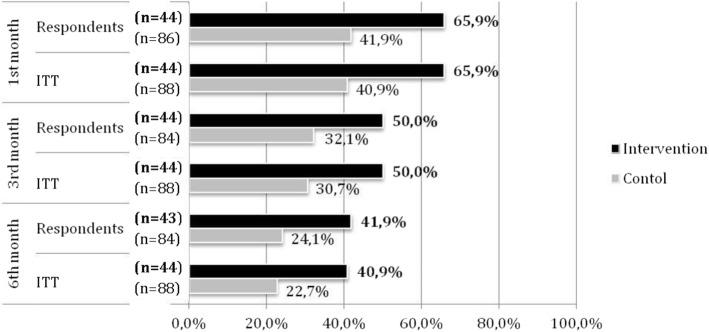
Abstinence rate at 1st month was 65.9% in the intervention group and 40.9% in the control group (p = 0.007); 50.0 and 30.7% at 3rd month and 40.9 and 22.7% at 6th month, consecutively (both p < 0.05). Being in the intervention group increased abstinence rate by 3.50 (OR, 95% CI = 1.30-9.44) times in the 1st month. When controlled for all other factors in the multivariate logistic regression, the intervention was the only variable significantly associated with abstinence. For secondary outcomes, the intervention increased abstinence rate by 2.50 (OR, 95% CI = 1.08-6.40) times in the 3rd and 2.31 (OR, 95% CI = 1.03-5.16) times in the 6th month. In the intervention group, the number of follow-ups and face-to-face follow-ups were higher at 1st and 3rd months and continuity of medication was longer at 3rd month.
CONCLUSIONS
WhatsApp support embedded in cessation service delivery increases the abstinence rate and has favorable effects on follow-up.
TRIAL REGISTRATION
This trial is retrospectively registered online at ClinicalTrials.gov with the identifier NCT03714971 .
背景
在土耳其,戒烟服务的需求有所增加,因为 2012 年计划戒烟的吸烟者达到 35%。全球都在使用通信技术来支持戒烟者,但将其整合到卫生服务中却很少见。本研究旨在评估在常规治疗的基础上,通过 WhatsApp 应用程序为大学医院戒烟门诊提供支持信息对第一个月的戒烟率的影响。
方法
2017 年 3 月至 7 月,对伊兹密尔大学医院公共卫生戒烟诊所的 132 名患者进行了一项随机对照干预研究。通过专家小组制定了干预内容,并开发了 60 条关于行动计划和预防复发的 WhatsApp 消息。这些信息持续了 3 个月,随访时间持续了 6 个月。主要结果是目标戒烟日第 1 个月的戒烟率。次要结果为第 3 个月和第 6 个月的持续戒烟率、随访次数、体重变化和药物治疗的连续性。采用意向治疗分析。
结果
干预组第 1 个月的戒烟率为 65.9%,对照组为 40.9%(p=0.007);第 3 个月为 50.0%和 30.7%,第 6 个月为 40.9%和 22.7%(均 p<0.05)。干预组第 1 个月的戒烟率增加了 3.50 倍(OR,95%CI=1.30-9.44)。在多变量逻辑回归中控制所有其他因素后,干预是唯一与戒烟显著相关的变量。对于次要结果,在第 3 个月和第 6 个月,干预使戒烟率分别增加了 2.50 倍(OR,95%CI=1.08-6.40)和 2.31 倍(OR,95%CI=1.03-5.16)。在干预组中,第 1 个月和第 3 个月的随访次数和面对面随访次数较高,第 3 个月的药物治疗连续性较长。
结论
嵌入戒烟服务中的 WhatsApp 支持提高了戒烟率,并对随访有积极影响。
试验注册
本试验在 ClinicalTrials.gov 网站上进行了回顾性注册,标识符为 NCT03714971。

 Zotero 插件