
桥本甲状腺炎对甲状腺结节细胞学及甲状腺癌风险的影响。
The Impact of Hashimoto Thyroiditis on Thyroid Nodule Cytology and Risk of Thyroid Cancer.
作者信息
Silva de Morais Nathalie, Stuart Jessica, Guan Haixia, Wang Zhihong, Cibas Edmund S, Frates Mary C, Benson Carol B, Cho Nancy L, Nehs Mathew A, Alexander Caroline A, Marqusee Ellen, Kim Mathew I, Lorch Jochen H, Barletta Justine A, Angell Trevor E, Alexander Erik K
机构信息
Thyroid Interdisciplinary Team, Brigham and Women's Hospital and Harvard Medical School, Boston, Massachusetts.
Endocrinology Service, Instituto Nacional de Câncer and Universidade Federal do Rio de Janeiro, Rio de Janeiro, Brazil.
出版信息
J Endocr Soc. 2019 Mar 5;3(4):791-800. doi: 10.1210/js.2018-00427. eCollection 2019 Apr 1.
CONTEXT
The impact of Hashimoto thyroiditis (HT) on the risk of thyroid cancer and its accurate detection remains unclear. The presence of a chronic lymphocytic infiltration imparts a logical mechanism potentially altering neoplastic transformation, while also influencing the accuracy of diagnostic evaluation.
METHODS
We performed a prospective, cohort analysis of 9851 consecutive patients with 21,397 nodules ≥1 cm who underwent nodule evaluation between 1995 and 2017. The definition of HT included (i) elevated thyroid peroxidase antibody (TPOAb) level and/or (ii) findings of diffuse heterogeneity on ultrasound, and/or (iii) the finding of diffuse lymphocytic thyroiditis on histopathology. The impact of HT on the distribution of cytology and, ultimately, on malignancy risk was determined.
RESULTS
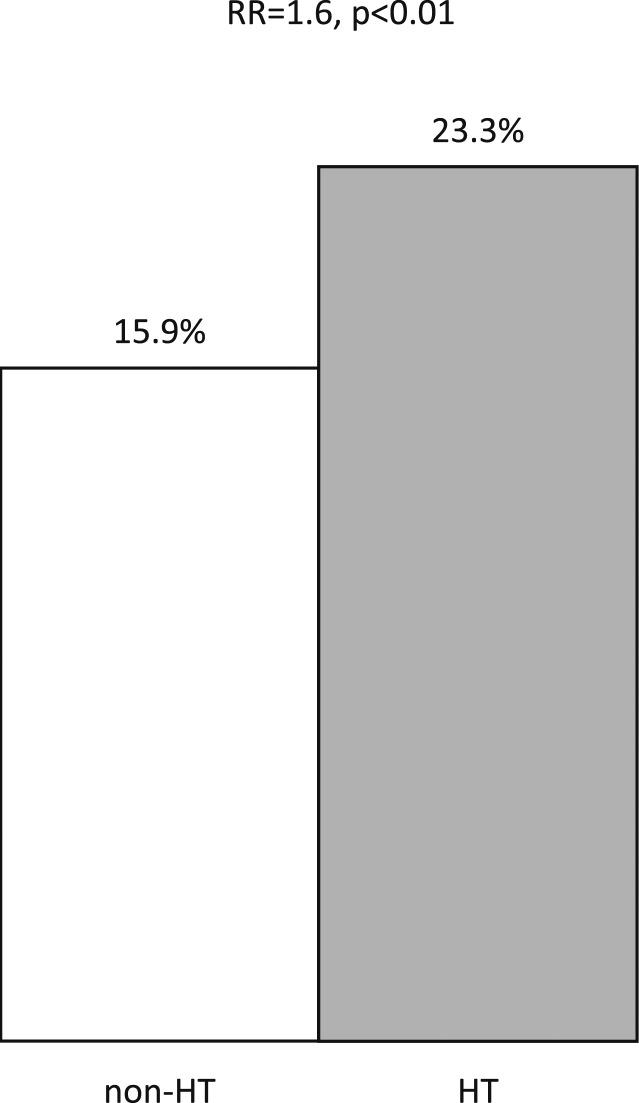
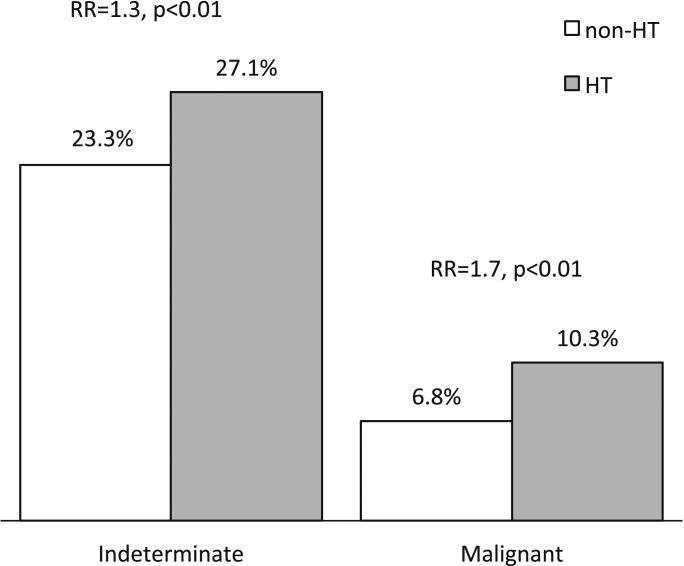
A total of 2651 patients (27%) were diagnosed with HT, and 3895 HT nodules and 10,168 non-HT nodules were biopsied. The prevalence of indeterminate and malignant cytology was higher in the HT vs non-HT group (indeterminate: 26.3% vs 21.8%, respectively, < 0.001; malignant: 10.0% vs 6.4%, respectively, < 0.001). Ultimately, the risk of any nodule proving malignant was significantly elevated in the setting of HT (relative risk, 1.6; 95% CI, 1.44 to 1.79; < 0.001), and was maintained when patients with solitary or multiple nodules were analyzed separately (HT vs non-HT: 24.5% vs 16.3% solitary; 22.1% vs 15.4% multinodular; < 0.01).
CONCLUSION
HT increases the risk of thyroid malignancy in any patient presenting for nodule evaluation. Diffuse sonographic heterogeneity and/or TPOAb positivity should be used for risk assessment at time of evaluation.
背景
桥本甲状腺炎(HT)对甲状腺癌风险的影响及其准确检测仍不清楚。慢性淋巴细胞浸润的存在赋予了一种可能改变肿瘤转化的合理机制,同时也影响诊断评估的准确性。
方法
我们对1995年至2017年间接受结节评估的9851例连续患者中的21397个直径≥1cm的结节进行了前瞻性队列分析。HT的定义包括:(i)甲状腺过氧化物酶抗体(TPOAb)水平升高和/或(ii)超声显示弥漫性异质性,和/或(iii)组织病理学发现弥漫性淋巴细胞性甲状腺炎。确定HT对细胞学分布以及最终对恶性风险的影响。
结果
共有2651例患者(27%)被诊断为HT,对3895个HT结节和10168个非HT结节进行了活检。HT组中不确定和恶性细胞学的患病率高于非HT组(不确定:分别为26.3%和21.8%,<0.001;恶性:分别为10.0%和6.4%,<0.001)。最终,在HT情况下,任何结节被证明为恶性的风险显著升高(相对风险,1.6;95%CI,1.44至1.79;<0.001),并且在分别分析单发或多发结节的患者时该风险仍然存在(HT组与非HT组:单发结节分别为24.5%和16.3%;多发结节分别为22.1%和15.4%;<0.01)。
结论
HT增加了任何接受结节评估患者的甲状腺恶性风险。在评估时应使用弥漫性超声异质性和/或TPOAb阳性进行风险评估。
 Zotero 插件