
TL1A(TNFSF15)和 DR3(TNFRSF25):细胞因子的共刺激系统,在肠道黏膜免疫中具有多种功能。
TL1A (TNFSF15) and DR3 (TNFRSF25): A Co-stimulatory System of Cytokines With Diverse Functions in Gut Mucosal Immunity.
机构信息
Gastroenterology and Hepatology Research Laboratory, Medical School, University of Crete, Heraklion, Greece.
Laboratory of Pharmacology, Faculty of Medicine, Democritus University of Thrace, Alexandroupolis, Greece.
出版信息
Front Immunol. 2019 Mar 27;10:583. doi: 10.3389/fimmu.2019.00583. eCollection 2019.
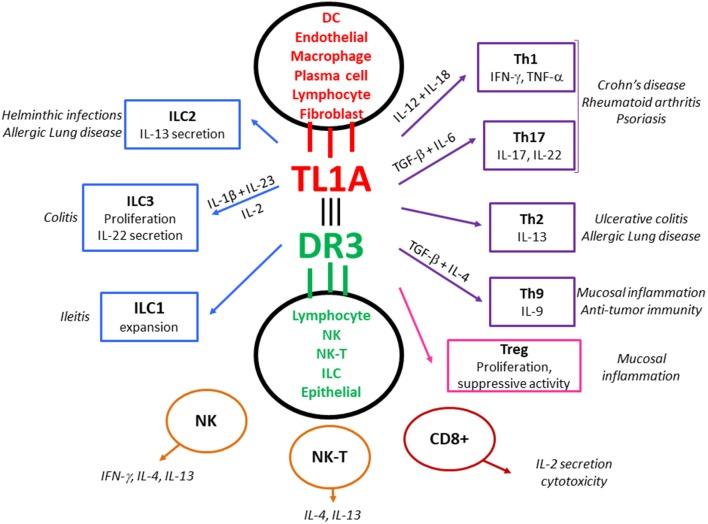
TL1A and its functional receptor DR3 are members of the TNF/TNFR superfamilies of proteins. Binding of APC-derived TL1A to lymphocytic DR3 provides co-stimulatory signals for activated lymphocytes. DR3 signaling affects the proliferative activity of and cytokine production by effector lymphocytes, but also critically influences the development and suppressive function of regulatory T-cells. DR3 was also found to be highly expressed by innate lymphoid cells (ILCS), which respond to stimulation by TL1A. Several recent studies with transgenic and knockout mice as well as neutralizing or agonistic antibodies for these two proteins, have clearly shown that TL1A/DR3 are important mediators of several chronic immunological disorders, including Inflammatory Bowel Disease (IBD). TL1A and DR3 are abundantly localized at inflamed intestinal areas of patients with IBD and mice with experimental ileitis or colitis and actively participate in the immunological pathways that underlie mucosal homeostasis and intestinal inflammation. DR3 signaling has demonstrated a dichotomous role in mucosal immunity. On the one hand, during acute mucosal injury it exerts protective functions by ameliorating the severity of acute inflammatory responses and facilitating tissue repair. On the other hand, it critically participates in the pro-inflammatory pathways that underlie chronic inflammatory responses, such as those that take place in IBD. These effects are mediated through modulation of the relative mucosal abundance and function of Th1, Th2, Th17, Th9, and Treg lymphocytes, but also of all types of ILCs. Recently, an important role was demonstrated for TL1A/DR3 as potential mediators of intestinal fibrosis that is associated with the presence of gut inflammation. These accumulating data have raised the possibility that TL1A/DR3 pathways may represent a valid therapeutic target for chronic immunological diseases. Nevertheless, applicability of such a therapeutic approach will greatly rely on the net result of TL1A/DR3 manipulation on the various cell populations that will be affected by this approach.
TL1A 和其功能性受体 DR3 是 TNF/TNFR 蛋白超家族的成员。APC 来源的 TL1A 与淋巴细胞 DR3 的结合为活化的淋巴细胞提供共刺激信号。DR3 信号影响效应淋巴细胞的增殖活性和细胞因子产生,但也严重影响调节性 T 细胞的发育和抑制功能。DR3 也在先天淋巴细胞(ILCS)中高度表达,这些细胞对 TL1A 的刺激作出反应。最近的一些使用转基因和基因敲除小鼠以及针对这两种蛋白的中和或激动性抗体的研究清楚地表明,TL1A/DR3 是几种慢性免疫性疾病(包括炎症性肠病(IBD))的重要介质。TL1A 和 DR3 在 IBD 患者的炎症肠道区域以及患有实验性回肠炎或结肠炎的小鼠中大量定位于炎症区域,并积极参与黏膜稳态和肠道炎症的免疫途径。DR3 信号在黏膜免疫中具有双重作用。一方面,在急性黏膜损伤时,它通过减轻急性炎症反应的严重程度和促进组织修复来发挥保护作用。另一方面,它严重参与了慢性炎症反应的促炎途径,如发生在 IBD 中的途径。这些作用是通过调节 Th1、Th2、Th17、Th9 和 Treg 淋巴细胞以及所有类型的 ILC 相对黏膜丰度和功能来介导的。最近,TL1A/DR3 作为与肠道炎症相关的肠道纤维化的潜在介质的重要作用得到了证明。这些累积的数据提出了这样一种可能性,即 TL1A/DR3 途径可能是慢性免疫性疾病的一个有效治疗靶点。然而,这种治疗方法的适用性将在很大程度上依赖于 TL1A/DR3 处理对受该方法影响的各种细胞群体的净结果。
 Zotero 插件