
通过固定化嗜热毁丝霉漆酶(MtL)实现各种木质素的聚合
Polymerization of Various Lignins via Immobilized Myceliophthora thermophila Laccase (MtL).
作者信息
Huber Daniela, Pellis Alessandro, Daxbacher Andreas, Nyanhongo Gibson S, Guebitz Georg M
机构信息
Institute of Environmental Biotechnology, University of Natural Resources and Life Sciences, Vienna, Konrad Lorenz Str. 20, 3430 Tulln, Austria.
Department of Biology, Botswana International University of Science and Technology, Private Bag 16, Plot 10017 Palapye, Botswana.
出版信息
Polymers (Basel). 2016 Aug 3;8(8):280. doi: 10.3390/polym8080280.
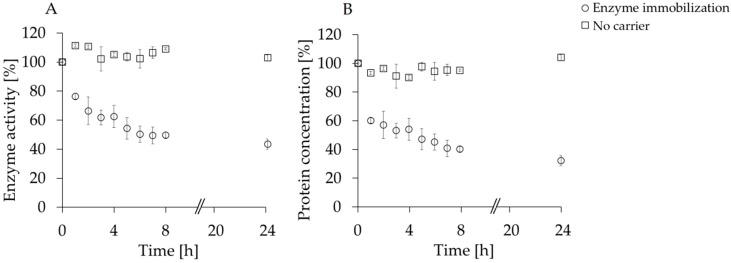
Enzymatic polymerization of lignin is an environmentally-friendly and sustainable method that is investigated for its potential in opening-up new applications of one of the most abundant biopolymers on our planet. In this work, the laccase from was successfully immobilized onto Accurel MP1000 beads (67% of protein bound to the polymeric carrier) and the biocatalyzed oxidation of Kraft lignin (KL) and lignosulfonate (LS) were carried out. Fluorescence intensity determination, phenol content analysis and size exclusion chromatography were performed in order to elucidate the extent of the polymerization reaction. The collected results show an 8.5-fold decrease of the LS samples' fluorescence intensity after laccase-mediated oxidation and a 12-fold increase of the weight average molecular weight was obtained.
木质素的酶促聚合是一种环境友好且可持续的方法,因其在开拓地球上最丰富的生物聚合物之一的新应用方面的潜力而受到研究。在这项工作中,来自[具体来源未给出]的漆酶成功固定在Accurel MP1000珠粒上(67%的蛋白质结合到聚合物载体上),并对硫酸盐针叶木浆木质素(KL)和木质素磺酸盐(LS)进行了生物催化氧化。进行了荧光强度测定、酚含量分析和尺寸排阻色谱,以阐明聚合反应的程度。收集的结果表明,漆酶介导的氧化后,LS样品的荧光强度降低了8.5倍,重均分子量增加了12倍。


 Zotero 插件