
2012-2017 年中国西南部血流感染中 ESKAPEEc 耐药的趋势变化和年龄分布。
Shifting trends and age distribution of ESKAPEEc resistance in bloodstream infection, Southwest China, 2012-2017.
机构信息
1Department of Laboratory Medicine, the First Affiliated Hospital of Chongqing Medical University, No.1, Youyi Road, Yuzhong District, Chongqing, 400016 People's Republic of China.
2Laboratory Medicine, Chongqing Medical University, No.1, Yixueyuan Road, Yuzhong District, Chongqing, 400016 People's Republic of China.
出版信息
Antimicrob Resist Infect Control. 2019 Mar 29;8:61. doi: 10.1186/s13756-019-0499-1. eCollection 2019.
BACKGROUND
ESKAPEEc contribute to a majority of bloodstream infections (BSIs) and their antibiogram have changed overtime, while data concerning about these alterations are lacking in China. Added that a paucity of studies referred to ESKAPEEc in pediatric BSIs, our study aimed to demonstrate the longitudinal alterations of ESKAPEEc distribution and antibiogram in adult and pediatric BSIs in Southwest China.
METHODS
A multicenter retrospective surveillance study was launched from 2012 to 2017. Data of China Antimicrobial Resistance Surveillance System (CARSS) was analyzed by Whonet 5.6 and Graphpad Prism 6 Software. test or exact test was used to examine and compare temporal changes.
RESULTS
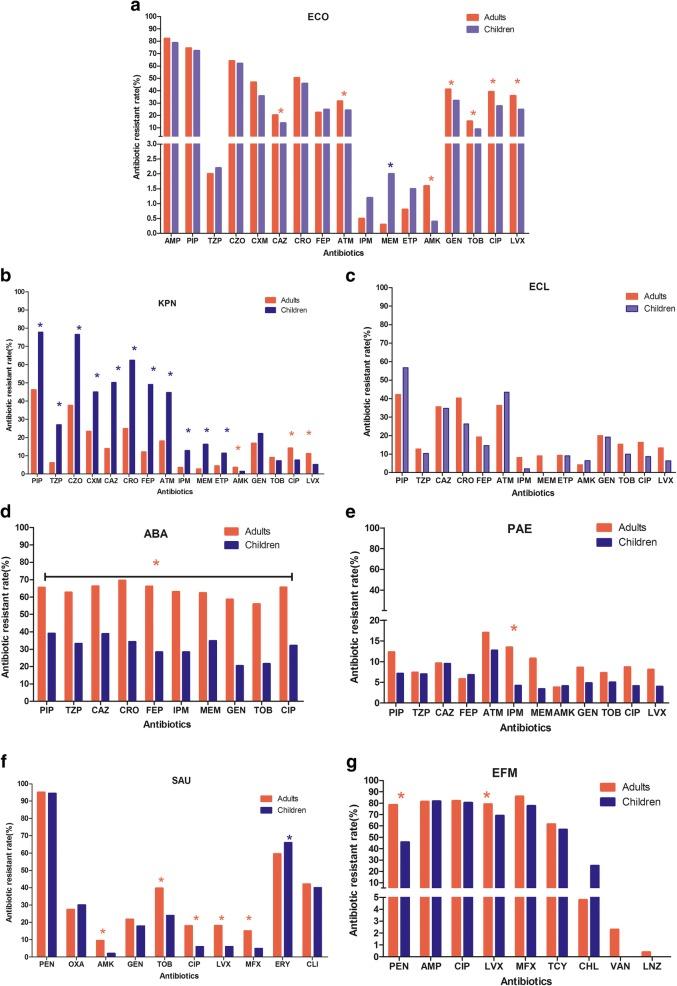
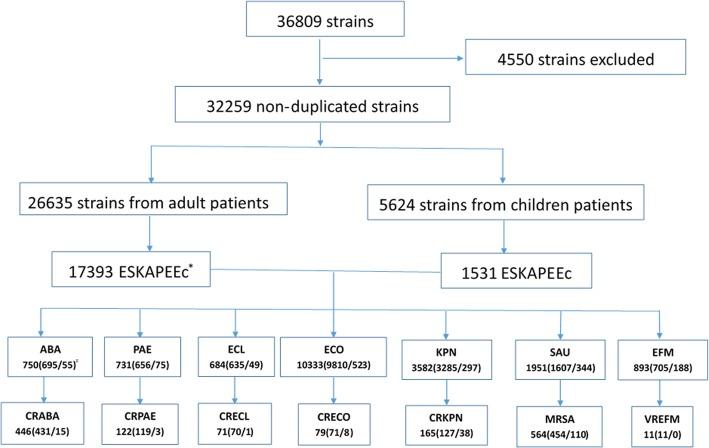
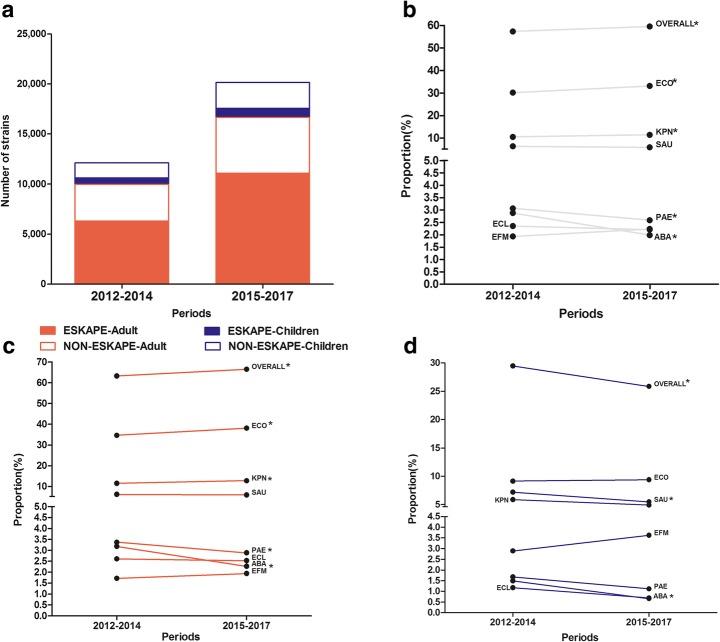
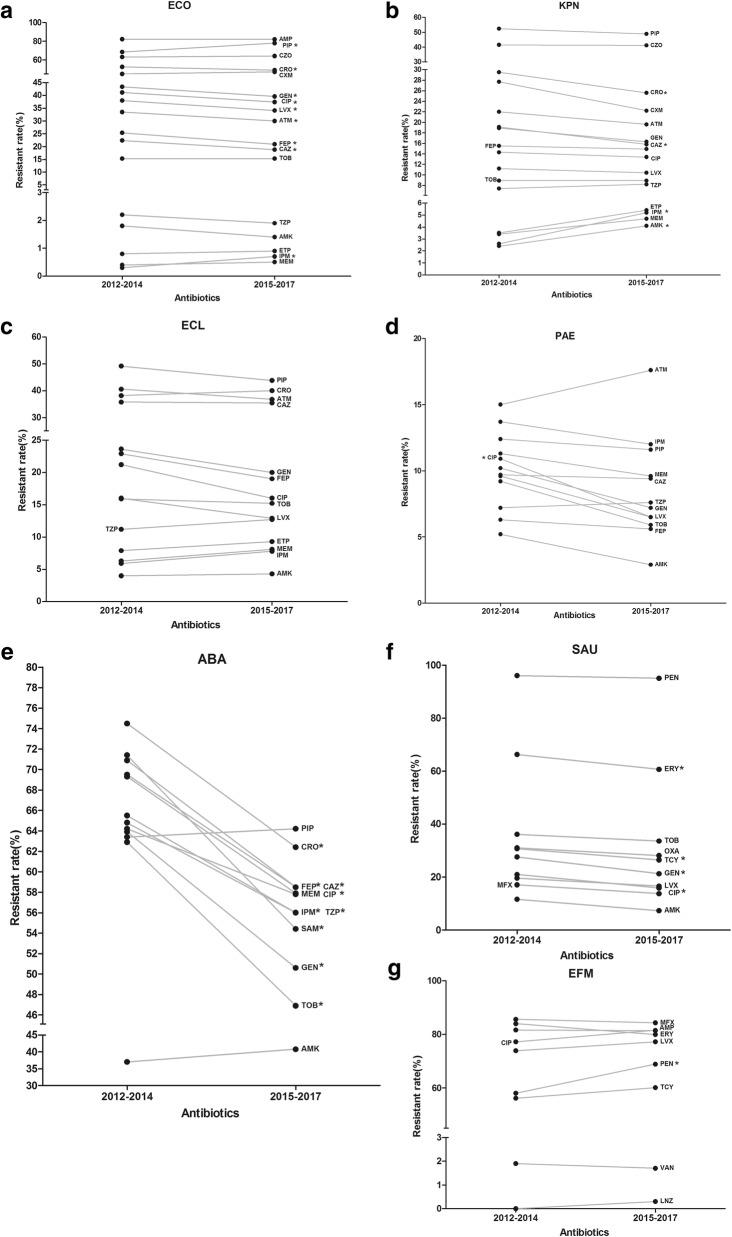
A total of 32,259 strains was isolated, with 17.4% from pediatric BSIs. ESKAPEEc contributed to 58.67% (18,924/32,259) of BSIs, with 65.3% of adult BSIs and 27.2% of pediatric BSIs. () and () were the two predominant species. Carbapenem resistance was prevalent in 0.76, 4.60, 9.47,13.66, 59.47% of , , , () and (), respectively. The proportions of methicillin-resistant (MRSA) and vancomycin-resistant (VREFM) were 28.91% and 2.20%, respectively. Between 2012-2014 and 2015-2017, and showed significantly increased resistance rates to imipenem but decreased to ceftriaxone and ceftazidime, while exhibited reduced resistances to almost all the beta-lactams tested. The prevalence of antimicrobial resistance to most of agents against Gram-positive ESKAPEEc did not significantly varied during the same timeframe. In comparison with those from adult BSIs, from pediatric BSIs exhibited high resistance rates to all the beta-lactams tested, especially to carbapenems (12.79% vs 3.87%), while showed low resistance rates to all the agents.
CONCLUSIONS
Ongoing burden of ESKAPEEc in BSIs and increasing trend of imipenem resistance in and call for continued surveillance. Carbapenems are still active against Gram-negative ESKAPEEc, except for and vancomycin or linezolid is still effective against Gram-positive ESKAPEEc. Carbapenem-resistant in children and carbapenem-resistant in adults necessitate effective antimicrobial strategies in consideration of age stratification.
背景
ESKAPEEc 是引起大多数血流感染(BSIs)的主要病原体,其药敏谱随时间发生了变化,而中国缺乏这方面的数据。此外,关于儿科 BSIs 中 ESKAPEEc 的研究较少,因此本研究旨在展示中国西南地区成人和儿科 BSIs 中 ESKAPEEc 分布和药敏谱的纵向变化。
方法
本研究采用多中心回顾性监测研究,时间范围为 2012 年至 2017 年。通过 Whonet 5.6 和 Graphpad Prism 6 软件对中国抗菌药物耐药性监测系统(CARSS)的数据进行分析。采用 检验或确切检验来检测和比较时间变化。
结果
共分离出 32259 株菌株,其中儿科 BSIs 中分离出 17.4%。ESKAPEEc 占 BSIs 的 58.67%(18924/32259),其中成人 BSIs 占 65.3%,儿科 BSIs 占 27.2%。 和 是两种主要的病原体。碳青霉烯类耐药率分别为 0.76%、4.60%、9.47%、13.66%、59.47%、46.0%和 9.47%。 ( )和 ( )的耐甲氧西林金黄色葡萄球菌(MRSA)和万古霉素耐药肠球菌(VREFM)的比例分别为 28.91%和 2.20%。2012-2014 年和 2015-2017 年, 和 对亚胺培南的耐药率显著升高,但对头孢曲松和头孢他啶的耐药率降低,而 对几乎所有测试的β-内酰胺类药物的耐药率降低。在同一时间段内,大多数革兰阳性 ESKAPEEc 对抗菌药物的耐药率没有明显变化。与成人 BSIs 相比,儿科 BSIs 中 对所有测试的β-内酰胺类药物均表现出较高的耐药率,尤其是对碳青霉烯类(12.79%比 3.87%),而 对所有药物的耐药率较低。
结论
BSIs 中 ESKAPEEc 的持续负担和 与 对亚胺培南耐药率的上升趋势,需要持续监测。除 和万古霉素或利奈唑胺外,碳青霉烯类药物仍对革兰氏阴性 ESKAPEEc 有效,而对革兰氏阳性 ESKAPEEc 仍有效。儿童耐碳青霉烯类 和成人耐碳青霉烯类 需要考虑年龄分层制定有效的抗菌策略。
 Zotero 插件