
静脉利多卡因在头颈部癌症手术中的评估:一项随机对照试验的研究方案。
Evaluation of intravenous lidocaine in head and neck cancer surgery: study protocol for a randomized controlled trial.
机构信息
Department of Anesthesiology and Critical Care, Croix-Rousse Hospital, Hospices Civils de Lyon, Lyon, France.
Department of Anesthesiology and Critical Care, Centre Léon Bérard, Lyon, France.
出版信息
Trials. 2019 Apr 15;20(1):220. doi: 10.1186/s13063-019-3303-x.
BACKGROUND
Pain after major head and neck cancer surgery is underestimated and has both nociceptive and neuropathic characteristics. Extended resection, flap coverage, nerve lesions, inflammation, and high-dose opioid administration can also lead to hyperalgesia and chronic postoperative pain. Opioids are frequently associated with adverse events such as dizziness, drowsiness, nausea and vomiting, or constipation disturbing postoperative recovery and extending the length of hospital stay. Patients eligible for major head and neck cancer surgery cannot benefit from full multimodal pain management with locoregional anesthesia. Intravenous lidocaine, investigated in several studies, has been found to decrease acute pain and morphine consumption. Some data suggest also that it can prevent chronic postsurgical pain. Evidence supporting its use varies between surgical procedures, and there is no published study regarding systemic lidocaine administration in major head and neck cancer surgery. We hypothesized that intravenous lidocaine infused in the perioperative period would lead to opioid sparing and chronic postsurgical pain reduction.
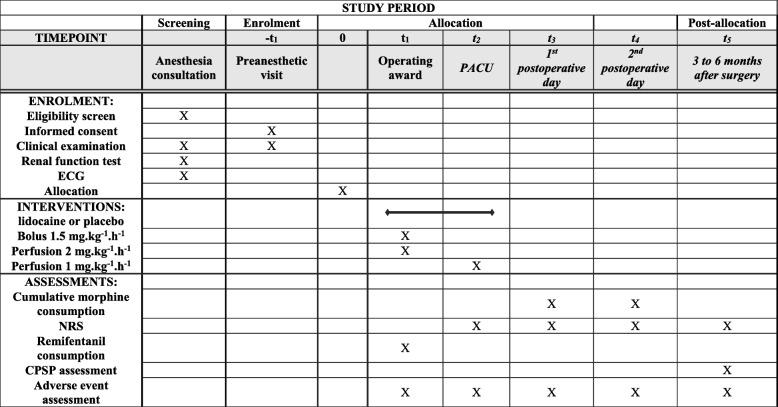
METHODS/DESIGN: A total of 128 patients undergoing major head and neck surgery will be included in this prospective two-center, double-blind, randomized controlled trial. Patients will be randomly assigned to lidocaine or placebo treatment. After induction of general anesthesia, an intravenous lidocaine bolus will be administered (1.5 mg.kg), followed by a continuous infusion (2 mg.kg.h) which will be reduced in the postanesthesia care unit (1 mg.kg.h). The primary outcome measure is morphine consumption 48 h after surgery. The secondary outcomes include intraoperative remifentanil consumption, morphine consumption 24 h after surgery, and chronic postsurgical pain that will be assessed 3-6 months after surgery.
DISCUSSION
Recent evidence suggests that intravenous lidocaine can lead to opioid sparing and chronic postsurgical pain reduction for certain types of surgery. This is the first trial to prospectively investigate the efficacy and safety of intravenous lidocaine in major head and neck cancer surgery.
TRIAL REGISTRATION
ClinicalTrials.gov, NCT02894710 . Registered on 11 August 2016.
背景
头颈部癌症手术后的疼痛被低估了,其具有伤害感受和神经病理性特征。广泛切除、皮瓣覆盖、神经损伤、炎症和大剂量阿片类药物的应用也可导致痛觉过敏和慢性术后疼痛。阿片类药物常伴有不良反应,如头晕、嗜睡、恶心和呕吐或便秘,这会干扰术后恢复并延长住院时间。适合进行头颈部癌症大手术的患者无法从局部麻醉的多模式全面疼痛管理中获益。几项研究调查了静脉注射利多卡因,发现其可减轻急性疼痛和吗啡用量。一些数据还表明它可以预防慢性术后疼痛。支持其应用的证据因手术类型而异,尚无关于头颈部癌症大手术中全身给予利多卡因的研究发表。我们假设围手术期静脉内给予利多卡因可减少阿片类药物的使用并减轻慢性术后疼痛。
方法/设计:本前瞻性、双盲、随机对照试验共纳入 128 例接受头颈部大手术的患者。患者将被随机分配至利多卡因或安慰剂治疗组。全麻诱导后,给予静脉注射利多卡因负荷剂量(1.5mg/kg),然后以 2mg/kg/h 的速度持续输注,在麻醉后恢复室(PACU)将剂量减少至 1mg/kg/h。主要结局测量指标为术后 48 小时吗啡用量。次要结局指标包括术中瑞芬太尼用量、术后 24 小时吗啡用量和术后 3-6 个月评估的慢性术后疼痛。
讨论
最近的证据表明,静脉内给予利多卡因可减少某些类型手术的阿片类药物用量和慢性术后疼痛。这是首个前瞻性研究静脉内给予利多卡因对头颈部癌症大手术疗效和安全性的试验。
试验注册
ClinicalTrials.gov,NCT02894710。于 2016 年 8 月 11 日注册。

 Zotero 插件