
随机因素对呼吸道病毒共感染动力学的影响。
Effect of stochasticity on coinfection dynamics of respiratory viruses.
机构信息
Department of Physics & Astronomy, Texas Christian University, Fort Worth, TX, USA.
Department of Pediatrics, University of Tennessee Health Science Center, Memphis, TN, USA.
出版信息
BMC Bioinformatics. 2019 Apr 16;20(1):191. doi: 10.1186/s12859-019-2793-6.
BACKGROUND
Respiratory viral infections are a leading cause of mortality worldwide. As many as 40% of patients hospitalized with influenza-like illness are reported to be infected with more than one type of virus. However, it is not clear whether these infections are more severe than single viral infections. Mathematical models can be used to help us understand the dynamics of respiratory viral coinfections and their impact on the severity of the illness. Most models of viral infections use ordinary differential equations (ODE) that reproduce the average behavior of the infection, however, they might be inaccurate in predicting certain events because of the stochastic nature of viral replication cycle. Stochastic simulations of single virus infections have shown that there is an extinction probability that depends on the size of the initial viral inoculum and parameters that describe virus-cell interactions. Thus the coinfection dynamics predicted by the ODE might be difficult to observe in reality.
RESULTS
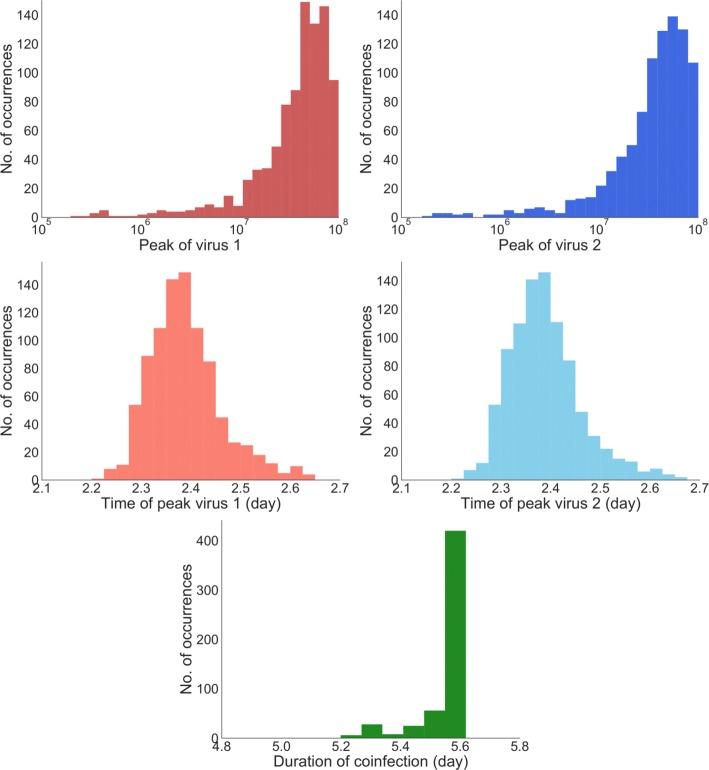
In this work, a continuous-time Markov chain (CTMC) model is formulated to investigate probabilistic outcomes of coinfections. This CTMC model is based on our previous coinfection model, expressed in terms of a system of ordinary differential equations. Using the Gillespie method for stochastic simulation, we examine whether stochastic effects early in the infection can alter which virus dominates the infection.
CONCLUSIONS
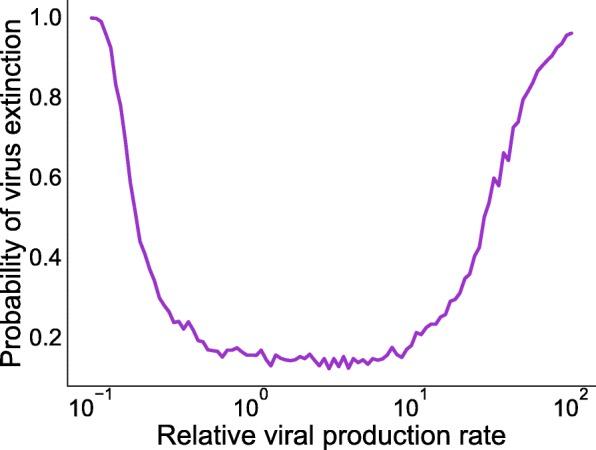
We derive extinction probabilities for each virus individually as well as for the infection as a whole. We find that unlike the prediction of the ODE model, for similar initial growth rates stochasticity allows for a slower growing virus to out-compete a faster growing virus.
背景
呼吸道病毒感染是全球范围内导致死亡的主要原因。据报道,多达 40%的流感样疾病住院患者感染了一种以上的病毒。然而,目前尚不清楚这些感染是否比单一病毒感染更为严重。数学模型可用于帮助我们了解呼吸道病毒混合感染的动态及其对疾病严重程度的影响。大多数病毒感染模型使用常微分方程(ODE)来再现感染的平均行为,但由于病毒复制周期的随机性,它们在预测某些事件时可能不够准确。对单一病毒感染的随机模拟表明,存在一个灭绝概率,该概率取决于初始病毒接种物的大小以及描述病毒-细胞相互作用的参数。因此,ODE 预测的混合感染动力学在现实中可能难以观察到。
结果
在这项工作中,我们制定了一个连续时间马尔可夫链(CTMC)模型来研究混合感染的概率结果。该 CTMC 模型基于我们之前的混合感染模型,用常微分方程系统表示。使用 Gillespie 方法进行随机模拟,我们研究了感染早期的随机效应对哪种病毒占主导地位的影响。
结论
我们推导出了每个病毒以及整个感染的灭绝概率。我们发现,与 ODE 模型的预测不同,对于相似的初始增长率,随机性允许生长较慢的病毒胜过生长较快的病毒。




 Zotero 插件