
动物寿命的差异:异质性和随机性的影响
Variance in animal longevity: contributions of heterogeneity and stochasticity.
作者信息
Hartemink Nienke, Caswell Hal
机构信息
Institute for Biodiversity and Ecosystem Dynamics, University of Amsterdam, P.O. Box 94248, 1090 GE Amsterdam, The Netherlands.
出版信息
Popul Ecol. 2018;60(1):89-99. doi: 10.1007/s10144-018-0616-7. Epub 2018 May 28.
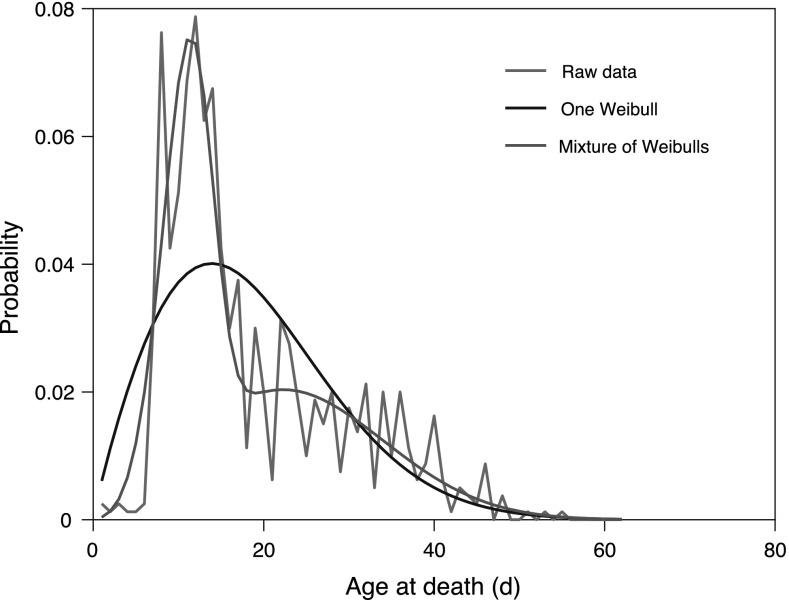
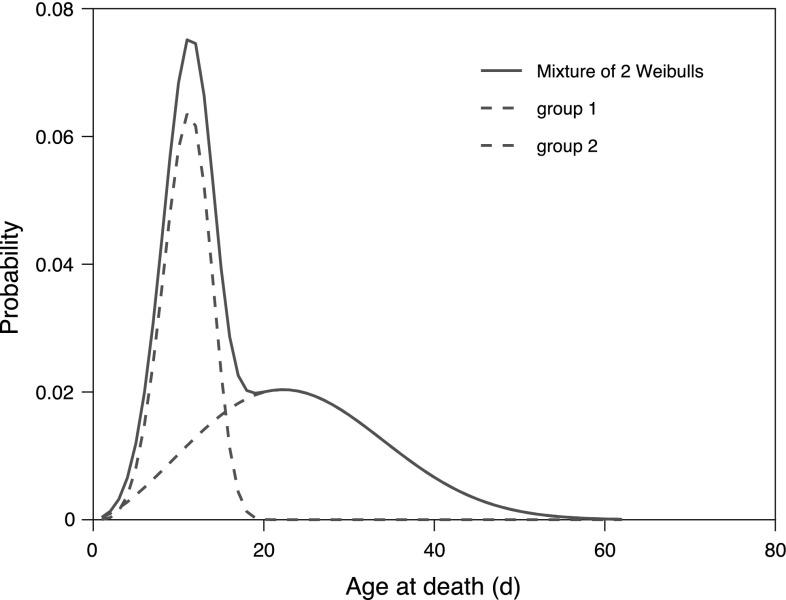
Variance in longevity among individuals may arise as an effect of heterogeneity (differences in mortality rates experienced at the same age or stage) or as an effect of individual stochasticity (the outcome of random demographic events during the life cycle). Decomposing the variance into components due to heterogeneity and stochasticity is crucial for evolutionary analyses.In this study, we analyze longevity from ten studies of invertebrates in the laboratory, and use the results to partition the variance in longevity into its components. To do so, we fit finite mixtures of Weibull survival functions to each data set by maximum likelihood, using the EM algorithm. We used the Bayesian Information Criterion to select the most well supported model. The results of the mixture analysis were used to construct an age × stage-classified matrix model, with heterogeneity groups as stages, from which we calculated the variance in longevity and its components. Almost all data sets revealed evidence of some degree of heterogeneity. The median contribution of unobserved heterogeneity to the total variance was 35%, with the remaining 65% due to stochasticity. The differences among groups in mean longevity were typically on the order of 30% of the overall life expectancy. There was considerable variation among data sets in both the magnitude of heterogeneity and the proportion of variance due to heterogeneity, but no clear patterns were apparent in relation to sex, taxon, or environmental conditions.
个体间寿命的差异可能源于异质性(相同年龄或阶段经历的死亡率差异)或个体随机性(生命周期中随机人口事件的结果)。将方差分解为异质性和随机性导致的成分对于进化分析至关重要。在本研究中,我们分析了来自十项实验室无脊椎动物研究的寿命,并利用结果将寿命方差划分为其组成部分。为此,我们使用期望最大化(EM)算法通过最大似然法将威布尔生存函数的有限混合拟合到每个数据集。我们使用贝叶斯信息准则来选择最受支持的模型。混合分析的结果用于构建一个年龄×阶段分类的矩阵模型,将异质性组作为阶段,从中我们计算了寿命方差及其组成部分。几乎所有数据集都显示出一定程度异质性的证据。未观察到的异质性对总方差的中位数贡献为35%,其余65%归因于随机性。组间平均寿命的差异通常约为总体预期寿命的30%。在异质性的大小和异质性导致的方差比例方面,数据集之间存在相当大的差异,但在性别、分类群或环境条件方面没有明显的模式。

 Zotero 插件