
罗萨达-多夫曼病的临床病理特征、治疗方法和结局。
Clinicopathological features, treatment approaches, and outcomes in Rosai-Dorfman disease.
机构信息
Division of Hematology, Mayo Clinic, Rochester, MN
Department of Laboratory Medicine and Pathology, Mayo Clinic, Rochester, MN.
出版信息
Haematologica. 2020 Jan 31;105(2):348-357. doi: 10.3324/haematol.2019.219626. Print 2020.
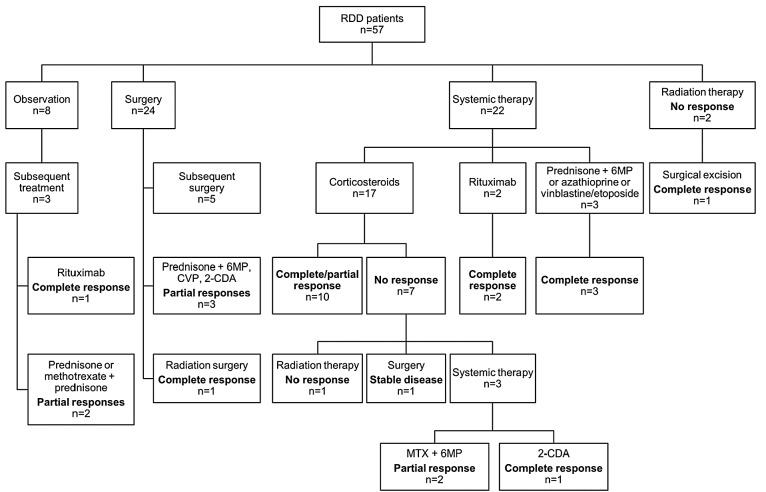
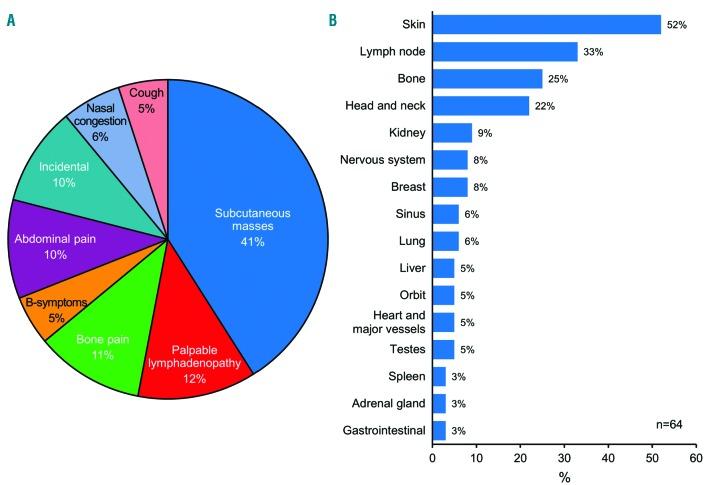
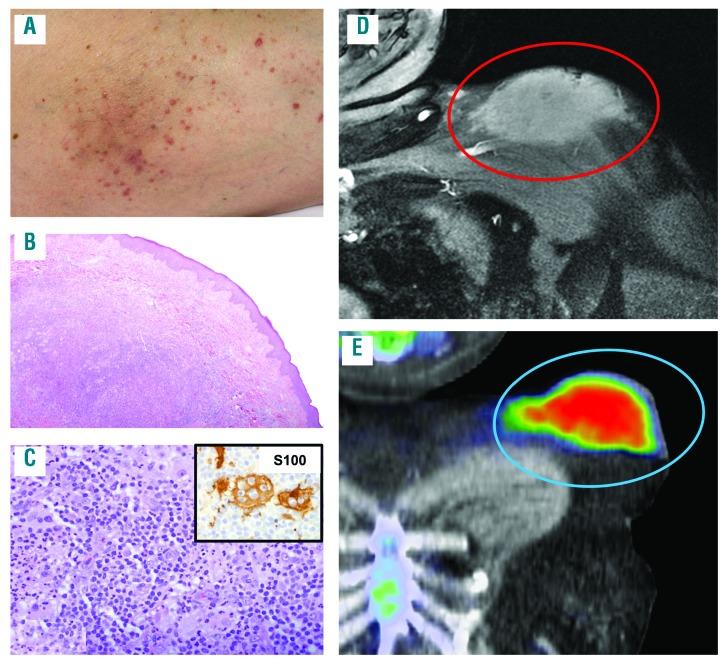
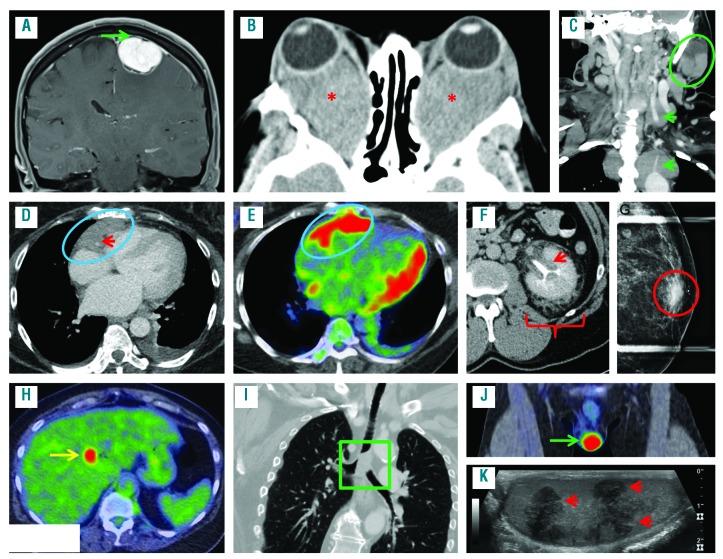
Rosai-Dorfman disease is a rare subtype of non-Langerhans cell histiocytosis. With the last major report published in 1990, there is a paucity of contemporary data on this disease. Our objective was to report the clinicopathological features, treatments and outcomes of patients seen at a tertiary referral center. Sixty-four patients with histopathological diagnosis of Rosai-Dorfman disease were identified from 1994 to 2017 (median age 50 years; range, 2-79). The median duration from symptom onset to diagnosis was seven months (range, 0-128), which was also reflected in the number of biopsies required to establish the diagnosis (median 2; range, 1-6). The most common presentation was subcutaneous masses (40%). Of the 64 patients, 8% had classical (nodal only) and 92% had extra-nodal disease (67% extra-nodal only). The most common organs involved were skin and subcutaneous tissue (52%), followed by lymph nodes (33%). Three patients had an overlap with Erdheim-Chester disease, which had not been described before. Two of these were found to have MAP2K1 mutations. Commonly utilized first line treatments were surgical excision (38%) and systemic corticosteroids (27%). Corticosteroids led to a response in 56% of the cases. Of those treated initially, 15 (30%) patients developed recurrent disease. The most commonly used systemic agent was cladribine (n=6), with 67% overall response rate. Our study demonstrates that Rosai-Dorfman disease has diverse clinical manifestations and outcomes. While this disease has been historically considered a benign entity, a subset of patients endures an aggressive course necessitating the use of systemic therapies.
罗道氏病(Rosai-Dorfman disease)是一种罕见的非朗格汉斯细胞组织细胞增生症的亚型。自 1990 年发表的最后一份主要报告以来,关于这种疾病的当代数据很少。我们的目的是报告在一个三级转诊中心就诊的患者的临床病理特征、治疗方法和结果。1994 年至 2017 年期间,从组织病理学诊断为罗道氏病的 64 名患者中确定(中位年龄 50 岁;范围,2-79)。从症状出现到诊断的中位时间为 7 个月(范围,0-128),这也反映了建立诊断所需的活检次数(中位数 2;范围,1-6)。最常见的表现是皮下肿块(40%)。64 名患者中,8%为经典(仅淋巴结),92%为结外疾病(67%仅结外)。最常见受累的器官是皮肤和皮下组织(52%),其次是淋巴结(33%)。有 3 例与之前未描述过的 Erdheim-Chester 病重叠。其中 2 例被发现有 MAP2K1 突变。常用的一线治疗方法是手术切除(38%)和全身皮质类固醇(27%)。皮质类固醇治疗使 56%的病例得到缓解。在最初接受治疗的患者中,15 例(30%)患者出现疾病复发。最常用的系统药物是克拉屈滨(n=6),总缓解率为 67%。我们的研究表明,罗道氏病的临床表现和结局多种多样。虽然这种疾病历史上被认为是良性实体,但一部分患者会经历侵袭性病程,需要使用系统治疗。


 Zotero 插件