
链脲佐菌素诱导糖尿病小鼠糖尿病膀胱功能障碍的时相功能性、形态学和分子变化。
Time-dependent functional, morphological, and molecular changes in diabetic bladder dysfunction in streptozotocin-induced diabetic mice.
机构信息
Department of pharmacology of Chinese Medicine, School of Pharmaceutical Sciences, Guangzhou University of Chinese Medicine, Guangzhou, China.
School of Basic Medical Sciences, Guangzhou University of Chinese Medicine, Guangzhou, China.
出版信息
Neurourol Urodyn. 2019 Jun;38(5):1266-1277. doi: 10.1002/nau.24008. Epub 2019 Apr 20.
AIM
Diabetic bladder dysfunction (DBD) is one of the most common and bothersome complications of diabetes mellitus (DM). This study aimed to investigate the functional, structural, and molecular changes of the bladder at 0, 3, 6, 9, and 12 weeks after DM induction by streptozotocin (STZ) in male C57BL/6 mice.
METHODS
Male C57BL/6J mice were injected with STZ (130 mg/kg). Then, diabetic general characteristics, cystometry test, histomorphometry, and contractile responses to α, β-methylene ATP, KCl, electrical-field stimulation, carbachol were performed at 0, 3, 6, 9, and 12 weeks after induction. Finally, protein and messenger RNA (mRNA) expressions of myosin Va and SLC17A9 were quantified.
RESULTS
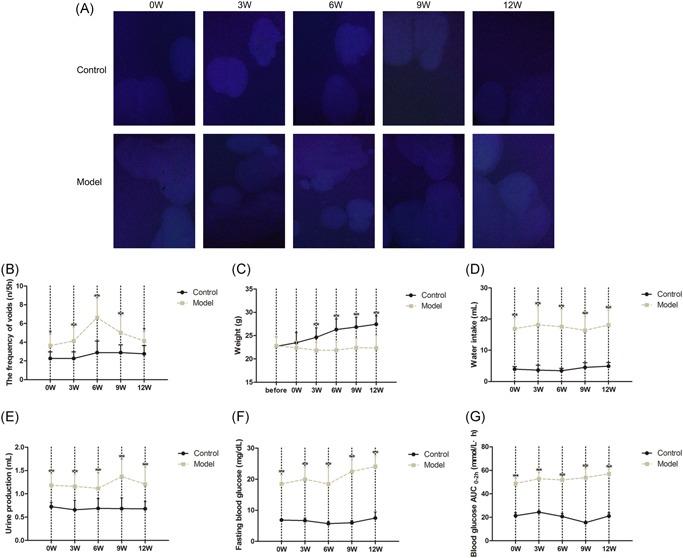
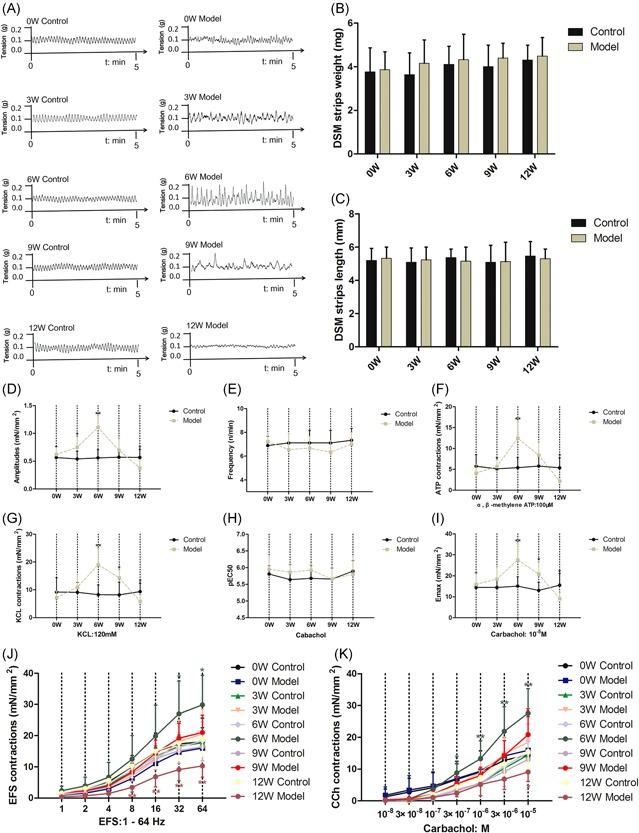
DM mice exhibited lower body weight, voiding efficiency and higher water intake, urine production, fasting blood glucose, oral glucose tolerance test, bladder wall thickness, maximum bladder capacity, residual volume, bladder compliance. In particular, nonvoiding contractions has increased more than five times at 6 weeks. And the amplitudes of spontaneous activity, contractile responses to all stimulus was about two times higher at 6 weeks but cut almost in half at 12 weeks. The protein and mRNA expressions of myosin Va and SLC17A9 were about two times higher at 6 weeks, but myosin Va was reverted nearly 40% while SLC17A9 is still higher at 12 weeks.
CONCLUSIONS
DBD transitioned from a compensated state to a decompensated state in STZ-induced DM mice at 9 to 12 weeks after DM induction. Our molecular data suggest that the transition may be closely related to the alterations of myosin Va and SLC17A9 expression levels in the bladder with time.
目的
糖尿病膀胱功能障碍(DBD)是糖尿病(DM)最常见和最麻烦的并发症之一。本研究旨在通过链脲佐菌素(STZ)诱导雄性 C57BL/6 小鼠 DM 后 0、3、6、9 和 12 周,研究膀胱的功能、结构和分子变化。
方法
雄性 C57BL/6J 小鼠注射 STZ(130mg/kg)。然后,在诱导后 0、3、6、9 和 12 周进行糖尿病一般特征、膀胱测压试验、组织形态计量学和对α、β-亚甲基 ATP、KCl、电刺激、卡巴胆碱的收缩反应。最后,定量肌球蛋白 Va 和 SLC17A9 的蛋白和信使 RNA(mRNA)表达。
结果
DM 小鼠表现出较低的体重、排尿效率和较高的饮水量、尿量、空腹血糖、口服糖耐量试验、膀胱壁厚度、最大膀胱容量、残余尿量、膀胱顺应性。特别是,在 6 周时非排尿收缩增加了五倍以上。而自发性活动的幅度、对所有刺激的收缩反应在 6 周时增加了约两倍,但在 12 周时几乎减半。肌球蛋白 Va 和 SLC17A9 的蛋白和 mRNA 表达在 6 周时增加了约两倍,但肌球蛋白 Va 在 12 周时几乎恢复了 40%,而 SLC17A9 仍较高。
结论
在 STZ 诱导的 DM 小鼠中,DBD 在 DM 诱导后 9 至 12 周从代偿状态转变为失代偿状态。我们的分子数据表明,这种转变可能与膀胱中肌球蛋白 Va 和 SLC17A9 表达水平随时间的变化密切相关。



 Zotero 插件