
肉类、鱼类、奶制品和蛋类的消费与缺血性心脏病风险。
Consumption of Meat, Fish, Dairy Products, and Eggs and Risk of Ischemic Heart Disease.
机构信息
Nuffield Department of Population Health, University of Oxford, United Kingdom (T.J.K., P.N.A., K.E.B.).
National Institute for Health Innovation, School of Population Health, University of Auckland, New Zealand (K.E.B.).
出版信息
Circulation. 2019 Jun 18;139(25):2835-2845. doi: 10.1161/CIRCULATIONAHA.118.038813. Epub 2019 Apr 22.
BACKGROUND
There is uncertainty about the relevance of animal foods to the pathogenesis of ischemic heart disease (IHD). We examined meat, fish, dairy products, and eggs and risk for IHD in the pan-European EPIC cohort (European Prospective Investigation Into Cancer and Nutrition).
METHODS
In this prospective study of 409 885 men and women in 9 European countries, diet was assessed with validated questionnaires and calibrated with 24-hour recalls. Lipids and blood pressure were measured in a subsample. During a mean of 12.6 years of follow-up, 7198 participants had a myocardial infarction or died of IHD. The relationships of animal foods with risk were examined with Cox regression with adjustment for other animal foods and relevant covariates.
RESULTS
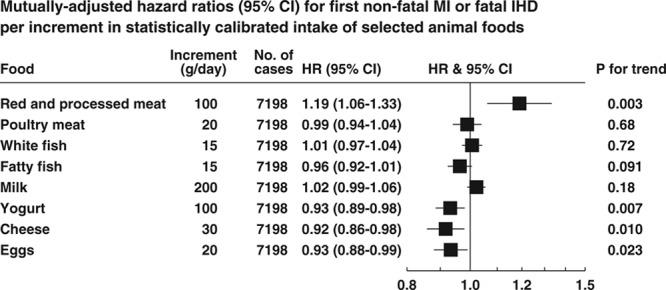
The hazard ratio (HR) for IHD was 1.19 (95% CI, 1.06-1.33) for a 100-g/d increment in intake of red and processed meat, and this remained significant after exclusion of the first 4 years of follow-up (HR, 1.25 [95% CI, 1.09-1.42]). Risk was inversely associated with intakes of yogurt (HR, 0.93 [95% CI, 0.89-0.98] per 100-g/d increment), cheese (HR, 0.92 [95% CI, 0.86-0.98] per 30-g/d increment), and eggs (HR, 0.93 [95% CI, 0.88-0.99] per 20-g/d increment); the associations with yogurt and eggs were attenuated and nonsignificant after exclusion of the first 4 years of follow-up. Risk was not significantly associated with intakes of poultry, fish, or milk. In analyses modeling dietary substitutions, replacement of 100 kcal/d from red and processed meat with 100 kcal/d from fatty fish, yogurt, cheese, or eggs was associated with ≈20% lower risk of IHD. Consumption of red and processed meat was positively associated with serum non-high-density lipoprotein cholesterol concentration and systolic blood pressure, and consumption of cheese was inversely associated with serum non-high-density lipoprotein cholesterol.
CONCLUSIONS
Risk for IHD was positively associated with consumption of red and processed meat and inversely associated with consumption of yogurt, cheese, and eggs, although the associations with yogurt and eggs may be influenced by reverse causation bias. It is not clear whether the associations with red and processed meat and cheese reflect causality, but they were consistent with the associations of these foods with plasma non-high-density lipoprotein cholesterol and for red and processed meat with systolic blood pressure, which could mediate such effects.
背景
动物食品与缺血性心脏病(IHD)发病机制的相关性尚不确定。我们在泛欧 EPIC 队列(欧洲癌症前瞻性调查和营养)中检查了肉类、鱼类、奶制品和鸡蛋与 IHD 的风险。
方法
在这项对 9 个欧洲国家的 409885 名男性和女性的前瞻性研究中,饮食通过经过验证的问卷进行评估,并通过 24 小时回忆进行校准。在一个亚组中测量血脂和血压。在平均 12.6 年的随访期间,7198 名参与者发生心肌梗死或死于 IHD。用 Cox 回归检查动物食品与风险的关系,调整其他动物食品和相关协变量。
结果
每增加 100 克/天的红肉和加工肉,IHD 的风险比(HR)为 1.19(95%CI,1.06-1.33),在前 4 年随访排除后,这一结果仍然显著(HR,1.25 [95%CI,1.09-1.42])。酸奶(每增加 100 克/天,HR 为 0.93 [95%CI,0.89-0.98])、奶酪(每增加 30 克/天,HR 为 0.92 [95%CI,0.86-0.98])和鸡蛋(每增加 20 克/天,HR 为 0.93 [95%CI,0.88-0.99])摄入量与风险呈负相关;在前 4 年随访排除后,与酸奶和鸡蛋的关联减弱且无统计学意义。禽类、鱼类或牛奶的摄入量与风险无显著相关性。在饮食替代模型分析中,用 100 千卡/天的高脂肪鱼类、酸奶、奶酪或鸡蛋替代 100 千卡/天的红肉和加工肉,与 IHD 风险降低约 20%相关。红肉和加工肉的摄入量与血清非高密度脂蛋白胆固醇浓度和收缩压呈正相关,而奶酪的摄入量与血清非高密度脂蛋白胆固醇浓度呈负相关。
结论
IHD 的风险与红肉和加工肉的摄入呈正相关,与酸奶、奶酪和鸡蛋的摄入呈负相关,尽管与酸奶和鸡蛋的关联可能受到反向因果关系偏倚的影响。红肉和加工肉以及奶酪与 IHD 之间的关联是否反映因果关系尚不清楚,但它们与这些食物与血浆非高密度脂蛋白胆固醇的关联一致,与红肉和加工肉与收缩压的关联一致,这些关联可能介导了这些效应。
 Zotero 插件