
放射性肺炎和免疫检查点抑制剂相关肺炎的临床表现、影像学表现和循环生物标志物具有特征性。
Pneumonitis resulting from radiation and immune checkpoint blockade illustrates characteristic clinical, radiologic and circulating biomarker features.
机构信息
Brigham and Women's Hospital, Dana-Farber Cancer Institute, 450 Brookline Ave, Boston, MA, 02215-5450, USA.
Dana-Farber Cancer Institute, Boston, MA, USA.
出版信息
J Immunother Cancer. 2019 Apr 24;7(1):112. doi: 10.1186/s40425-019-0583-3.
BACKGROUND
Pneumonitis is a potential consequence of both lung-directed radiation and immune checkpoint blockade (ICB), particularly treatment with PD-1/PD-L1 inhibitors. Significant morbidity and mortality can result, and severe pneumonitis attributed to ICB precludes continued therapy. Thus, discriminating between radiation- and ICB- related pneumonitis is of importance for the increasing number of patients receiving both treatments. Furthermore, data are limited regarding the interplay between radiation- and ICB-induced lung injury, and which biomarkers might be associated with toxicity.
CASE PRESENTATION
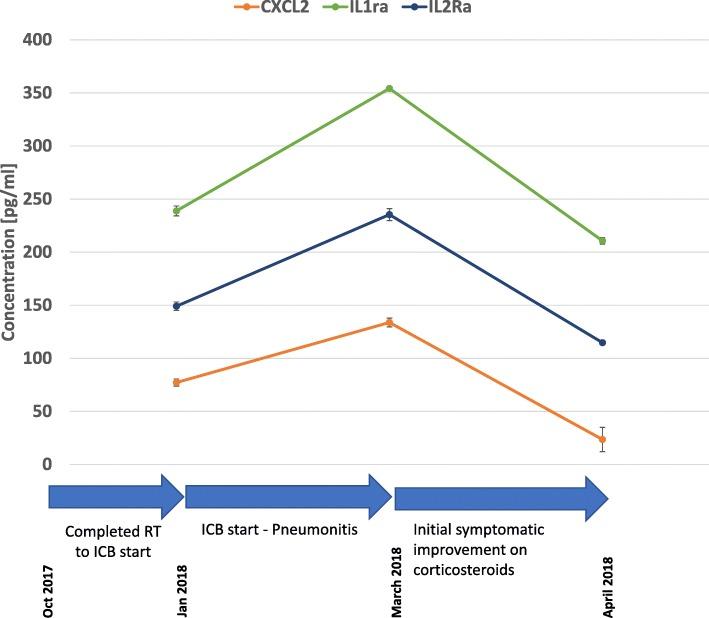
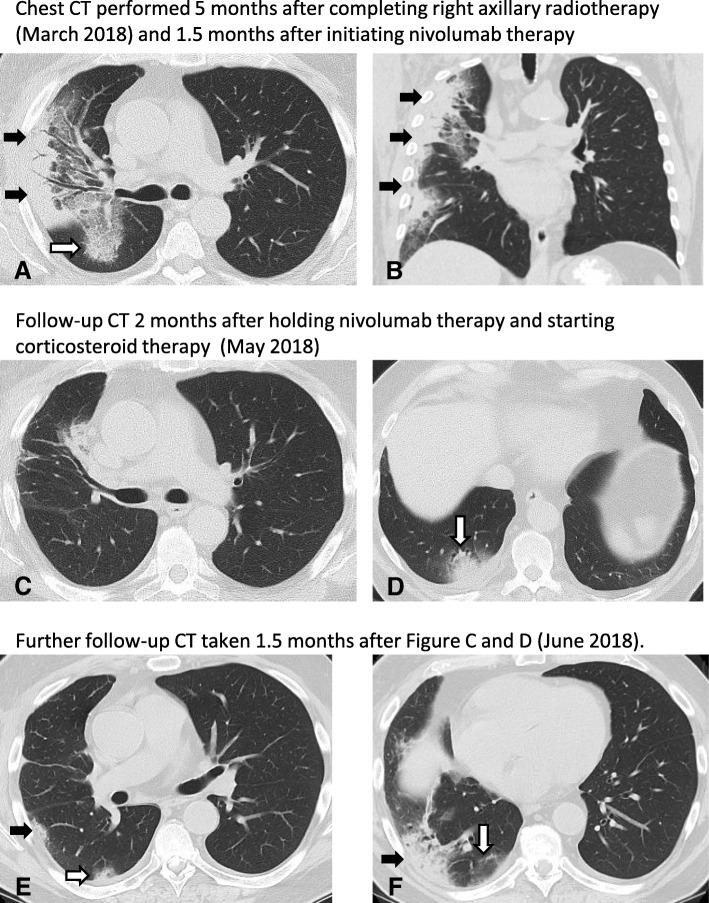
We report longitudinal clinical and radiologic data, and circulating biomarkers in a melanoma patient treated with axillary radiation followed by ICB who developed consolidation and ground glass opacities (GGO) within the radiation field suggestive of radiation-pneumonitis followed by consolidation outside of the radiation field suggestive of ICB-related pneumonitis. Of note, symptomatic radiation-pneumonitis developed despite a low radiation dose to the lung (V20 < 8%), and ICB-related pneumonitis was limited to the ipsilateral lung, suggesting additive effect of radiation and ICB in the development of lung injury. Circulating biomarker analyses demonstrated increases in CXCR2, IL1ra and IL2ra that coincided with the development of symptomatic pneumonitis.
CONCLUSIONS
These data highlight the imaging findings associated with radiation and ICB-related lung toxicity, and anecdotally describe a clinical course with circulating biomarker correlates. This information can help guide clinical evaluation and future research investigations into the toxicity of combined radiation immunotherapy approaches.
背景
肺炎是肺部放射治疗和免疫检查点阻断(ICB)的潜在后果,特别是使用 PD-1/PD-L1 抑制剂治疗时。这可能导致严重的发病率和死亡率,而归因于 ICB 的严重肺炎会妨碍继续治疗。因此,区分放射性和 ICB 相关肺炎对于越来越多接受这两种治疗的患者具有重要意义。此外,关于放射性和 ICB 诱导的肺损伤之间的相互作用以及哪些生物标志物可能与毒性相关的数据有限。
病例介绍
我们报告了一名接受腋窝放疗后接受 ICB 治疗的黑色素瘤患者的纵向临床和影像学数据以及循环生物标志物,该患者在放射野内出现实变和磨玻璃影(GGO),提示放射性肺炎,随后在放射野外出现实变,提示 ICB 相关肺炎。值得注意的是,尽管肺接受的辐射剂量较低(V20<8%),但仍出现症状性放射性肺炎,并且 ICB 相关肺炎仅限于同侧肺,这表明放射性和 ICB 在肺损伤发展中具有相加作用。循环生物标志物分析显示,CXCR2、IL1ra 和 IL2ra 的增加与症状性肺炎的发生同时发生。
结论
这些数据突出了与放射性和 ICB 相关肺毒性相关的影像学发现,并描述了一种具有循环生物标志物相关性的临床过程。这些信息可以帮助指导联合放射免疫治疗方法的毒性的临床评估和未来研究调查。

 Zotero 插件