
一期转换带至腹腔镜袖状胃切除术并发症发生率的降低:一项回顾性队列研究。
Decreasing complication rates for one-stage conversion band to laparoscopic sleeve gastrectomy: A retrospective cohort study.
作者信息
Garneau Pierre Y, Abouzahr Omar, Garofalo Fabio, AlEnazi Naif, Bacon Simon L, Denis Ronald, Pescarus Radu, Atlas Henri
机构信息
Department of Surgery, Division of Bariatric Surgery, Sacré-Coeur Hospital of Montreal, University of Montreal, Québec H4J 1C5, Canada.
Montreal Behavioural Medicine Centre, Sacré-Coeur Hospital of Montreal, University of Montreal, 5400 boul. Gouin Ouest Montréal, Québec H4J 1C5, Canada.
出版信息
J Minim Access Surg. 2020 Jul-Sep;16(3):264-268. doi: 10.4103/jmas.JMAS_86_18.
BACKGROUND
Laparoscopic adjustable gastric banding (LAGB) revision surgery is often necessary because of its high failure rate. The objective of this study was to demonstrate that better patient selection, when converting a failed LAGB to a laparoscopic sleeve gastrectomy (LSG) as a one-stage revision procedure, is safe, feasible and improves the complication rate.
PATIENTS AND METHODS
A retrospective chart review was performed on patients who underwent a one-stage conversion of failed gastric banding to a LSG. Collected data included age, sex, body mass index (BMI), intraoperative complications, length of stay and post-operative complications. The results were compared to a previous study of 90 cases of LSG as a revision procedure for failed LAGB.
RESULTS
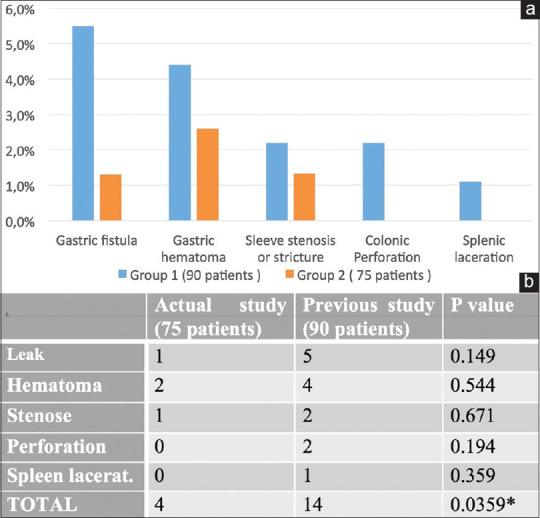
There were 75 patients in the current study, 61 women and 14 men, aged 25-67 (average: 46), with a mean BMI of 45 kg/m (32-66). Seventy patients (93.3%) were operated for insufficient weight loss and 5 patients (6.7%) for intolerance to the band. In our previous study, 35 patients (39%) were operated for slippage, erosion or obstruction and 14 (15.6%) had post-operative complications as opposed to only 4 patients (5.3%) in this series (P = 0.0359). Gastric leak also improved to 1.3% compared to 5.5% previously. Average hospitalisation time was 2.5 days (1-40).
CONCLUSIONS
Rigorous patient selection, without band complications such as slippage, erosion or obstruction, allows for a significantly lower rate of operative complications for a one-stage conversion of failed gastric banding to a LSG.
背景
由于腹腔镜可调节胃束带术(LAGB)失败率较高,因此通常需要进行翻修手术。本研究的目的是证明,在将失败的LAGB转换为腹腔镜袖状胃切除术(LSG)作为一期翻修手术时,更好的患者选择是安全可行的,并且可以降低并发症发生率。
患者与方法
对接受一期将失败的胃束带术转换为LSG的患者进行回顾性病历审查。收集的数据包括年龄、性别、体重指数(BMI)、术中并发症、住院时间和术后并发症。将结果与之前一项针对90例将LSG作为失败LAGB翻修手术的研究进行比较。
结果
本研究中有75例患者,其中61例女性,14例男性,年龄在25至67岁之间(平均46岁),平均BMI为45kg/m²(32至66)。70例患者(93.3%)因体重减轻不足接受手术,5例患者(6.7%)因对束带不耐受接受手术。在我们之前的研究中,35例患者(39%)因滑脱、侵蚀或梗阻接受手术,14例患者(15.6%)有术后并发症,而本系列中只有4例患者(5.3%)出现术后并发症(P = 0.0359)。胃漏发生率也从之前的5.5%降至1.3%。平均住院时间为2.5天(1至40天)。
结论
严格的患者选择,避免出现如滑脱、侵蚀或梗阻等束带并发症,可使失败的胃束带术一期转换为LSG的手术并发症发生率显著降低。


 Zotero 插件