
原子精确的硫醇化氢化铜纳米团簇作为温和条件下酮类的单中心加氢催化剂
Atomically Precise, Thiolated Copper-Hydride Nanoclusters as Single-Site Hydrogenation Catalysts for Ketones in Mild Conditions.
作者信息
Sun Cunfa, Mammen Nisha, Kaappa Sami, Yuan Peng, Deng Guocheng, Zhao Chaowei, Yan Juanzhu, Malola Sami, Honkala Karoliina, Häkkinen Hannu, Teo Boon K, Zheng Nanfeng
机构信息
State Key Laboratory for Physical Chemistry of Solid Surfaces, Collaborative Innovation Center of Chemistry for Energy Materials, National & Local Joint Engineering Research Center of Preparation Technology of Nanomaterials, College of Chemistry and Chemical Engineering , Xiamen University , Xiamen 361005 , China.
出版信息
ACS Nano. 2019 May 28;13(5):5975-5986. doi: 10.1021/acsnano.9b02052. Epub 2019 May 10.
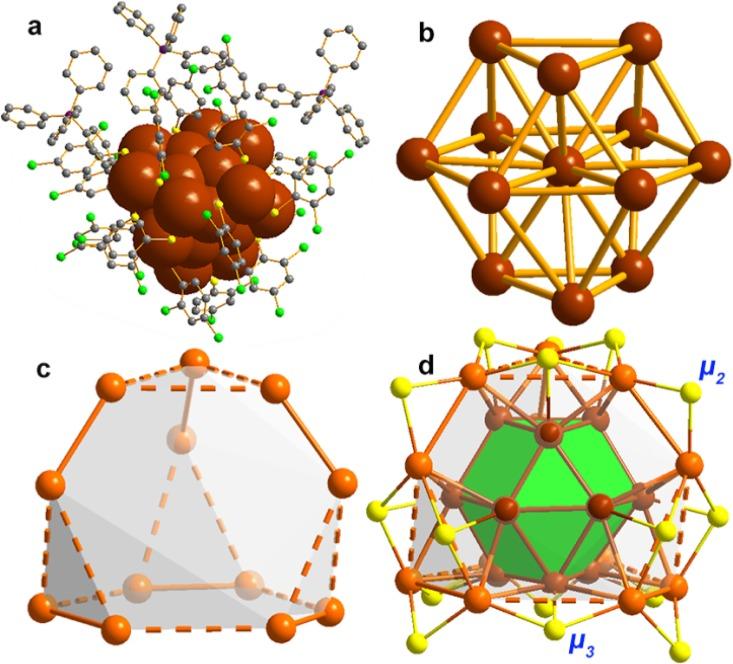
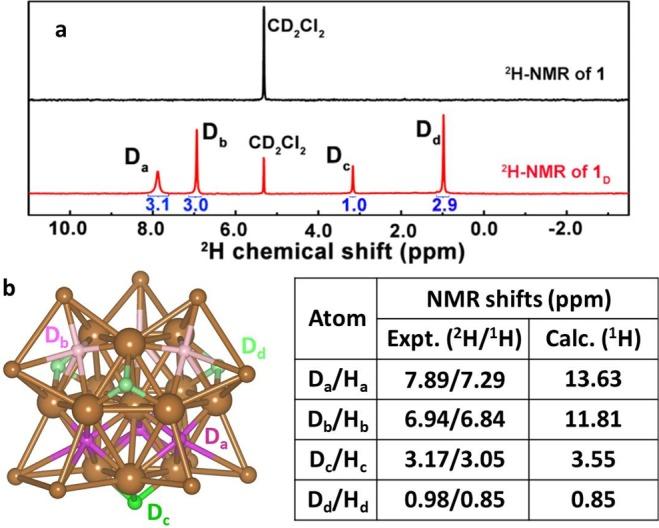
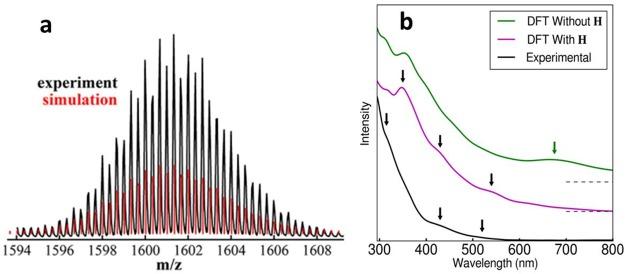
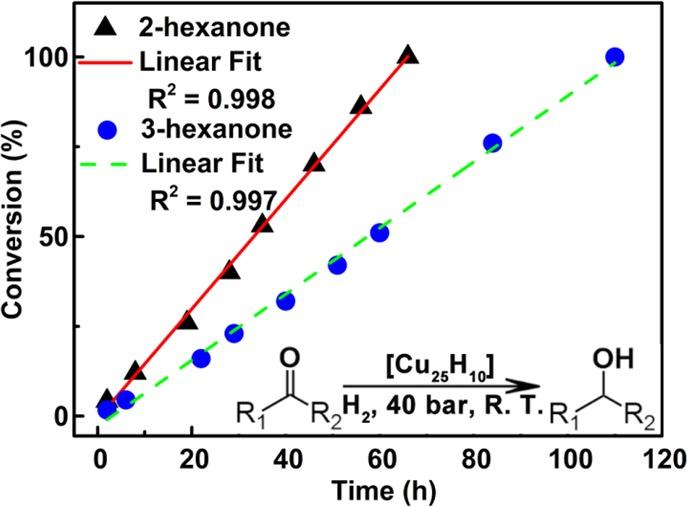
Copper-hydrides are known catalysts for several technologically important reactions such as hydrogenation of CO, hydroamination of alkenes and alkynes, and chemoselective hydrogenation of unsaturated ketones to unsaturated alcohols. Stabilizing copper-based particles by ligand chemistry to nanometer scale is an appealing route to make active catalysts with optimized material economy; however, it has been long believed that the ligand-metal interface, particularly if sulfur-containing thiols are used as stabilizing agent, may poison the catalyst. We report here a discovery of an ambient-stable thiolate-protected copper-hydride nanocluster [CuH(SPhCl)] that readily catalyzes hydrogenation of ketones to alcohols in mild conditions. A full experimental and theoretical characterization of its atomic and electronic structure shows that the 10 hydrides are instrumental for the stability of the nanocluster and are in an active role being continuously consumed and replenished in the hydrogenation reaction. Density functional theory computations suggest, backed up by the experimental evidence, that the hydrogenation takes place only around a single site of the 10 hydride locations, rendering the [CuH(SPhCl)] one of the first nanocatalysts whose structure and catalytic functions are characterized fully to atomic precision. Understanding of a working catalyst at the atomistic level helps to optimize its properties and provides fundamental insights into the controversial issue of how a stable, ligand-passivated, metal-containing nanocluster can be at the same time an active catalyst.
氢化铜是多种技术上重要反应的已知催化剂,如一氧化碳的氢化、烯烃和炔烃的氢胺化,以及将不饱和酮化学选择性氢化为不饱和醇。通过配体化学将铜基颗粒稳定到纳米尺度是制备具有优化材料经济性的活性催化剂的一条有吸引力的途径;然而,长期以来人们一直认为,配体-金属界面,特别是如果使用含硫硫醇作为稳定剂,可能会使催化剂中毒。我们在此报告发现了一种在环境条件下稳定的硫醇盐保护的氢化铜纳米团簇[CuH(SPhCl)],它在温和条件下能轻易催化酮氢化为醇。对其原子和电子结构进行的全面实验和理论表征表明,10个氢化物对纳米团簇的稳定性至关重要,并且在氢化反应中持续消耗和补充,发挥着积极作用。密度泛函理论计算表明,在实验证据的支持下,氢化仅在10个氢化物位置的单个位点周围发生,这使得[CuH(SPhCl)]成为首批其结构和催化功能被完全表征到原子精度的纳米催化剂之一。在原子水平上理解工作中的催化剂有助于优化其性能,并为关于稳定的、配体钝化的含金属纳米团簇如何同时成为活性催化剂这一有争议的问题提供基本见解。



 Zotero 插件