
预测免疫性血栓性血小板减少性紫癜复发的因素及利妥昔单抗的疗效。
Predictors of relapse and efficacy of rituximab in immune thrombotic thrombocytopenic purpura.
机构信息
Department of Medicine, Massachusetts General Hospital, Boston, MA.
Division of Hematology, Harvard Medical School, Boston, MA.
出版信息
Blood Adv. 2019 May 14;3(9):1512-1518. doi: 10.1182/bloodadvances.2019031039.
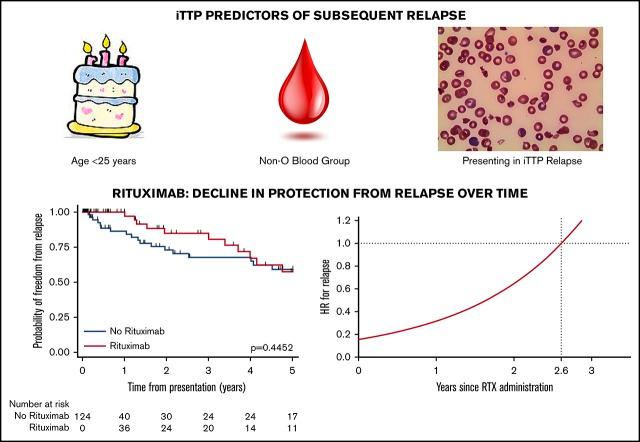
Patients with immune-mediated thrombotic thrombocytopenic purpura (iTTP) often experience life-threatening relapses of the disease, and rituximab (RTX) can be used to mitigate relapse risk. However, the predictors of relapse in iTTP and the magnitude and duration of effect of RTX remain key unanswered questions. Using a multi-institutional cohort of consecutive adult patients with iTTP, we used survival analysis to compare relapse rates between patients who received RTX during the index presentation with acute iTTP and those who did not. Of 124 patients, 60 (48%) received RTX and 34 (27%) experienced relapse. Median time to relapse was 3.71 (interquartile range, 1.75-4.9) and 1.33 (interquartile range, 0.43-2.35) years for RTX-treated and untreated patients, respectively. RTX conferred protection from relapse at 1 year of follow-up ( = .01) but not at 5 years of follow-up. Extended Cox regression was then used to identify predictors of relapse and to estimate the protective effect of RTX. The following parameters were independently associated with increased risk for subsequent relapse: presenting in iTTP relapse (hazard ratio [HR], 2.97; 95% confidence interval [CI], 1.4-6.4), age younger than 25 years (HR, 2.94; 95% CI, 1.2-7.2), and non-O blood group (HR, 2.15; 95% CI, 1.06-4.39). RTX initially provided protection from relapse (HR, 0.16; 95% CI, 0.04-0.70), but this effect gradually diminished, returning to the baseline risk for untreated patients at approximately 2.6 years. Patients who are young, have non-O blood group, or present with relapsed iTTP are at increased risk for subsequent relapse. RTX appears to confer short-term protection from relapse.
患有免疫介导性血栓性血小板减少性紫癜(iTTP)的患者常经历危及生命的疾病复发,利妥昔单抗(RTX)可用于降低复发风险。然而,iTTP 患者的复发预测因素以及 RTX 的效应幅度和持续时间仍是关键的未决问题。本研究使用多机构连续成人 iTTP 队列,通过生存分析比较了在急性 iTTP 指数发作期间接受 RTX 治疗的患者与未接受 RTX 治疗的患者的复发率。在 124 例患者中,60 例(48%)接受了 RTX 治疗,34 例(27%)发生了复发。RTX 治疗组和未治疗组的中位复发时间分别为 3.71(四分位距,1.75-4.9)和 1.33(四分位距,0.43-2.35)年。RTX 在 1 年随访时( =.01)提供了对复发的保护作用,但在 5 年随访时没有。然后使用扩展 Cox 回归来识别复发的预测因素,并估计 RTX 的保护作用。以下参数与随后的复发风险增加独立相关:iTTP 复发时就诊(危险比 [HR],2.97;95%置信区间 [CI],1.4-6.4)、年龄小于 25 岁(HR,2.94;95% CI,1.2-7.2)和非 O 血型(HR,2.15;95% CI,1.06-4.39)。RTX 最初提供了对复发的保护作用(HR,0.16;95% CI,0.04-0.70),但这种效应逐渐减弱,大约在 2.6 年后恢复为未治疗患者的基线风险。年轻、非 O 血型或有 iTTP 复发就诊的患者复发风险增加。RTX 似乎可提供短期的复发保护作用。
 Zotero 插件