
过去 25 年欧洲年轻人结直肠癌发病率不断上升。
Increasing incidence of colorectal cancer in young adults in Europe over the last 25 years.
机构信息
Gastroenterology and Hepatology, Erasmus MC University Medical Center, Rotterdam, The Netherlands.
Public Health, Erasmus MC University Medical Center, Rotterdam, The Netherlands.
出版信息
Gut. 2019 Oct;68(10):1820-1826. doi: 10.1136/gutjnl-2018-317592. Epub 2019 May 16.
OBJECTIVE
The incidence of colorectal cancer (CRC) declines among subjects aged 50 years and above. An opposite trend appears among younger adults. In Europe, data on CRC incidence among younger adults are lacking. We therefore aimed to analyse European trends in CRC incidence and mortality in subjects younger than 50 years.
DESIGN
Data on age-related CRC incidence and mortality between 1990 and 2016 were retrieved from national and regional cancer registries. Trends were analysed by Joinpoint regression and expressed as annual percent change.
RESULTS
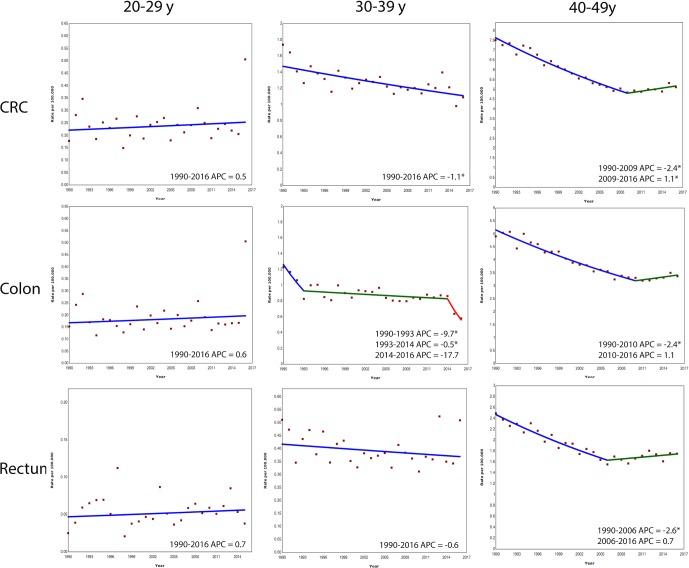
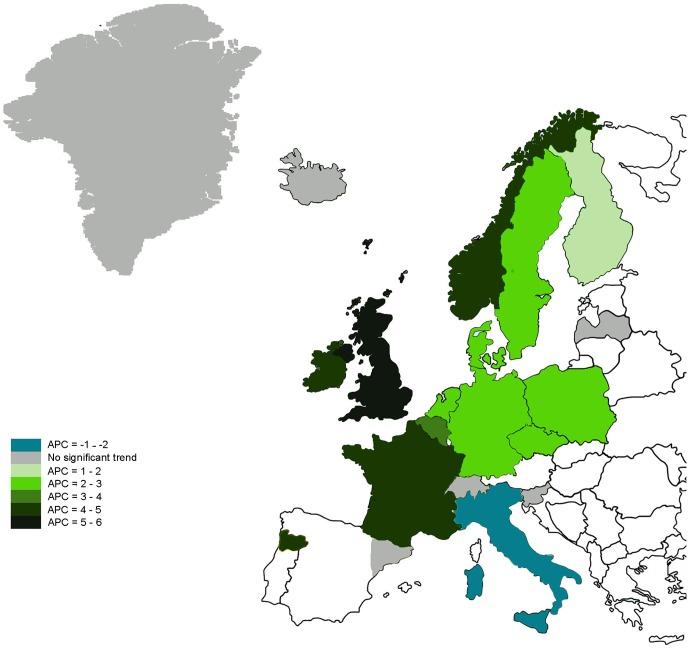
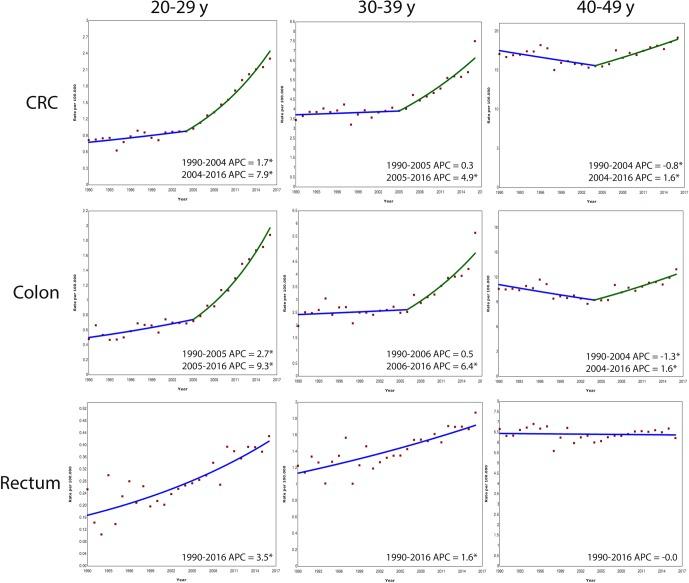
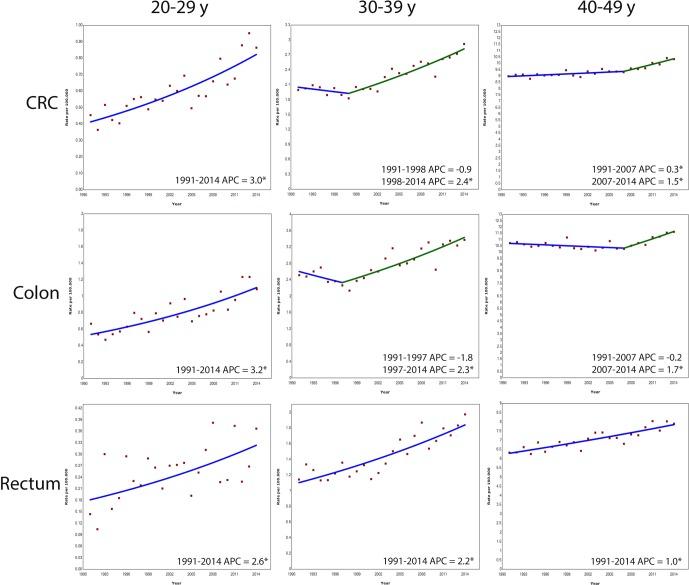
We retrieved data on 143.7 million people aged 20-49 years from 20 European countries. Of them, 187 918 (0.13%) were diagnosed with CRC. On average, CRC incidence increased with 7.9% per year among subjects aged 20-29 years from 2004 to 2016. The increase in the age group of 30-39 years was 4.9% per year from 2005 to 2016, the increase in the age group of 40-49 years was 1.6% per year from 2004 to 2016. This increase started earliest in subjects aged 20-29 years, and 10-20 years later in those aged 30-39 and 40-49 years. This is consistent with an age-cohort phenomenon. Although in most European countries the CRC incidence had risen, some heterogeneity was found between countries. CRC mortality did not significantly change among the youngest adults, but decreased with 1.1%per year between 1990 and 2016 and 2.4% per year between 1990 and 2009 among those aged 30-39 years and 40-49 years, respectively.
CONCLUSION
CRC incidence rises among young adults in Europe. The cause for this trend needs to be elucidated. Clinicians should be aware of this trend. If the trend continues, screening guidelines may need to be reconsidered.
目的
50 岁及以上人群的结直肠癌(CRC)发病率下降。而在年轻人中则出现了相反的趋势。在欧洲,缺乏有关年轻人 CRC 发病率的数据。因此,我们旨在分析欧洲 50 岁以下人群 CRC 发病率和死亡率的趋势。
设计
从国家和地区癌症登记处检索了与年龄相关的 CRC 发病率和死亡率数据。通过 Joinpoint 回归分析趋势,并以年百分比变化表示。
结果
我们从 20 个欧洲国家检索了 1437 万 20-49 岁人群的数据。其中,187918 人(0.13%)被诊断为 CRC。2004 年至 2016 年,20-29 岁人群的 CRC 发病率平均每年增加 7.9%。2005 年至 2016 年,30-39 岁人群的发病率每年增加 4.9%,2004 年至 2016 年,40-49 岁人群的发病率每年增加 1.6%。这种增长最早出现在 20-29 岁人群中,而 30-39 岁和 40-49 岁人群则分别在 10-20 年后出现。这与年龄队列现象一致。尽管在大多数欧洲国家 CRC 的发病率都有所上升,但各国之间仍存在一定的异质性。最年轻的成年人的 CRC 死亡率没有显著变化,但在 1990 年至 2016 年期间,30-39 岁和 40-49 岁人群的死亡率分别以每年 1.1%和 2.4%的速度下降。
结论
欧洲年轻人的 CRC 发病率上升。需要阐明这种趋势的原因。临床医生应该意识到这一趋势。如果这种趋势持续下去,筛查指南可能需要重新考虑。
 Zotero 插件