
肿瘤微环境中的调节性 T 细胞(Treg 细胞):Treg 细胞能否成为新的治疗靶点?
Regulatory T (Treg) cells in cancer: Can Treg cells be a new therapeutic target?
机构信息
Division of Cancer Immunology, Research Institute/Exploratory Oncology Research & Clinical Trial Center (EPOC), National Cancer Center, Tokyo, Japan.
Department of Immunology, Nagoya University Graduate School of Medicine, Nagoya, Japan.
出版信息
Cancer Sci. 2019 Jul;110(7):2080-2089. doi: 10.1111/cas.14069. Epub 2019 Jun 18.
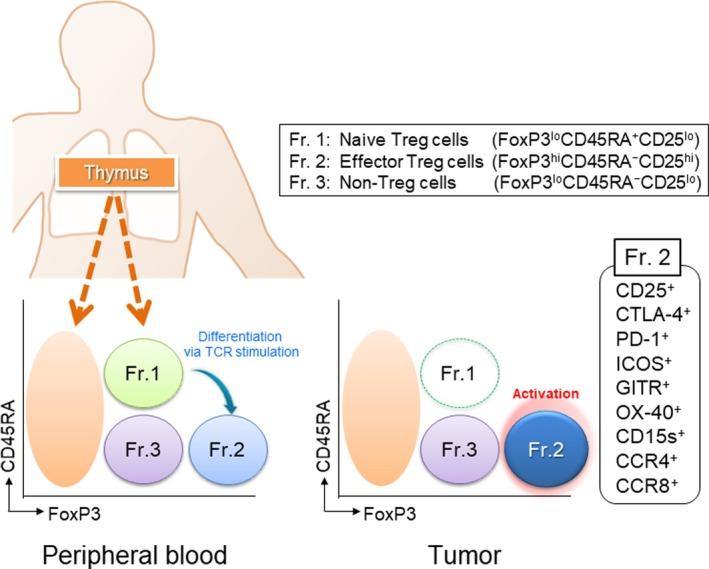
Regulatory T (Treg) cells suppress abnormal/excessive immune responses to self- and nonself-antigens to maintain immune homeostasis. In tumor immunity, Treg cells are involved in tumor development and progression by inhibiting antitumor immunity. There are several Treg cell immune suppressive mechanisms: inhibition of costimulatory signals by CD80 and CD86 expressed by dendritic cells through cytotoxic T-lymphocyte antigen-4, interleukin (IL)-2 consumption by high-affinity IL-2 receptors with high CD25 (IL-2 receptor α-chain) expression, secretion of inhibitory cytokines, metabolic modulation of tryptophan and adenosine, and direct killing of effector T cells. Infiltration of Treg cells into the tumor microenvironment (TME) occurs in multiple murine and human tumors. Regulatory T cells are chemoattracted to the TME by chemokine gradients such as CCR4-CCL17/22, CCR8-CCL1, CCR10-CCL28, and CXCR3-CCL9/10/11. Regulatory T cells are then activated and inhibit antitumor immune responses. A high infiltration by Treg cells is associated with poor survival in various types of cancer. Therefore, strategies to deplete Treg cells and control of Treg cell functions to increase antitumor immune responses are urgently required in the cancer immunotherapy field. Various molecules that are highly expressed by Treg cells, such as immune checkpoint molecules, chemokine receptors, and metabolites, have been targeted by Abs or small molecules, but additional strategies are needed to fine-tune and optimize for augmenting antitumor effects restricted in the TME while avoiding systemic autoimmunity. Here, we provide a brief synopsis of these cells in cancer and how they can be controlled to achieve therapeutic outcomes.
调节性 T (Treg) 细胞抑制对自身和非自身抗原的异常/过度免疫反应,以维持免疫稳态。在肿瘤免疫中,Treg 细胞通过抑制抗肿瘤免疫而参与肿瘤的发生和进展。Treg 细胞有几种免疫抑制机制:通过细胞毒性 T 淋巴细胞抗原-4抑制树突状细胞表达的 CD80 和 CD86 的共刺激信号,高亲和力 IL-2 受体(高表达 CD25(IL-2 受体 α 链))消耗 IL-2,分泌抑制性细胞因子,色氨酸和腺苷的代谢调节,以及直接杀伤效应 T 细胞。在多种鼠和人类肿瘤中,Treg 细胞浸润肿瘤微环境 (TME)。趋化因子梯度如 CCR4-CCL17/22、CCR8-CCL1、CCR10-CCL28 和 CXCR3-CCL9/10/11 可将 Treg 细胞募集到 TME 中。Treg 细胞被激活并抑制抗肿瘤免疫反应。Treg 细胞的高浸润与各种类型癌症的不良生存相关。因此,在癌症免疫治疗领域迫切需要消耗 Treg 细胞的策略和控制 Treg 细胞功能以增加抗肿瘤免疫反应。Treg 细胞高度表达的各种分子,如免疫检查点分子、趋化因子受体和代谢物,已被 Abs 或小分子靶向,但需要额外的策略来微调和优化,以增强在 TME 中受限的抗肿瘤效果,同时避免全身自身免疫。在这里,我们简要概述了这些细胞在癌症中的作用以及如何控制它们以实现治疗效果。

 Zotero 插件