
炎症性肠病患者维生素 D 状态的季节性变化 - 一项回顾性队列研究。
Seasonal variability of vitamin D status in patients with inflammatory bowel disease - A retrospective cohort study.
机构信息
Department of Medicine II, Medical Center-University of Freiburg, Faculty of Medicine, University of Freiburg, Germany.
Berta-Ottenstein-Programme, Faculty of Medicine, University of Freiburg, Germany.
出版信息
PLoS One. 2019 May 23;14(5):e0217238. doi: 10.1371/journal.pone.0217238. eCollection 2019.
OBJECTIVES
Vitamin D deficiency predicts unfavorable disease outcomes in inflammatory bowel disease. Endogenous vitamin D synthesis is affected by seasonal factors including sunlight exposure, raising the question whether seasonality determines the risk of vitamin D deficiency and may mask other clinical risk factors.
METHODS
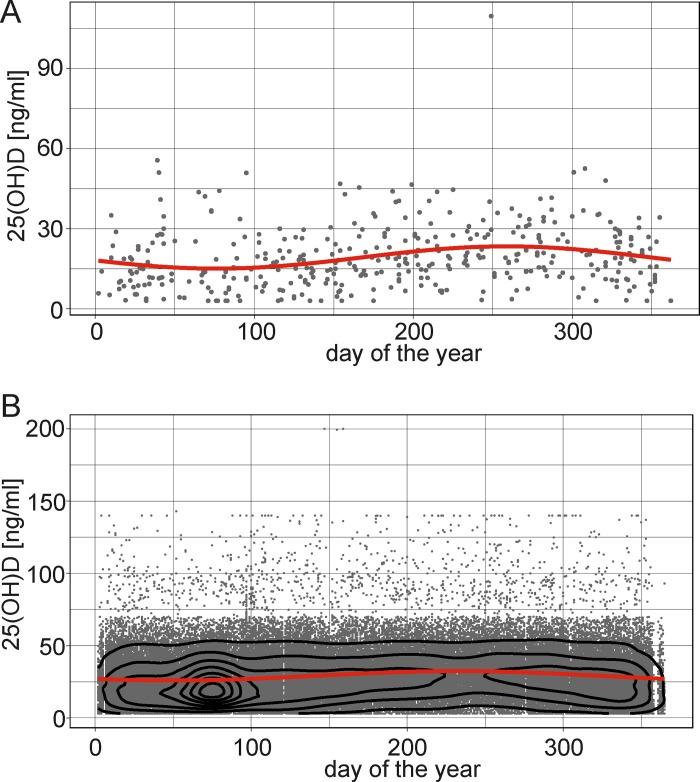
Univariable and multiple regression analyses were performed in a retrospective cohort of 384 patients to determine risk factors for vitamin D deficiency. Since the observed 25-hydroxyvitamin D [25(OH)D] concentrations followed a sinusoidal pattern over the year, all 25(OH)D concentrations were normalized for the predicted variability of the respective day of analysis based on a sinusoidal regression analysis of 25(OH)D test results obtained in more than 86,000 control serum samples.
RESULTS
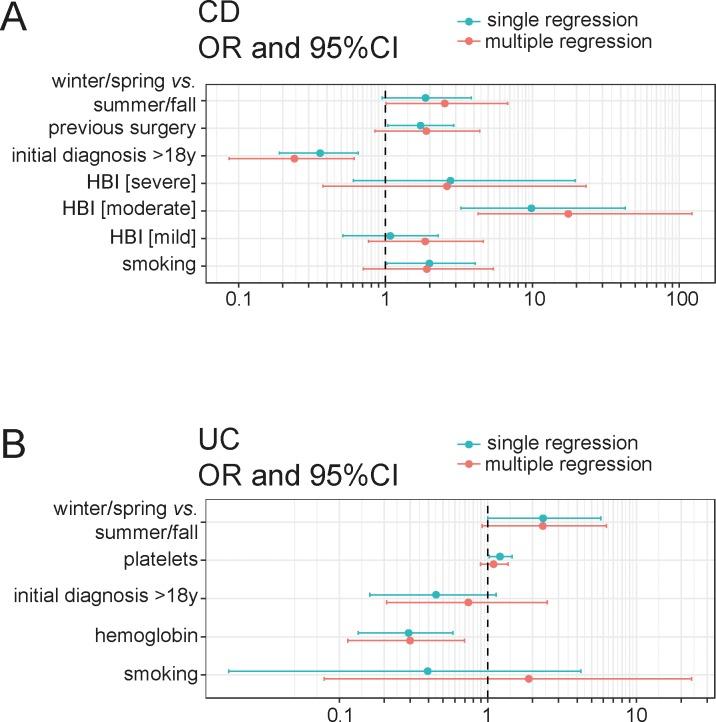
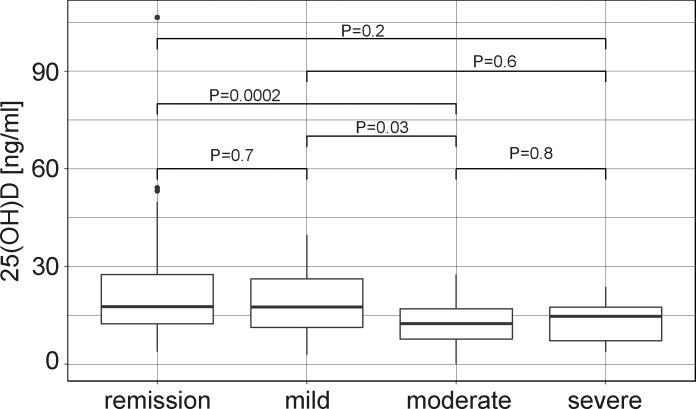
Vitamin D deficiency was highly prevalent in patients with Crohn's disease or ulcerative colitis (63% and 55%, respectively) and associated with winter/spring seasons. After normalization of 25(OH)D concentrations for the day of analysis, vitamin D deficiency was associated with histories of complications related to inflammatory bowel disease, surgery, smoking and ongoing diarrhea while initial disease manifestation during adulthood, ongoing vitamin D supplementation and diagnosis of ulcerative colitis vs. Crohn's disease appeared to be protective. Multiple regression analyses revealed that vitamin D deficiency was associated with disease activity in Crohn's disease and anemia in ulcerative colitis patients. Only few deficient patients achieved sufficient 25(OH)D concentrations over time. However, increasing 25(OH)D concentrations correlated with improved Crohn's disease activity.
CONCLUSIONS
Vitamin D deficiency was highly prevalent in patients with Crohn's disease and ulcerative colitis and dependent on the season of the year. Following normalization for seasonality by sinusoidal regression analysis, vitamin D deficiency was found to be associated with parameters of complicated disease course while increasing 25(OH)D concentrations over time correlated with reduced activity of Crohn's disease.
目的
维生素 D 缺乏症可预测炎症性肠病的不良预后。内源性维生素 D 的合成受季节因素(包括阳光照射)的影响,这引发了一个问题,即季节性是否决定了维生素 D 缺乏症的风险,以及是否可能掩盖其他临床危险因素。
方法
对 384 例患者的回顾性队列进行单变量和多变量回归分析,以确定维生素 D 缺乏症的危险因素。由于观察到的 25-羟维生素 D [25(OH)D]浓度全年呈正弦模式变化,因此根据超过 86000 例对照血清样本的 25(OH)D 检测结果的正弦回归分析,对所有 25(OH)D 浓度进行了校正,以反映分析当天的预测变异性。
结果
克罗恩病或溃疡性结肠炎患者的维生素 D 缺乏症患病率非常高(分别为 63%和 55%),并与冬/春季有关。在对 25(OH)D 浓度进行分析日校正后,维生素 D 缺乏症与与炎症性肠病相关的并发症、手术、吸烟和持续性腹泻史有关,而成年期初发疾病、持续维生素 D 补充以及溃疡性结肠炎与克罗恩病的诊断则具有保护作用。多变量回归分析显示,维生素 D 缺乏症与克罗恩病的疾病活动度以及溃疡性结肠炎患者的贫血有关。只有少数缺乏症患者随着时间的推移能够达到足够的 25(OH)D 浓度。然而,25(OH)D 浓度的增加与克罗恩病活动度的改善相关。
结论
克罗恩病和溃疡性结肠炎患者的维生素 D 缺乏症患病率非常高,且与一年中的季节有关。通过正弦回归分析对季节性进行校正后,发现维生素 D 缺乏症与复杂疾病病程的参数有关,而随着时间的推移 25(OH)D 浓度的增加与克罗恩病活动度的降低相关。
 Zotero 插件