
与房室传导阻滞相关的危险因素。
Risk Factors Associated With Atrioventricular Block.
机构信息
Department of Internal Medicine, Päijät-Häme Central Hospital, Lahti, Finland.
Electrophysiology Section, Division of Cardiology, University of California, San Francisco.
出版信息
JAMA Netw Open. 2019 May 3;2(5):e194176. doi: 10.1001/jamanetworkopen.2019.4176.
IMPORTANCE
Pacemaker implantations as a treatment for atrioventricular (AV) block are increasing worldwide. Prevention strategies for AV block are lacking because modifiable risk factors have not yet been identified.
OBJECTIVE
To identify risk factors for AV block in community-dwelling individuals.
DESIGN, SETTING, AND PARTICIPANTS: In this population-based cohort study, data from the Mini-Finland Health Survey, conducted from January 1, 1978, to December 31, 1980, were used to examine demographics, comorbidities, habits, and laboratory and electrocardiographic (ECG) measurements as potential risk factors for incident AV block. Data were ascertained during follow-up from January 1, 1987, through December 31, 2011, using a nationwide registry. A total of 6146 community-dwelling individuals were included in the analysis performed from January 15 through April 3, 2018.
MAIN OUTCOMES AND MEASURES
Incidence of AV block (hospitalization for second- or third-degree AV block).
RESULTS
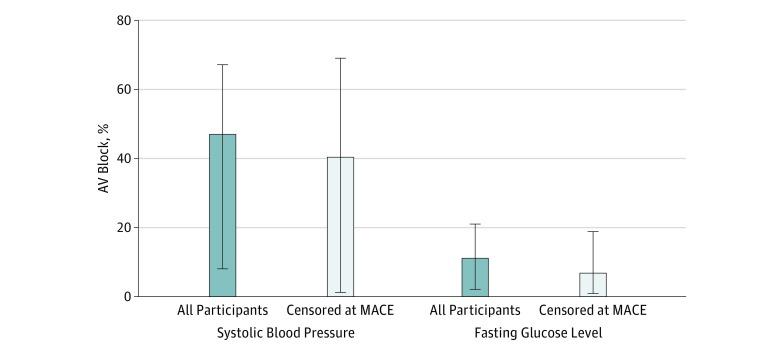
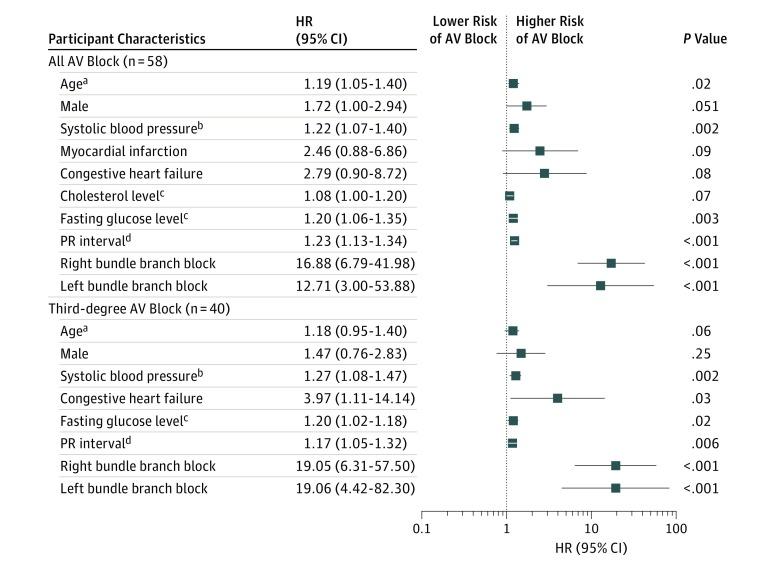
Among the 6146 participants (3449 [56.1%] women; mean [SD] age, 49.2 [12.9] years), 529 (8.6%) had ECG evidence of conduction disease and 58 (0.9%) experienced a hospitalization with AV block. Older age (hazard ratio [HR] per 5-year increment, 1.34; 95% CI, 1.16-1.54; P < .001), male sex (HR, 2.04; 95% CI, 1.19-3.45; P = .01), a history of myocardial infarction (HR, 3.54; 95% CI, 1.33-9.42; P = .01), and a history of congestive heart failure (HR, 3.33; 95% CI, 1.10-10.09; P = .03) were each independently associated with AV block. Two modifiable risk factors were also independently associated with AV block. Every 10-mm Hg increase in systolic blood pressure was associated with a 22% higher risk (HR, 1.22; 95% CI, 1.10-1.34; P = .005), and every 20-mg/dL increase in fasting glucose level was associated with a 22% higher risk (HR, 1.22; 95% CI, 1.08-1.35; P = .001). Both risk factors remained statistically significant (HR for systolic blood pressure, 1.26 [95% CI, 1.06-1.49; P = .007]; HR for glucose level, 1.22 [95% CI, 1.04-1.43; P = .01]) after adjustment for major adverse coronary events during the follow-up period. In population-attributable risk assessment, an estimated 47% (95% CI, 8%-67%) of AV blocks may have been avoided if all participants exhibited ideal blood pressure and 11% (95% CI, 2%-21%) may have been avoided if all had a normal fasting glucose level.
CONCLUSIONS AND RELEVANCE
In this analysis of data from a population-based cohort study, suboptimal blood pressure and fasting glucose level were associated with AV block. These results suggest that a large proportion of AV blocks are assocated with these risk factors, even after adjusting for other major adverse coronary events.
重要性
作为治疗房室(AV)阻滞的起搏器植入术在全球范围内不断增加。由于尚未确定可改变的危险因素,因此缺乏预防 AV 阻滞的策略。
目的
确定社区居民中 AV 阻滞的危险因素。
设计、地点和参与者:在这项基于人群的队列研究中,使用来自 1978 年 1 月 1 日至 1980 年 12 月 31 日的微型芬兰健康调查的数据,检查人口统计学、合并症、习惯以及实验室和心电图(ECG)测量作为潜在的危险因素。在 1987 年 1 月 1 日至 2011 年 12 月 31 日的随访期间,通过全国性登记处确定数据。共有 6146 名社区居民被纳入 2018 年 1 月 15 日至 4 月 3 日进行的分析。
主要结果和测量
AV 阻滞的发生率(因二度或三度 AV 阻滞而住院)。
结果
在 6146 名参与者中(3449 [56.1%] 名女性;平均[标准差]年龄,49.2[12.9]岁),529 名(8.6%)有心电图传导疾病证据,58 名(0.9%)经历了 AV 阻滞的住院治疗。年龄较大(每增加 5 年的风险比[HR],1.34;95%置信区间[CI],1.16-1.54;P < 0.001)、男性(HR,2.04;95% CI,1.19-3.45;P = 0.01)、心肌梗死史(HR,3.54;95% CI,1.33-9.42;P = 0.01)和充血性心力衰竭史(HR,3.33;95% CI,1.10-10.09;P = 0.03)均与 AV 阻滞独立相关。两个可改变的危险因素也与 AV 阻滞独立相关。收缩压每增加 10mmHg,风险增加 22%(HR,1.22;95% CI,1.10-1.34;P = 0.005),空腹血糖水平每增加 20mg/dL,风险增加 22%(HR,1.22;95% CI,1.08-1.35;P = 0.001)。在调整随访期间主要不良冠状动脉事件后,这两个危险因素仍然具有统计学意义(收缩压的 HR,1.26[95% CI,1.06-1.49;P = 0.007];血糖水平的 HR,1.22[95% CI,1.04-1.43;P = 0.01])。在人群归因风险评估中,如果所有参与者的血压理想,如果所有参与者的空腹血糖水平正常,估计可避免 47%(95% CI,8%-67%)的 AV 阻滞,如果所有参与者的空腹血糖水平正常,可避免 11%(95% CI,2%-21%)的 AV 阻滞。
结论和相关性
在这项基于人群的队列研究数据分析中,血压和空腹血糖水平不理想与 AV 阻滞有关。这些结果表明,即使在调整了其他主要不良冠状动脉事件后,这些风险因素仍与很大一部分 AV 阻滞有关。
 Zotero 插件