
机器人辅助上肢卒中康复训练(RATULS):一项多中心随机对照试验。
Robot assisted training for the upper limb after stroke (RATULS): a multicentre randomised controlled trial.
机构信息
Stroke Research Group, Institute of Neuroscience, Newcastle University, Newcastle upon Tyne, UK; Stroke Northumbria, Northumbria Healthcare NHS Foundation Trust, North Tyneside, UK; Newcastle Hospitals NHS Foundation Trust, Newcastle upon Tyne, UK.
Stroke Research Group, Institute of Neuroscience, Newcastle University, Newcastle upon Tyne, UK.
出版信息
Lancet. 2019 Jul 6;394(10192):51-62. doi: 10.1016/S0140-6736(19)31055-4. Epub 2019 May 22.
BACKGROUND
Loss of arm function is a common problem after stroke. Robot-assisted training might improve arm function and activities of daily living. We compared the clinical effectiveness of robot-assisted training using the MIT-Manus robotic gym with an enhanced upper limb therapy (EULT) programme based on repetitive functional task practice and with usual care.
METHODS
RATULS was a pragmatic, multicentre, randomised controlled trial done at four UK centres. Stroke patients aged at least 18 years with moderate or severe upper limb functional limitation, between 1 week and 5 years after their first stroke, were randomly assigned (1:1:1) to receive robot-assisted training, EULT, or usual care. Robot-assisted training and EULT were provided for 45 min, three times per week for 12 weeks. Randomisation was internet-based using permuted block sequences. Treatment allocation was masked from outcome assessors but not from participants or therapists. The primary outcome was upper limb function success (defined using the Action Research Arm Test [ARAT]) at 3 months. Analyses were done on an intention-to-treat basis. This study is registered with the ISRCTN registry, number ISRCTN69371850.
FINDINGS
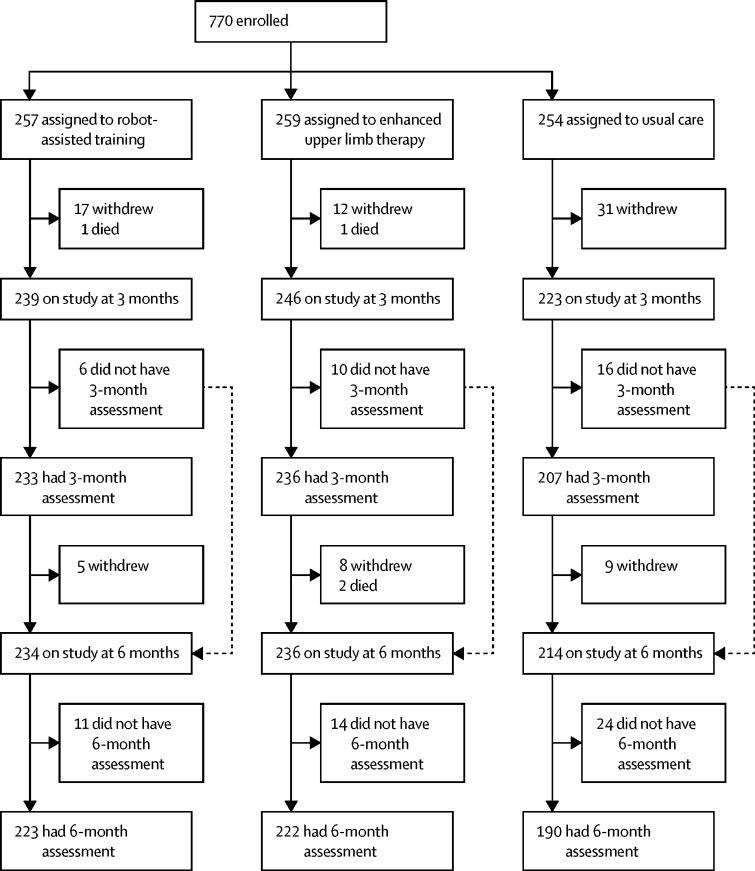
Between April 14, 2014, and April 30, 2018, 770 participants were enrolled and randomly assigned to either robot-assisted training (n=257), EULT (n=259), or usual care (n=254). The primary outcome of ARAT success was achieved by 103 (44%) of 232 patients in the robot-assisted training group, 118 (50%) of 234 in the EULT group, and 85 (42%) of 203 in the usual care group. Compared with usual care, robot-assisted training (adjusted odds ratio [aOR] 1·17 [98·3% CI 0·70-1·96]) and EULT (aOR 1·51 [0·90-2·51]) did not improve upper limb function; the effects of robot-assisted training did not differ from EULT (aOR 0·78 [0·48-1·27]). More participants in the robot-assisted training group (39 [15%] of 257) and EULT group (33 [13%] of 259) had serious adverse events than in the usual care group (20 [8%] of 254), but none were attributable to the intervention.
INTERPRETATION
Robot-assisted training and EULT did not improve upper limb function after stroke compared with usual care for patients with moderate or severe upper limb functional limitation. These results do not support the use of robot-assisted training as provided in this trial in routine clinical practice.
FUNDING
National Institute for Health Research Health Technology Assessment Programme.
背景
手臂功能丧失是中风后常见的问题。机器人辅助训练可能会改善手臂功能和日常生活活动能力。我们比较了使用 MIT-Manus 机器人健身房进行机器人辅助训练与基于重复功能任务练习的强化上肢治疗(EULT)方案以及常规护理的临床效果。
方法
RATULS 是一项在英国四个中心进行的实用、多中心、随机对照试验。至少 18 岁的中风患者,上肢功能中度或重度受限,首次中风后 1 周到 5 年之间,随机分为(1:1:1)接受机器人辅助训练、EULT 或常规护理。机器人辅助训练和 EULT 每次 45 分钟,每周 3 次,共 12 周。使用随机区组序列进行基于互联网的随机分组。治疗分配对结果评估者是盲的,但对参与者和治疗师不是盲的。主要结局是 3 个月时上肢功能成功(使用动作研究上肢测试 [ARAT] 定义)。意向治疗分析。这项研究在 ISRCTN 注册中心注册,编号 ISRCTN69371850。
结果
2014 年 4 月 14 日至 2018 年 4 月 30 日,共纳入并随机分配 770 名参与者至机器人辅助训练组(n=257)、EULT 组(n=259)或常规护理组(n=254)。机器人辅助训练组有 232 名患者中的 103 名(44%)、EULT 组有 234 名患者中的 118 名(50%)、常规护理组有 203 名患者中的 85 名(42%)达到 ARAT 成功的主要结局。与常规护理相比,机器人辅助训练(调整后的优势比 [aOR] 1.17 [98.3%CI 0.70-1.96])和 EULT(aOR 1.51 [0.90-2.51])并未改善上肢功能;机器人辅助训练的效果与 EULT 无差异(aOR 0.78 [0.48-1.27])。机器人辅助训练组(39 [15%] of 257)和 EULT 组(33 [13%] of 259)比常规护理组(20 [8%] of 254)有更多的严重不良事件,但没有一个归因于干预措施。
解释
与常规护理相比,对于上肢功能中度或重度受限的中风患者,机器人辅助训练和 EULT 并未改善上肢功能。这些结果不支持在常规临床实践中使用本试验中提供的机器人辅助训练。
资金来源
英国国家卫生研究院健康技术评估计划。

 Zotero 插件