
癌症相关突变及其他:异柠檬酸脱氢酶在人类疾病中的新兴生物学。
Cancer-associated mutation and beyond: The emerging biology of isocitrate dehydrogenases in human disease.
机构信息
Ken and Ruth Davee Department of Neurology, The Northwestern Brain Tumor Institute, The Robert H. Lurie Comprehensive Cancer Center, Northwestern University, 303 East Superior, Chicago, IL 60611, USA.
International Institute for Nanotechnology, Northwestern University, 2145 Sheridan Road, Evanston, IL 60208, USA.
出版信息
Sci Adv. 2019 May 22;5(5):eaaw4543. doi: 10.1126/sciadv.aaw4543. eCollection 2019 May.
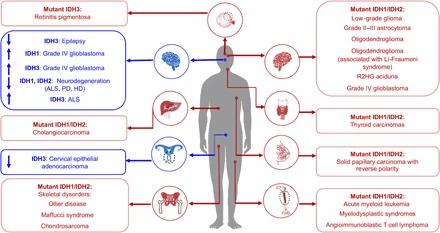
Isocitrate dehydrogenases (IDHs) are critical metabolic enzymes that catalyze the oxidative decarboxylation of isocitrate to α-ketoglutarate (αKG), NAD(P)H, and CO. IDHs epigenetically control gene expression through effects on αKG-dependent dioxygenases, maintain redox balance and promote anaplerosis by providing cells with NADPH and precursor substrates for macromolecular synthesis, and regulate respiration and energy production through generation of NADH. Cancer-associated mutations in and represent one of the most comprehensively studied mechanisms of IDH pathogenic effect. Mutant enzymes produce ()-2-hydroxyglutarate, which in turn inhibits αKG-dependent dioxygenase function, resulting in a global hypermethylation phenotype, increased tumor cell multipotency, and malignancy. Recent studies identified wild-type IDHs as critical regulators of normal organ physiology and, when transcriptionally induced or down-regulated, as contributing to cancer and neurodegeneration, respectively. We describe how mutant and wild-type enzymes contribute on molecular levels to disease pathogenesis, and discuss efforts to pharmacologically target IDH-controlled metabolic rewiring.
异柠檬酸脱氢酶(IDHs)是关键的代谢酶,可催化异柠檬酸的氧化脱羧生成α-酮戊二酸(αKG)、NAD(P)H 和 CO。IDHs 通过影响αKG 依赖性双加氧酶来表观遗传调控基因表达,通过为细胞提供 NADPH 和大分子合成的前体底物来维持氧化还原平衡并促进补料,以及通过生成 NADH 来调节呼吸和能量产生。和中的癌症相关突变代表了 IDH 致病效应中研究最广泛的机制之一。突变酶产生()-2-羟基戊二酸,进而抑制 αKG 依赖性双加氧酶的功能,导致全局超甲基化表型、增加肿瘤细胞多能性和恶性。最近的研究确定野生型 IDHs 是正常器官生理学的关键调节剂,并且当转录诱导或下调时,分别有助于癌症和神经退行性变。我们描述了突变酶和野生型酶如何在分子水平上促进疾病的发病机制,并讨论了靶向 IDH 控制的代谢重编程的药理学努力。


 Zotero 插件