
大型漂流物体传播莱塞普斯入侵物种的可能性:以一个分离浮标为例。
The potential of large rafting objects to spread Lessepsian invaders: the case of a detached buoy.
作者信息
Ivkić Angelina, Steger Jan, Galil Bella S, Albano Paolo G
机构信息
1Department of Palaeontology, University of Vienna, Althanstrasse 14, 1090 Vienna, Austria.
2Faculty of Geosciences, Utrecht University, Princetonlaan 8a, 3584 CB Utrecht, The Netherlands.
出版信息
Biol Invasions. 2019;21(6):1887-1893. doi: 10.1007/s10530-019-01972-4. Epub 2019 Mar 29.
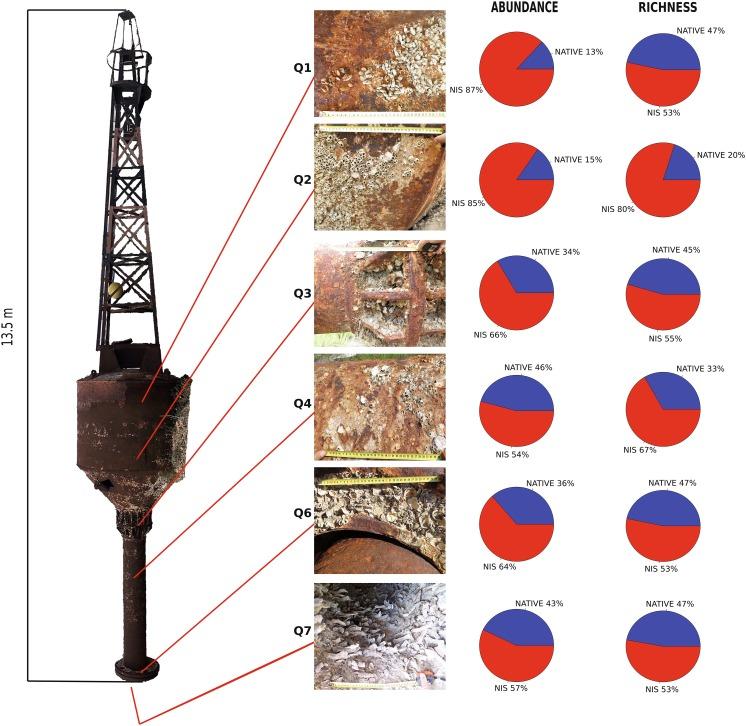
A diverse and abundant fouling community dominated by Lessepsian non-indigenous species was identified on a 13.5-m-long steel buoy stranded on the Israeli coast but originating from Port Said, at the Mediterranean entrance of the Suez Canal, Egypt. The molluscan community was sampled quantitatively by scraping. Three quarters of the individuals and more than half of the species were non-indigenous. Among the latter, a mytilid bivalve, cf. , was first recorded in the Mediterranean Sea on the basis of these samples, suggesting that the full consideration of all potential vectors can contribute to non-indigenous species detection. Large floating objects in coastal waters, such as buoys, are particularly suitable for colonization by Lessepsian species because hard substrates, and artificial ones in particular, are highly susceptible to the establishment of non-indigenous species. Moreover, their size and persistence enable the development of abundant and mature fouling communities that can disseminate propagules as eggs and larvae over long distances and for extended periods if detached. This report highlights the potential for large rafting debris as a vector of the spread of non-indigenous biota within the Mediterranean Sea.
在搁浅于以色列海岸、原产于埃及苏伊士运河北部地中海入口塞得港的一个13.5米长的钢制浮标上,发现了一个由红海非本土物种主导的多样且丰富的污损生物群落。通过刮擦对软体动物群落进行了定量采样。四分之三的个体和超过一半的物种是非本土的。其中,一种贻贝双壳类动物,cf.,基于这些样本首次在地中海被记录,这表明全面考虑所有潜在传播媒介有助于非本土物种的检测。沿海水域中的大型漂浮物,如浮标,特别适合红海物种定殖,因为硬质底物,尤其是人工底物,极易受到非本土物种的侵袭。此外,它们的大小和持久性使得丰富且成熟的污损生物群落得以发展,这些群落如果脱离,可以将卵和幼虫等繁殖体远距离、长时间传播。本报告强调了大型漂流残骸作为地中海非本土生物群扩散载体的可能性。
 Zotero 插件