
血清胆固醇水平与 2 型糖尿病患者周围神经损伤的关系。
Association of Serum Cholesterol Levels With Peripheral Nerve Damage in Patients With Type 2 Diabetes.
机构信息
Department of Neuroradiology, Heidelberg University Hospital, Heidelberg, Germany.
Department of Endocrinology, Diabetology and Clinical Chemistry (Internal Medicine 1), Heidelberg University Hospital, Heidelberg, Germany.
出版信息
JAMA Netw Open. 2019 May 3;2(5):e194798. doi: 10.1001/jamanetworkopen.2019.4798.
IMPORTANCE
Lowering serum cholesterol levels is a well-established treatment for dyslipidemia in patients with type 2 diabetes (T2D). However, nerve lesions in patients with T2D increase with lower serum cholesterol levels, suggesting that lowering serum cholesterol levels is associated with diabetic polyneuropathy (DPN) in patients with T2D.
OBJECTIVE
To investigate whether there is an association between serum cholesterol levels and peripheral nerve lesions in patients with T2D with and without DPN.
DESIGN, SETTING, AND PARTICIPANTS: This single-center, cross-sectional, prospective cohort study was performed from June 1, 2015, to March 31, 2018. Observers were blinded to clinical data. A total of 256 participants were approached, of whom 156 were excluded. A total of 100 participants consented to undergo magnetic resonance neurography of the right leg at the Department of Neuroradiology and clinical, serologic, and electrophysiologic assessment at the Department of Endocrinology, Heidelberg University Hospital, Heidelberg, Germany.
EXPOSURES
Quantification of the nerve's diameter and lipid equivalent lesion (LEL) load with a subsequent analysis of all acquired clinical and serologic data with use of 3.0-T magnetic resonance neurography of the right leg with 3-dimensional reconstruction of the sciatic nerve.
MAIN OUTCOMES AND MEASURES
The primary outcome was lesion load and extension. Secondary outcomes were clinical, serologic, and electrophysiologic findings.
RESULTS
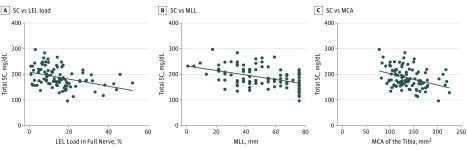
A total of 100 participants with T2D (mean [SD] age, 64.6 [0.9] years; 68 [68.0%] male) participated in the study. The LEL load correlated positively with the nerve's mean cross-sectional area (r = 0.44; P < .001) and the maximum length of a lesion (r = 0.71; P < .001). The LEL load was negatively associated with total serum cholesterol level (r = -0.41; P < .001), high-density lipoprotein cholesterol level (r = -0.30; P = .006), low-density lipoprotein cholesterol level (r = -0.33; P = .003), nerve conduction velocities of the tibial (r = -0.33; P = .01) and peroneal (r = -0.51; P < .001) nerves, and nerve conduction amplitudes of the tibial (r = -0.31; P = .02) and peroneal (r = -0.28; P = .03) nerves.
CONCLUSIONS AND RELEVANCE
The findings suggest that lowering serum cholesterol levels in patients with T2D and DPN is associated with a higher amount of nerve lesions and declining nerve conduction velocities and amplitudes. These findings may be relevant to emerging therapies that promote an aggressive lowering of serum cholesterol levels in patients with T2D.
重要性
降低血清胆固醇水平是治疗 2 型糖尿病(T2D)患者血脂异常的有效方法。然而,T2D 患者的神经病变会随着血清胆固醇水平的降低而增加,这表明降低血清胆固醇水平与 T2D 患者的糖尿病多发性神经病变(DPN)有关。
目的
研究 T2D 合并或不合并 DPN 患者的血清胆固醇水平与周围神经病变之间是否存在关联。
设计、地点和参与者:这是一项于 2015 年 6 月 1 日至 2018 年 3 月 31 日进行的单中心、横断面、前瞻性队列研究。观察者对临床数据不了解。共接触了 256 名参与者,其中 156 名被排除。共有 100 名参与者同意在德国海德堡大学医院神经放射科接受右腿磁共振神经成像检查,并在该院内分泌科进行临床、血清学和电生理评估。
暴露情况
使用 3.0-T 右腿磁共振神经成像和坐骨神经 3 维重建,对右侧坐骨神经进行定量分析,测量神经的直径和脂质等效病变(LEL)负荷,并对所有获得的临床和血清学数据进行后续分析。
主要结局和测量指标
主要结局为病变负荷和病变延伸程度。次要结局包括临床、血清学和电生理结果。
结果
共纳入 100 名 T2D 患者(平均[标准差]年龄 64.6[0.9]岁;68[68.0%]为男性)参与研究。LEL 负荷与神经的平均横截面积呈正相关(r=0.44;P<0.001),与最大病变长度呈正相关(r=0.71;P<0.001)。LEL 负荷与总血清胆固醇水平(r=-0.41;P<0.001)、高密度脂蛋白胆固醇水平(r=-0.30;P=0.006)、低密度脂蛋白胆固醇水平(r=-0.33;P=0.003)、胫神经(r=-0.33;P=0.01)和腓总神经(r=-0.51;P<0.001)的神经传导速度以及胫神经(r=-0.31;P=0.02)和腓总神经(r=-0.28;P=0.03)的神经传导幅度呈负相关。
结论和相关性
研究结果表明,降低 T2D 合并 DPN 患者的血清胆固醇水平与更多的神经病变以及神经传导速度和幅度下降有关。这些发现可能与新兴的治疗方法有关,这些方法可能会促进 T2D 患者积极降低血清胆固醇水平。

 Zotero 插件