
慢性阻塞性肺疾病中的趋化因子:从意义到治疗用途。
Chemokines in COPD: From Implication to Therapeutic Use.
机构信息
Univ-Bordeaux, Centre de Recherche Cardio-thoracique de Bordeaux, U1045, CIC 1401, F-33604 Pessac, France.
INSERM, Centre de Recherche Cardio-thoracique de Bordeaux, U1045, CIC 1401, F-33604 Pessac, France.
出版信息
Int J Mol Sci. 2019 Jun 6;20(11):2785. doi: 10.3390/ijms20112785.
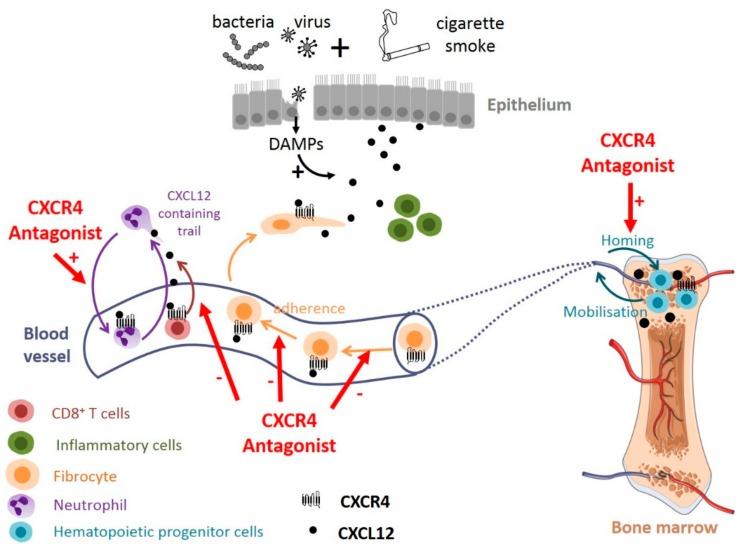
Chronic Obstructive Pulmonary Disease (COPD) represents the 3rd leading cause of death in the world. The underlying pathophysiological mechanisms have been the focus of extensive research in the past. The lung has a complex architecture, where structural cells interact continuously with immune cells that infiltrate into the pulmonary tissue. Both types of cells express chemokines and chemokine receptors, making them sensitive to modifications of concentration gradients. Cigarette smoke exposure and recurrent exacerbations, directly and indirectly, impact the expression of chemokines and chemokine receptors. Here, we provide an overview of the evidence regarding chemokines involvement in COPD, and we hypothesize that a dysregulation of this tightly regulated system is critical in COPD evolution, both at a stable state and during exacerbations. Targeting chemokines and chemokine receptors could be highly attractive as a mean to control both chronic inflammation and bronchial remodeling. We present a special focus on the CXCL8-CXCR1/2, CXCL9/10/11-CXCR3, CCL2-CCR2, and CXCL12-CXCR4 axes that seem particularly involved in the disease pathophysiology.
慢性阻塞性肺疾病(COPD)是世界上第 3 大死亡原因。在过去,其潜在的病理生理机制一直是广泛研究的焦点。肺具有复杂的结构,其中结构细胞与浸润到肺组织中的免疫细胞持续相互作用。这两种类型的细胞都表达趋化因子和趋化因子受体,使它们对浓度梯度的变化敏感。香烟烟雾暴露和反复加重,直接和间接地影响趋化因子和趋化因子受体的表达。在这里,我们提供了关于趋化因子在 COPD 中的作用的证据概述,并假设这种严格调控系统的失调在 COPD 的稳定状态和加重期间的演变中至关重要。针对趋化因子和趋化因子受体可能是控制慢性炎症和支气管重塑的一种极具吸引力的方法。我们特别关注 CXCL8-CXCR1/2、CXCL9/10/11-CXCR3、CCL2-CCR2 和 CXCL12-CXCR4 轴,它们似乎特别参与疾病的病理生理。

 Zotero 插件