
脑功能、结构和基因组数据相互关联,但在精神分裂症中对疾病持续时间和疾病阶段的敏感性不同。
Brain function, structure and genomic data are linked but show different sensitivity to duration of illness and disease stage in schizophrenia.
机构信息
Brainnetome Center and National Laboratory of Pattern Recognition, Institute of Automation, Chinese Academy of Sciences, Beijing 100190, China; University of Chinese Academy of Sciences, Beijing 100049, China.
Wuxi Mental Health Center, Wuxi 214000, China.
出版信息
Neuroimage Clin. 2019;23:101887. doi: 10.1016/j.nicl.2019.101887. Epub 2019 May 31.
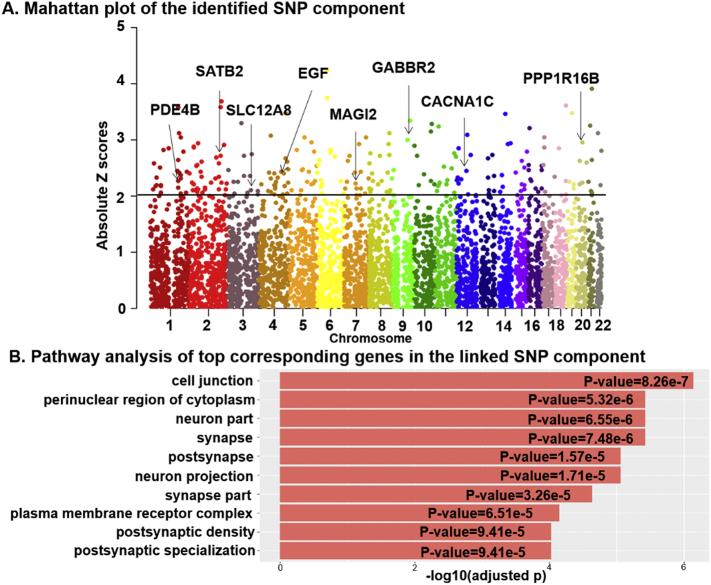
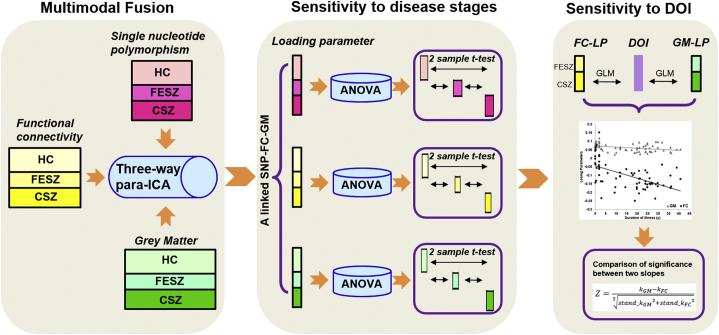
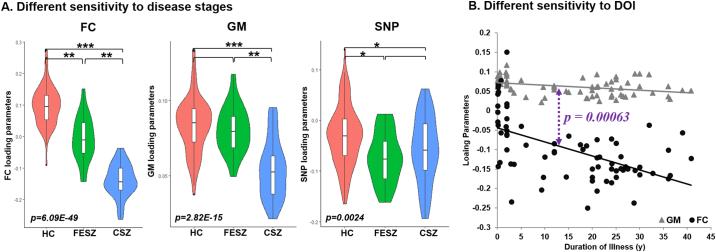
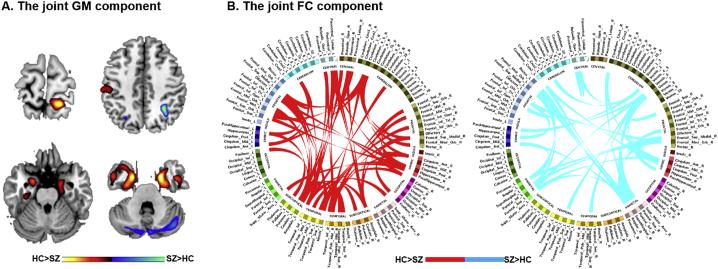
The progress of schizophrenia at various stages is an intriguing question, which has been explored to some degree using single-modality brain imaging data, e.g. gray matter (GM) or functional connectivity (FC). However it remains unclear how those changes from different modalities are correlated with each other and if the sensitivity to duration of illness and disease stages across modalities is different. In this work, we jointly analyzed FC, GM volume and single nucleotide polymorphisms (SNPs) data of 159 individuals including healthy controls (HC), drug-naïve first-episode schizophrenia (FESZ) and chronic schizophrenia patients (CSZ), aiming to evaluate the links among SNP, FC and GM patterns, and their sensitivity to duration of illness and disease stages in schizophrenia. Our results suggested: 1) both GM and FC highlighted impairments in hippocampal, temporal gyrus and cerebellum in schizophrenia, which were significantly correlated with genes like SATB2, GABBR2, PDE4B, CACNA1C etc. 2) GM and FC presented gradually decrease trend (HC > FESZ>CSZ), while SNP indicated a non-gradual variation trend with un-significant group difference observed between FESZ and CSZ; 3) Group difference between HC and FESZ of FC was more remarkable than GM, and FC presented a stronger negative correlation with duration of illness than GM (p = 0.0006). Collectively, these results highlight the benefit of leveraging multimodal data and provide additional clues regarding the impact of mental illness at various disease stages.
精神分裂症在各个阶段的进展是一个有趣的问题,已经有研究使用单模态脑影像数据(如灰质(GM)或功能连接(FC))对其进行了一定程度的探索。然而,目前尚不清楚不同模态的这些变化如何相互关联,以及不同模态对疾病持续时间和疾病阶段的敏感性是否不同。在这项工作中,我们联合分析了 159 名个体的 FC、GM 体积和单核苷酸多态性(SNP)数据,包括健康对照(HC)、未经药物治疗的首发精神分裂症(FESZ)和慢性精神分裂症患者(CSZ),旨在评估 SNP、FC 和 GM 模式之间的联系,以及它们对精神分裂症中疾病持续时间和疾病阶段的敏感性。我们的研究结果表明:1)GM 和 FC 均突出显示了精神分裂症中海马、颞叶回和小脑的损伤,这些损伤与 SATB2、GABBR2、PDE4B、CACNA1C 等基因显著相关;2)GM 和 FC 呈现逐渐下降的趋势(HC>FESZ>CSZ),而 SNP 则呈现非渐变的变化趋势,FESZ 和 CSZ 之间没有观察到显著的组间差异;3)与 GM 相比,HC 和 FESZ 之间的 FC 组间差异更为显著,并且 FC 与疾病持续时间的负相关性强于 GM(p=0.0006)。总之,这些结果强调了利用多模态数据的优势,并为各种疾病阶段的精神疾病的影响提供了更多线索。

 Zotero 插件