
内侧颞叶亚区体积与认知评估之间的关联。
Association between subfield volumes of the medial temporal lobe and cognitive assessments.
作者信息
Ogawa Masayo, Sone Daichi, Beheshti Iman, Maikusa Norihide, Okita Kyoji, Takano Harumasa, Matsuda Hiroshi
机构信息
Integrative Brain Imaging Center, National Center of Neurology and Psychiatry, Kodaira, Tokyo, Japan.
出版信息
Heliyon. 2019 Jun 4;5(6):e01828. doi: 10.1016/j.heliyon.2019.e01828. eCollection 2019 Jun.
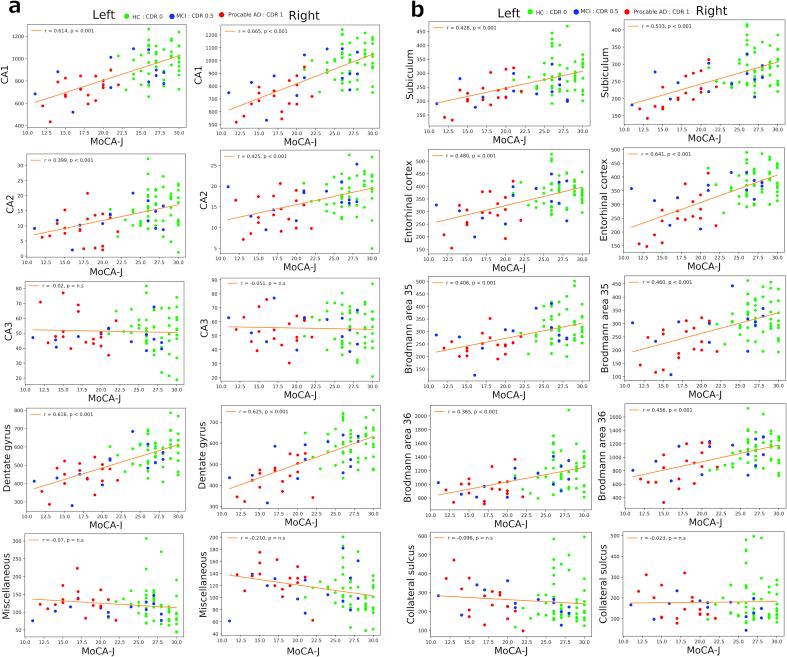
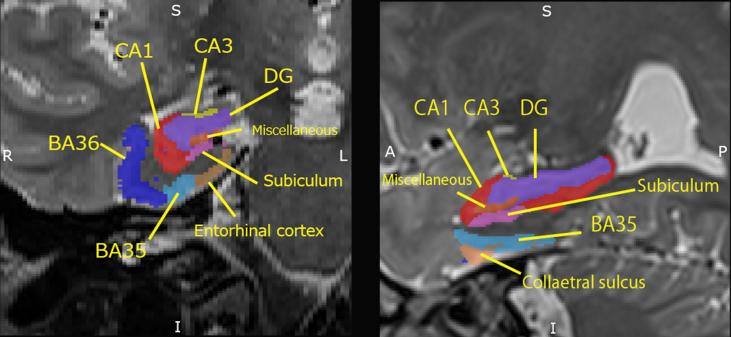
Cognitive assessments and neuroimaging are routinely combined in clinical practice to diagnose dementia represented by Alzheimer's disease (AD). The Montreal Cognitive Assessment (MoCA) is reported to be more suitable than the Mini-Mental State Examination (MMSE) for screening mild cognitive impairment (MCI) and mild AD. On the other hand, attention to the subfield volumes of the medial temporal lobe has recently been considered important for the differential diagnosis and early detection of AD. The aim of this study was to uncover which specific hippocampal subfields and adjacent extrahippocampal structures contribute to deficits in cognitive assessment scores in patients with MCI and AD. We recruited from our institute 31 Japanese patients-14 with amnestic MCI and 17 with probable AD, with a clinical dementia rating (CDR) of 0.5 and 1, respectively-and 50 healthy elderly individuals with a CDR of 0. All participants underwent magnetic resonance imaging and cognitive assessments with the MMSE, Wechsler Memory Scale-Revised Logical Memory I and II, and Japanese version of the MoCA (MoCA-J). With adjustment for age and sex, we performed partial correlation analysis of the cognitive assessment scores with the subfield volumes of the medial temporal lobe measured by software-mediated automatic segmentation of hippocampal subfields using high-resolution T1-and T2-weighted images. Compared with normal controls, patients with MCI and AD showed subfield volume reductions in cornu ammonis (CA) 1, CA2, Brodmann area (BA) 35, BA36, the dentate gyrus (DG), the subiculum, and the entorhinal cortex (ERC). All participants showed high correlation coefficients (above 0.6) between cognitive assessment scores and subfield volumes in CA1, the DG, the subiculum, the ERC, and BA36. In patients with MCI and AD, the MoCA-J showed higher correlations than the MMSE with subfield volumes in CA1, the DG, the subiculum, and the ERC. These results suggest that the combination of the in vivo analysis of subfield morphometry of the medial temporal lobe with the MoCA-J paradigm provides important insights into whether changes within specific subfields are related to the cognitive profile in MCI and AD.
在临床实践中,认知评估和神经影像学检查通常结合使用,以诊断以阿尔茨海默病(AD)为代表的痴呆症。据报道,蒙特利尔认知评估量表(MoCA)比简易精神状态检查表(MMSE)更适合用于筛查轻度认知障碍(MCI)和轻度AD。另一方面,最近人们认为关注内侧颞叶的子区域体积对于AD的鉴别诊断和早期检测很重要。本研究的目的是揭示哪些特定的海马子区域和相邻的海马外结构导致了MCI和AD患者认知评估分数的缺陷。我们从本机构招募了31名日本患者,其中14名患有遗忘型MCI,17名患有很可能的AD,临床痴呆评定量表(CDR)分别为0.5和1,以及50名CDR为0的健康老年人。所有参与者均接受了磁共振成像检查,并使用MMSE、韦氏记忆量表修订版逻辑记忆I和II以及日语版MoCA(MoCA-J)进行了认知评估。在对年龄和性别进行调整后,我们使用高分辨率T1加权和T2加权图像,通过软件介导的海马子区域自动分割,对认知评估分数与内侧颞叶子区域体积进行了偏相关分析。与正常对照组相比,MCI和AD患者在海马角(CA)1、CA2、布罗德曼区(BA)35、BA36、齿状回(DG)、下托和内嗅皮质(ERC)的子区域体积减小。所有参与者在CA1、DG、下托、ERC和BA36的认知评估分数与子区域体积之间均显示出高相关系数(高于0.6)。在MCI和AD患者中,MoCA-J与CA1、DG、下托和ERC的子区域体积的相关性高于MMSE。这些结果表明,内侧颞叶子区域形态计量学的体内分析与MoCA-J范式相结合,为特定子区域内的变化是否与MCI和AD的认知特征相关提供了重要见解。
 Zotero 插件