
韩国的贫血症与健康相关生活质量:来自 2008-2016 年韩国国家健康和营养检查调查的数据。
Anemia and health-related quality of life in South Korea: data from the Korean national health and nutrition examination survey 2008-2016.
机构信息
Department of Medical Lifescience, The Catholic University College of Medicine, 222, Banpo-daero, Seocho-gu, Seoul, 137-701, South Korea.
Department of Family Medicine, Korea University College of Medicine, 73 Inchon-ro, Seoungbuk-Gu, Seoul, 136-705, South Korea.
出版信息
BMC Public Health. 2019 Jun 13;19(1):735. doi: 10.1186/s12889-019-6930-y.
BACKGROUND
Anemia is associated with impaired quality of life (QoL). We examined the relationship between anemia and QoL in the Korean population using the EuroQol five-dimensional (EQ-5D) questionnaire.
METHODS
Data of 30,526 subjects were included from the Korean National Health and Nutrition Examination Survey (2008-2016). The QoL was assessed using three-levels of the EQ-5D questionnaire (G1, G2, and G3). Analysis of variance was used to compare the prevalence of anemia according to the three levels of health status in each of the five dimensions of EQ-5D. Multiple linear regression analysis was used to evaluate the association between hemoglobin level and QoL, and multivariable logistic regression analysis was used to evaluate the odds ratios (ORs) and 95% confidence intervals (CIs) for low levels of each of the five dimensions of EQ-5D.
RESULTS
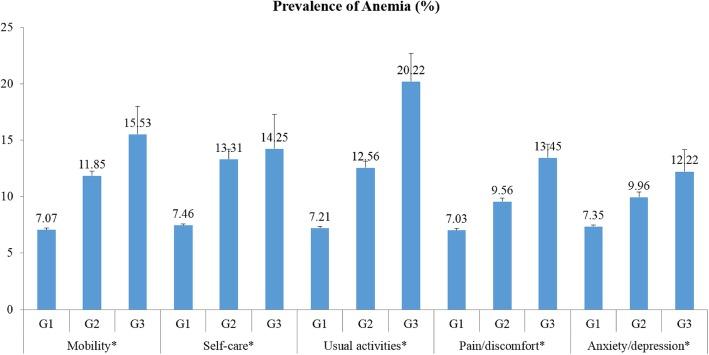
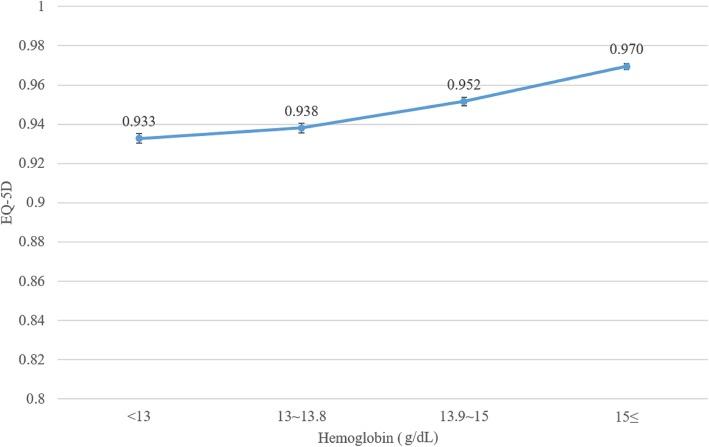
As the level of EQ-5D was worse (from G1 to G3), the prevalence of anemia increased (p for trend < 0.001). Hemoglobin level and EQ-5D showed positive association after adjusting for all covariates such as age, sex, smoking, alcohol drinking, exercise, education, income, marital status, urban living, diabetes mellitus, hypertension, hypercholesterolemia, chronic kidney disease, total calorie intake, and protein intake. Subjects with anemia had increased ORs for low levels (G2 + G3) of each dimension of EQ-5D compared to subjects without anemia. ORs and 95% CIs for mobility, self-care, and usual activities were 1.208(1.078, 1.353), 1.161(0.98, 1.376), and 1.331(1.173, 1.51), respectively, after adjusting for all covariates. Pain/discomfort and anxiety/depression were not associated with increased ORs for low levels of EQ-5D.
CONCLUSIONS
In South Korea, low QoL was associated with anemia, particularly in the mobility, self-care, and usual activities dimensions of EQ-5D.
背景
贫血与生活质量(QoL)受损有关。我们使用欧洲五维健康量表(EQ-5D)问卷检查了韩国人群中贫血与 QoL 之间的关系。
方法
纳入了 2008-2016 年韩国国家健康和营养检查调查(KNHANES)的 30526 名受试者的数据。使用 EQ-5D 的三个级别(G1、G2 和 G3)评估 QoL。方差分析用于比较 EQ-5D 的五个维度中每个维度健康状况的三个级别下贫血的患病率。多线性回归分析用于评估血红蛋白水平与 QoL 的关系,多变量逻辑回归分析用于评估每个 EQ-5D 五个维度中低水平的优势比(OR)和 95%置信区间(CI)。
结果
随着 EQ-5D 水平的恶化(从 G1 到 G3),贫血的患病率增加(趋势 p <0.001)。在校正了年龄、性别、吸烟、饮酒、运动、教育、收入、婚姻状况、城市居住、糖尿病、高血压、高胆固醇血症、慢性肾脏病、总热量摄入和蛋白质摄入等所有协变量后,血红蛋白水平和 EQ-5D 呈正相关。与无贫血的受试者相比,贫血患者 EQ-5D 各维度的低水平(G2+G3)的 OR 增加。在校正了所有协变量后,移动性、自我护理和日常活动的 OR 和 95%CI 分别为 1.208(1.078,1.353)、1.161(0.98,1.376)和 1.331(1.173,1.51)。疼痛/不适和焦虑/抑郁与 EQ-5D 低水平的 OR 增加无关。
结论
在韩国,低 QoL 与贫血有关,尤其是在 EQ-5D 的移动性、自我护理和日常活动维度。
 Zotero 插件