
促进将质量登记处的数据用于当地质量改进工作的因素:丹麦心脏康复数据库的横断面调查。
Facilitators for using data from a quality registry in local quality improvement work: a cross-sectional survey of the Danish Cardiac Rehabilitation Database.
机构信息
The Danish Knowledge Centre for Rehabilitation and Palliative Care, University of Southern Denmark and the Region of Southern Denmark, Odense, Denmark.
Department of Medicine, Holbaek University Hospital, Holbaek, Denmark.
出版信息
BMJ Open. 2019 Jun 12;9(6):e028291. doi: 10.1136/bmjopen-2018-028291.
OBJECTIVES
To investigate use of data from a clinical quality registry for cardiac rehabilitation in Denmark, considering the extent to which data are used for local quality improvement and what facilitates the use of these data, with a particular focus on whether there are differences between frontline staff and managers.
DESIGN
Cross-sectional nationwide survey study.
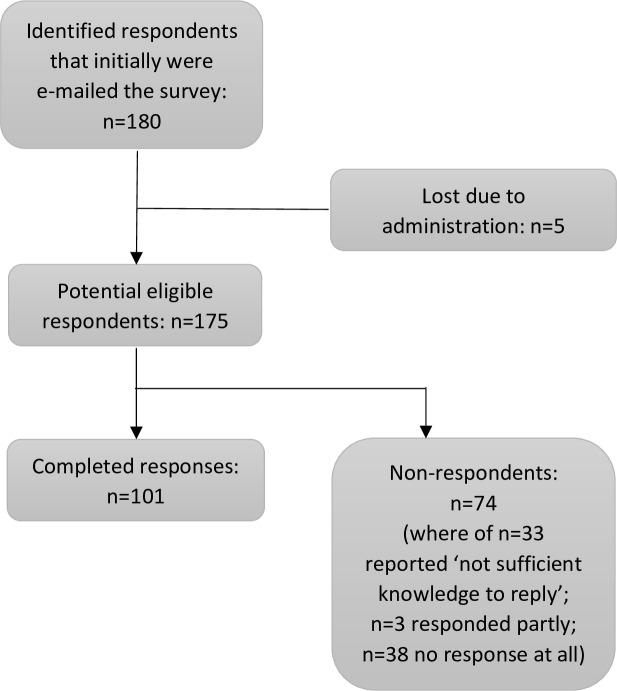
SETTING, METHODS AND PARTICIPANTS: A previously validated, Swedish questionnaire regarding use of data from clinical quality registries was translated and emailed to frontline staff, mid-level managers and heads of departments (n=175) in all 30 hospital departments participating in the Danish Cardiac Rehabilitation Database. Data were analysed descriptively and through multiple linear regression.
RESULTS
Survey response rate was 58% (101/175). Reports of registry use at department level (measured through an index comprising seven items; score min 0, max 7, where a low score indicates less use of data) varied significantly between groups of respondents: frontline staff mean score 1.3 (SD=2.0), mid-level management mean 2.4 (SD=2.3) and heads of departments mean 3.0 (SD=2.5), p=0.006. Overall, department level use of data was positively associated with higher perceived data quality and usefulness (regression coefficient=0.22, p=0.019), management request for data (regression coefficient=0.40, p=0.008) and personal motivation of the respondent (regression coefficient=1.63, p<0.001). Among managers, use of registry data was associated with data quality and usefulness (regression coefficient=0.43, p=0.027), and among frontline staff, reported data use was associated with management involvement in quality improvement work (regression coefficient=0.90, p=0.017) and personal motivation (regression coefficient=1.66, p<0.001).
CONCLUSIONS
The findings suggest relatively sparse use of data in local quality improvement work. A complex interplay of factors seem to be associated with data use with varying aspects being of importance for frontline staff and managers.
目的
调查丹麦心脏康复临床质量注册数据的使用情况,考虑数据用于当地质量改进的程度,以及促进这些数据使用的因素,特别关注一线工作人员和管理人员之间是否存在差异。
设计
横断面全国调查研究。
设置、方法和参与者:对先前验证过的瑞典临床质量登记数据使用问卷进行翻译,并通过电子邮件发送给所有参与丹麦心脏康复数据库的 30 个医院部门的一线工作人员、中层管理人员和部门主管(n=175)。数据通过描述性分析和多元线性回归进行分析。
结果
调查响应率为 58%(101/175)。部门层面的登记使用报告(通过包括七个项目的指数来衡量;得分范围为 0-7,得分越低表示数据使用越少)在不同组别的受访者之间差异显著:一线工作人员平均得分为 1.3(标准差 2.0),中层管理人员平均得分为 2.4(标准差 2.3),部门主管平均得分为 3.0(标准差 2.5),p=0.006。总体而言,数据质量和有用性感知较高(回归系数=0.22,p=0.019)、管理层对数据的需求(回归系数=0.40,p=0.008)和受访者的个人动力(回归系数=1.63,p<0.001)与部门层面的数据使用呈正相关。在管理人员中,登记数据的使用与数据质量和有用性相关(回归系数=0.43,p=0.027),而在一线工作人员中,报告的数据使用与管理层参与质量改进工作(回归系数=0.90,p=0.017)和个人动力(回归系数=1.66,p<0.001)相关。
结论
研究结果表明,数据在当地质量改进工作中的使用相对较少。各种因素之间存在复杂的相互作用,这些因素与数据的使用有关,其中一些方面对一线工作人员和管理人员很重要。
 Zotero 插件