
儿童哮喘治疗的教育和健康结果:苏格兰 683716 名儿童的全苏格兰记录链接研究。
Educational and health outcomes of children treated for asthma: Scotland-wide record linkage study of 683 716 children.
机构信息
Institute of Health and Wellbeing, University of Glasgow, Glasgow, UK
Dept of Child Health, University of Aberdeen, Aberdeen, UK.
出版信息
Eur Respir J. 2019 Sep 5;54(3). doi: 10.1183/13993003.02309-2018. Print 2019 Sep.
BACKGROUND
The global prevalence of childhood asthma is increasing. The condition impacts physical and psychosocial morbidity; therefore, wide-ranging effects on health and education outcomes are plausible.
METHODS
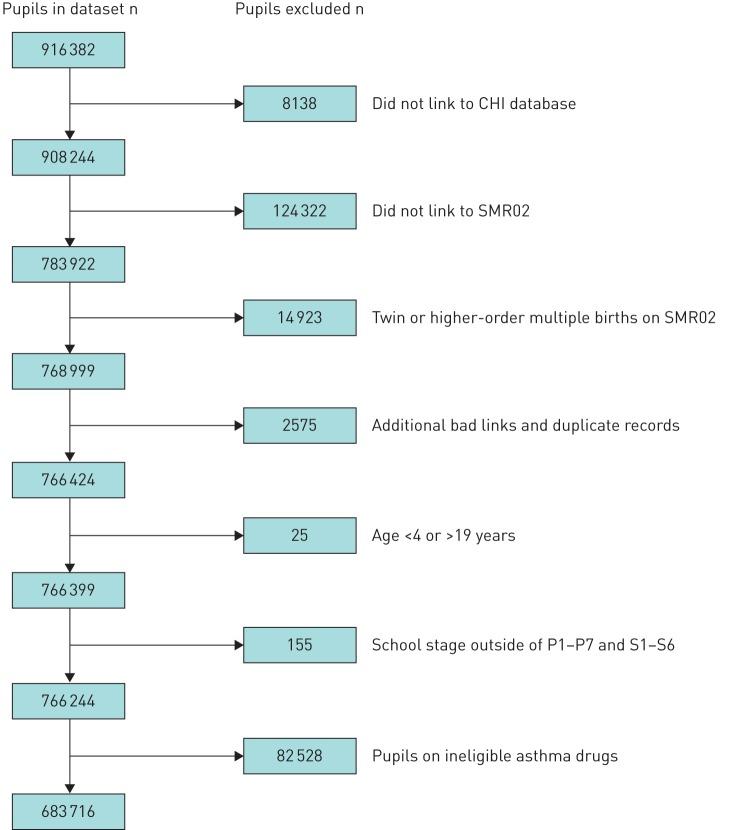
Linkage of eight Scotland-wide databases, covering dispensed prescriptions, hospital admissions, maternity records, death certificates, annual pupil census, examinations, school absences/exclusions and unemployment, provided data on 683 716 children attending Scottish schools between 2009 and 2013. We compared schoolchildren on medication for asthma with peers, adjusting for sociodemographic, maternity and comorbidity confounders, and explored effect modifiers and mediators.
RESULTS
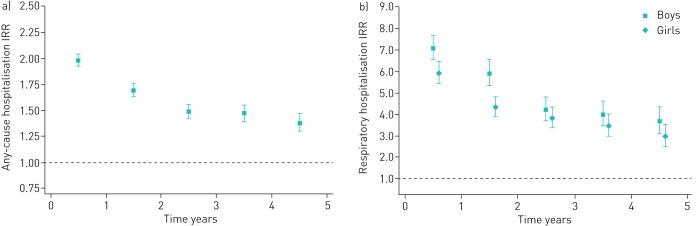
The 45 900 (6.0%) children treated for asthma had an increased risk of hospitalisation, particularly within the first year of treatment (incidence rate ratio 1.98, 95% CI 1.93-2.04), and increased mortality (HR 1.77, 95% CI 1.30-2.40). They were more likely to have special educational need for mental (OR 1.76, 95% CI 1.49-2.08) and physical (OR 2.76, 95% CI 2.57-2.95) health reasons, and performed worse in school exams (OR 1.11, 95% CI 1.06-1.16). Higher absenteeism (incidence rate ratio 1.25, 95% CI 1.24-1.26) partially explained their poorer attainment.
CONCLUSIONS
Children with treated asthma have poorer education and health outcomes than their peers. Educational interventions that mitigate the adverse effects of absenteeism should be considered.
背景
全球儿童哮喘患病率正在上升。这种疾病会影响身体和心理社会发病率;因此,对健康和教育结果的广泛影响是合理的。
方法
通过链接覆盖苏格兰的 8 个数据库,包括配药处方、住院记录、产妇记录、死亡证明、年度学生普查、考试、学校缺勤/开除和失业记录,我们获取了 2009 年至 2013 年间在苏格兰学校就读的 683716 名儿童的数据。我们将接受哮喘治疗的学童与同龄人进行比较,调整了社会人口统计学、产妇和合并症混杂因素,并探讨了调节因素和中介因素。
结果
45900 名(6.0%)接受哮喘治疗的儿童住院风险增加,特别是在治疗的第一年(发病率比 1.98,95%CI 1.93-2.04),死亡率也增加(HR 1.77,95%CI 1.30-2.40)。他们更有可能因精神(OR 1.76,95%CI 1.49-2.08)和身体(OR 2.76,95%CI 2.57-2.95)健康原因需要特殊教育,并且在学校考试中表现更差(OR 1.11,95%CI 1.06-1.16)。更高的缺勤率(发病率比 1.25,95%CI 1.24-1.26)部分解释了他们较差的成绩。
结论
接受哮喘治疗的儿童比同龄人在教育和健康方面的结果更差。应考虑采取教育干预措施来减轻缺勤的不利影响。

 Zotero 插件