
乌克兰西部的 、 与 、与蜱传脑炎病毒的共感染情况。
Prevalence of in and and Coinfection with and Tick-Borne Encephalitis Virus in Western Ukraine.
机构信息
Research Institute of Epidemiology and Hygiene, Danylo Halytsky Lviv National Medical University, Lviv, Ukraine.
出版信息
Vector Borne Zoonotic Dis. 2019 Nov;19(11):793-801. doi: 10.1089/vbz.2019.2450. Epub 2019 Jun 18.
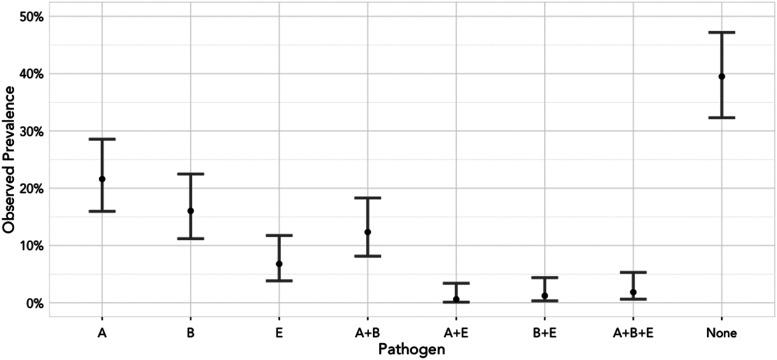
Tick-borne encephalitis virus (TBEV) and , the causative agent of Lyme disease (LD), are widespread in Western Ukraine. However, relatively little is known about in this region. This study examined patterns of infection with in two tick vectors compared with the better studied TBEV and Ticks were collected in three different ecosystems of the Western Ukraine during 2009-2014. Samples were examined for pathogen detection using real-time polymerase chain reaction (PCR), and logistic regression models were developed to assess the significance of different factors. Among the three selected ecological systems of the Western region of Ukraine, 5130 ticks belonging to and were collected between 2009 and 2014. They were grouped into 366 pools and were tested by PCR for . A subsample (1620 ticks, 162 pools) of the ticks was concurrently tested by PCR for , , and TBEV. Overall, there was no trend in the proportion of positive ticks across years ( > 0.05). However, the prevalence of was higher (27.4%) in than in (15.9%) (OR = 2.69; 95% CI, 1.52-4.94 (Lower, Upper 95% CI)). Infection was more common in forested habitats (OR = 1.89; 95% CI, 1.07-3.36) and during the later summer-early autumn (3.78; 95% CI, 1.79-8.06). was found in 29.3% and 31.9% of and , respectively; and TBEV was found in 6.3% and 14.5% of and . Coinfection of and occurred more often than chance and was more frequent than any other combination of pathogens ( = 0.031). Our study is the first to explore the potential relationship between the ecosystems, vectors, and the presence of Human Granulocytic Anaplasmosis (HGA) and other tick-borne infections in Western Ukraine. demonstrated a greater prevalence in in the forested area in Western Ukraine. Altogether, HGA, LD, and tick-borne encephalitis (TBE) pathogens are actively circulating in these ecosystems and have the potential to coinfect vectors that might increase the risk of transmitting multiple pathogens to humans during host feeding by individual ticks.
在乌克兰西部,蜱传脑炎病毒(TBEV)和伯氏疏螺旋体(病原体引起莱姆病(LD))广泛传播。然而,关于该地区的感染情况知之甚少。本研究比较了两种蜱传病毒的感染模式,与研究更为充分的 TBEV 和 TBEV 相比,研究了伯氏疏螺旋体在两个蜱虫载体中的感染情况。2009 年至 2014 年期间,在乌克兰西部的三个不同生态系统中采集了蜱虫样本。使用实时聚合酶链反应(PCR)检测病原体,建立逻辑回归模型以评估不同因素的重要性。在乌克兰西部的三个选定生态系统中,2009 年至 2014 年间共采集了 5130 只属于 和 的蜱虫。将它们分为 366 个池,并通过 PCR 检测进行检测。蜱虫的一个亚样本(1620 只,162 个池)同时通过 PCR 检测 、 、和 TBEV。总体而言,阳性蜱虫的比例没有随年份变化的趋势(>0.05)。然而,在森林栖息地中, 的流行率更高(27.4%)比在非森林栖息地(15.9%)更高(OR=2.69;95%CI,1.52-4.94(下,上 95%CI))。在森林生境中(OR=1.89;95%CI,1.07-3.36)和夏末初秋(3.78;95%CI,1.79-8.06)感染更为常见。在 和 中分别发现了 29.3%和 31.9%的 ;在 和 中分别发现了 6.3%和 14.5%的 TBEV。 和 同时感染的情况比随机情况更为常见,而且比其他任何病原体组合更为常见(=0.031)。我们的研究首次探索了乌克兰西部生态系统、媒介和人类粒细胞埃立克体病(HGA)和其他蜱传感染之间的潜在关系。研究表明,在乌克兰西部森林地区, 的流行率更高。总的来说,HGA、LD 和 TBE 病原体在这些生态系统中活跃循环,并有可能共同感染蜱虫,这可能会增加单个蜱虫在宿主吸血时传播多种病原体给人类的风险。


 Zotero 插件