
儿童乳糜泻,尤其是伴有 1 型糖尿病的儿童,其血液细胞因子平衡发生显著变化,这可能反映了小肠黏膜的炎症过程。
Celiac Disease in Children, Particularly with Accompanying Type 1 Diabetes, Is Characterized by Substantial Changes in the Blood Cytokine Balance, Which May Reflect Inflammatory Processes in the Small Intestinal Mucosa.
机构信息
Department of Immunology, Institute of Biomedicine and Translational Medicine, University of Tartu, Ravila 19, 51014 Tartu, Estonia.
Department of Pediatrics, Institute of Clinical Medicine, University of Tartu, Estonia.
出版信息
J Immunol Res. 2019 May 12;2019:6179243. doi: 10.1155/2019/6179243. eCollection 2019.
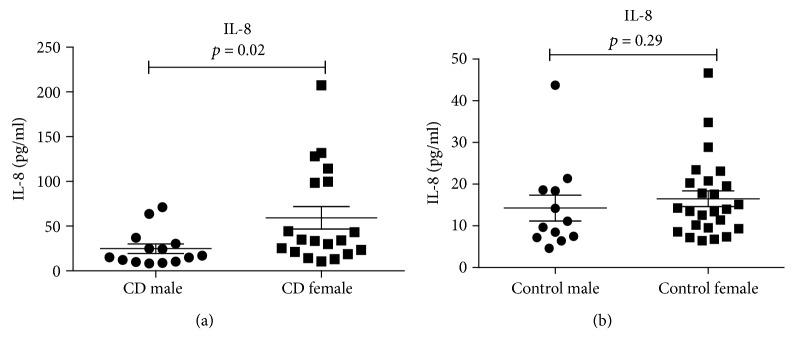
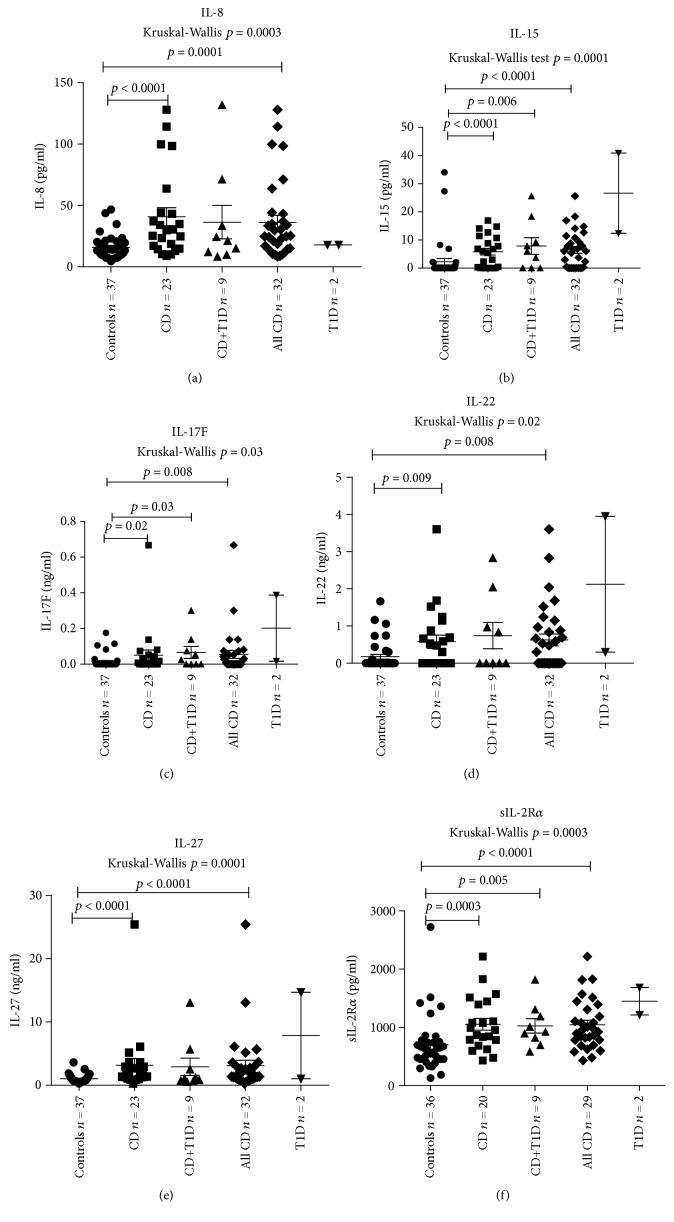
Cytokines play a pivotal role in the maintenance of intestinal homeostasis inducing pro- or anti-inflammatory response and mucosal barrier function in celiac disease (CD) and type 1 diabetes (T1D). We aimed to compare the levels of pro- and anti-inflammatory cytokines in CD patients without and with coexisting T1D, as well as to evaluate its association with the presence of enteroviruses (EV), regulatory T cells (Tregs), and dendritic cells (DCs) in small bowel mucosa. Altogether, 72 patients (median age 10.1 years) who had undergone small bowel biopsy were studied. The study group consisted of 24 patients with CD (median age 6.5 years), 9 patients with CD and concomitant T1D (median age 7.0 years), two patients with T1D (median age 8.5 years), and 37 patients (median age 14.0 years) with functional gastrointestinal disorders (FGD) and a normal small bowel mucosa as controls. The levels of 33 cytokines in serum were measured by multiple analysis using the Milliplex® MAP Magnetic Bead assay. The densities of FOXP3+ Tregs, CD11c+ DC, indoleamine 2,3-dioxygenase+ (IDO+) DC, langerin+ (CD207+) DCs, and EV were evaluated by immunohistochemistry as described in our previous studies. Circulating anti-EV IgA and IgG were evaluated using ELISA. The most important finding of the study is the significant increase of the serum levels of IL-5, IL-8, IL-13, IL-15, IL-17F, IL-22, IL-27, IP-10, MIP-1, sIL-2R, sTNFRII, and TNF in CD patients compared to controls and its correlation with the degree of small bowel mucosa damage graded according to the Marsh classification. The leptin level was higher in females in all study groups. The levels of IL-2, IL-6, IL-12 (P70), IL-15, IP-10, and IFN correlated significantly with the density of FOXP3+ Tregs in of the small bowel mucosa, which supports the evidence about the signaling role of these cytokines in the peripheral maintenance of FOXP3+ Tregs. At the same time, a significant negative correlation occurred between the level of IL-4 and density of FOXP3+ Tregs in controls. Another important finding of our study was the correlation of IL-17F, IP-10, sTNFRII, MCP-1, and GM-CSF with the density of EV-positive cells in the of the small bowel mucosa. Correlation of MIP-1 (CCL-4) with CD103+ DC and langerin+ DC densities may point to their significance in the recruitment of immune cells into the and in driving the inflammatory response in CD patients. Our results suggest the predominance of Th1 and Th17 immune responses over EV VP1 protein in CD and T1D patients. The significant elevation of Th2 cytokines, like IL-5 and IL-13, but not IL-4, in CD patients and its correlation with the degree of small bowel mucosa damage could reflect the role of these cytokines in gut defense and inflammation.
细胞因子在维持肠道内稳态中起着关键作用,可在乳糜泻 (CD) 和 1 型糖尿病 (T1D) 中诱导促炎或抗炎反应和黏膜屏障功能。我们旨在比较无共存 T1D 的 CD 患者和共存 T1D 的 CD 患者的促炎和抗炎细胞因子水平,并评估其与小肠黏膜中肠病毒 (EV)、调节性 T 细胞 (Tregs) 和树突状细胞 (DC) 的存在的关系。共有 72 名 (中位年龄 10.1 岁) 接受小肠活检的患者接受了研究。研究组包括 24 名 CD 患者 (中位年龄 6.5 岁)、9 名 CD 合并 T1D 患者 (中位年龄 7.0 岁)、2 名 T1D 患者 (中位年龄 8.5 岁) 和 37 名功能性胃肠疾病 (FGD) 患者 (中位年龄 14.0 岁) 作为对照,他们的小肠黏膜正常。使用 Milliplex® MAP 磁珠分析的多重分析测量了血清中 33 种细胞因子的水平。如我们之前的研究所述,通过免疫组织化学评估 FOXP3+Tregs、CD11c+DC、吲哚胺 2,3-双加氧酶+ (IDO+)DC、朗格汉斯+ (CD207+)DC 和 EV 的密度。使用 ELISA 评估循环抗 EV IgA 和 IgG。本研究最重要的发现是与对照组相比,CD 患者血清中 IL-5、IL-8、IL-13、IL-15、IL-17F、IL-22、IL-27、IP-10、MIP-1、sIL-2R、sTNFRII 和 TNF 的水平显著增加,且与根据 Marsh 分类评定的小肠黏膜损伤程度相关。在所有研究组中,女性的瘦素水平均较高。IL-2、IL-6、IL-12 (P70)、IL-15、IP-10 和 IFN 的水平与 FOXP3+Tregs 在小肠黏膜中的密度显著相关,这支持了这些细胞因子在周围维持 FOXP3+Tregs 中的信号作用的证据。同时,在对照组中,IL-4 水平与 FOXP3+Tregs 的密度之间存在显著负相关。我们研究的另一个重要发现是 IL-17F、IP-10、sTNFRII、MCP-1 和 GM-CSF 与小肠黏膜中 EV 阳性细胞密度的相关性。MIP-1 (CCL-4) 与 CD103+DC 和朗格汉斯+DC 密度的相关性可能表明它们在免疫细胞招募到 中以及在 CD 患者的炎症反应中具有重要意义。我们的结果表明,在 CD 和 T1D 患者中,Th1 和 Th17 免疫反应优先于 EV VP1 蛋白。CD 患者 Th2 细胞因子(如 IL-5 和 IL-13)而非 IL-4 的显著升高及其与小肠黏膜损伤程度的相关性,可能反映了这些细胞因子在肠道防御和炎症中的作用。
 Zotero 插件