
[TIMP-2]•[IGFBP7] 生物标志物检测在重症监护中评估急性肾损伤风险的临床应用:专家小组的指导意见。
Clinical use of [TIMP-2]•[IGFBP7] biomarker testing to assess risk of acute kidney injury in critical care: guidance from an expert panel.
机构信息
Florida Hospital, 601 E. Rollins Street, Orlando, FL, 32803, USA.
University Hospital Regensburg, Franz-Josef-Strauß-Allee 11, 93053, Regensburg, Germany.
出版信息
Crit Care. 2019 Jun 20;23(1):225. doi: 10.1186/s13054-019-2504-8.
BACKGROUND
The first FDA-approved test to assess risk for acute kidney injury (AKI), [TIMP-2]•[IGFBP7], is clinically available in many parts of the world, including the USA and Europe. We sought to understand how the test is currently being used clinically.
METHODS
We invited a group of experts knowledgeable on the utility of this test for kidney injury to a panel discussion regarding the appropriate use of the test. Specifically, we wanted to identify which patients would be appropriate for testing, how the results are interpreted, and what actions would be taken based on the results of the test. We used a modified Delphi method to prioritize specific populations for testing and actions based on biomarker test results. No attempt was made to evaluate the evidence in support of various actions however.
RESULTS
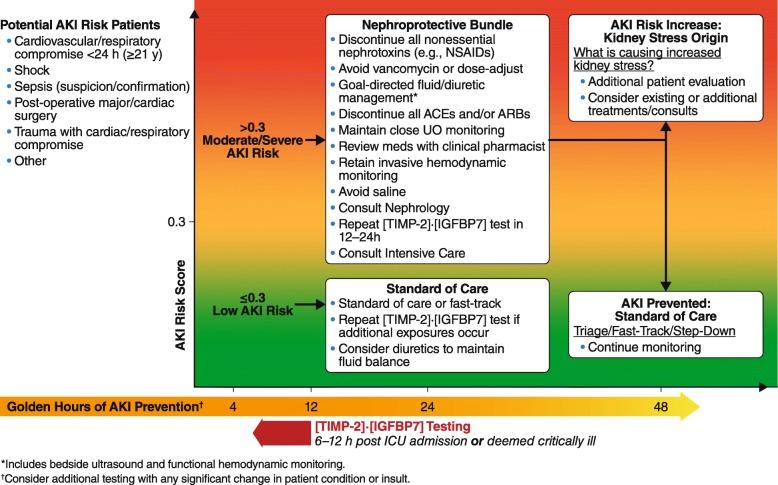
Our results indicate that clinical experts have developed similar practice patterns for use of the [TIMP-2]•[IGFBP7] test in Europe and North America. Patients undergoing major surgery (both cardiac and non-cardiac), those who were hemodynamically unstable, or those with sepsis appear to be priority patient populations for testing kidney stress. It was agreed that, in patients who tested positive, management of potentially nephrotoxic drugs and fluids would be a priority. Patients who tested negative may be candidates for "fast-track" protocols.
CONCLUSION
In the experience of our expert panel, biomarker testing has been a priority after major surgery, hemodynamic instability, or sepsis. Our panel members reported that a positive test prompts management of nephrotoxic drugs as well as fluids, while patients with negative results are considered to be excellent candidates for "fast-track" protocols.
背景
首个经美国食品药品监督管理局(FDA)批准用于评估急性肾损伤(AKI)风险的检测方法 [TIMP-2]•[IGFBP7] 在世界许多地区(包括美国和欧洲)已临床可用。我们试图了解该检测目前在临床上是如何使用的。
方法
我们邀请了一组对该检测用于肾损伤的实用性具有专业知识的专家,就该检测的合理应用进行了小组讨论。具体而言,我们希望确定哪些患者适合进行检测,如何解释检测结果,以及根据检测结果将采取哪些措施。我们使用改良 Delphi 方法,根据生物标志物检测结果,对特定人群进行检测和采取措施进行优先级排序。但是,我们没有尝试评估支持各种措施的证据。
结果
我们的研究结果表明,欧洲和北美的临床专家已经制定了类似的 [TIMP-2]•[IGFBP7] 检测应用实践模式。接受重大手术(包括心脏和非心脏手术)、血流动力学不稳定或脓毒症的患者似乎是检测肾脏应激的优先患者群体。专家们一致认为,在检测结果为阳性的患者中,管理潜在肾毒性药物和液体是当务之急。检测结果为阴性的患者可能是“快速通道”方案的候选者。
结论
在我们的专家小组的经验中,生物标志物检测一直是重大手术后、血流动力学不稳定或脓毒症后的优先事项。我们的小组成员报告称,阳性检测结果提示管理肾毒性药物和液体,而阴性检测结果的患者被认为是“快速通道”方案的优秀候选者。


 Zotero 插件