
绘制 2000-17 年全球间日疟原虫流行状况和临床负担图:时空建模研究。
Mapping the global endemicity and clinical burden of Plasmodium vivax, 2000-17: a spatial and temporal modelling study.
机构信息
Malaria Atlas Project, Big Data Institute, Li Ka Shing Centre for Health Information and Discovery, University of Oxford, Oxford, UK.
Menzies School of Health Research and Charles Darwin University, Darwin, NT, Australia.
出版信息
Lancet. 2019 Jul 27;394(10195):332-343. doi: 10.1016/S0140-6736(19)31096-7. Epub 2019 Jun 19.
BACKGROUND
Plasmodium vivax exacts a significant toll on health worldwide, yet few efforts to date have quantified the extent and temporal trends of its global distribution. Given the challenges associated with the proper diagnosis and treatment of P vivax, national malaria programmes-particularly those pursuing malaria elimination strategies-require up to date assessments of P vivax endemicity and disease impact. This study presents the first global maps of P vivax clinical burden from 2000 to 2017.
METHODS
In this spatial and temporal modelling study, we adjusted routine malariometric surveillance data for known biases and used socioeconomic indicators to generate time series of the clinical burden of P vivax. These data informed Bayesian geospatial models, which produced fine-scale predictions of P vivax clinical incidence and infection prevalence over time. Within sub-Saharan Africa, where routine surveillance for P vivax is not standard practice, we combined predicted surfaces of Plasmodium falciparum with country-specific ratios of P vivax to P falciparum. These results were combined with surveillance-based outputs outside of Africa to generate global maps.
FINDINGS
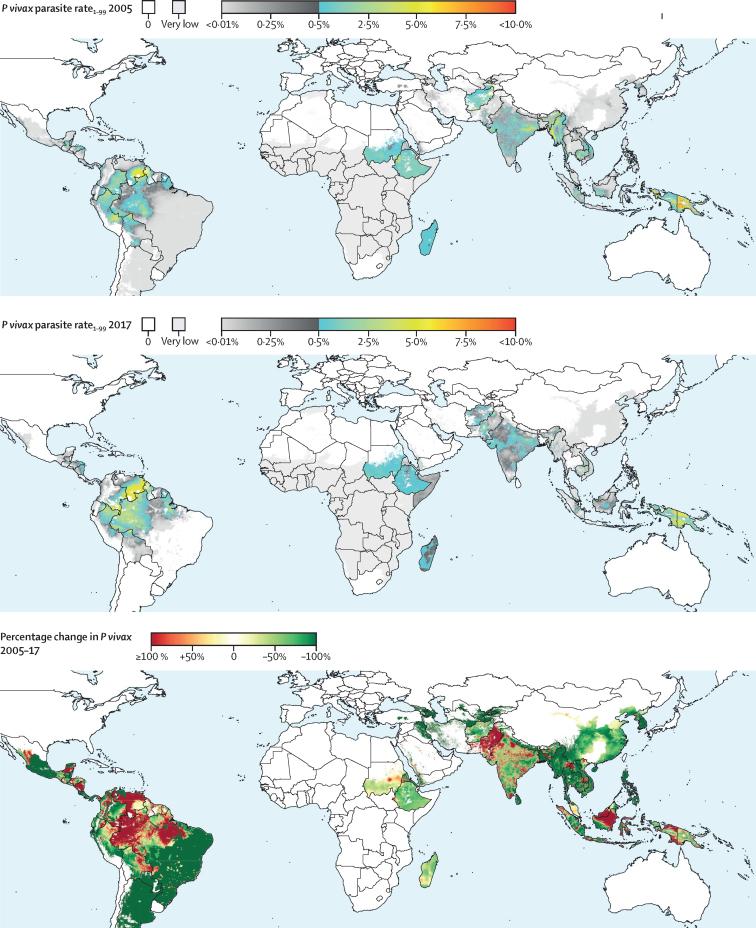
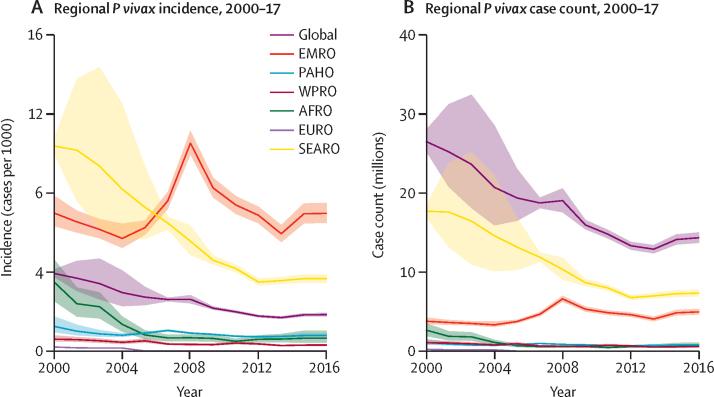
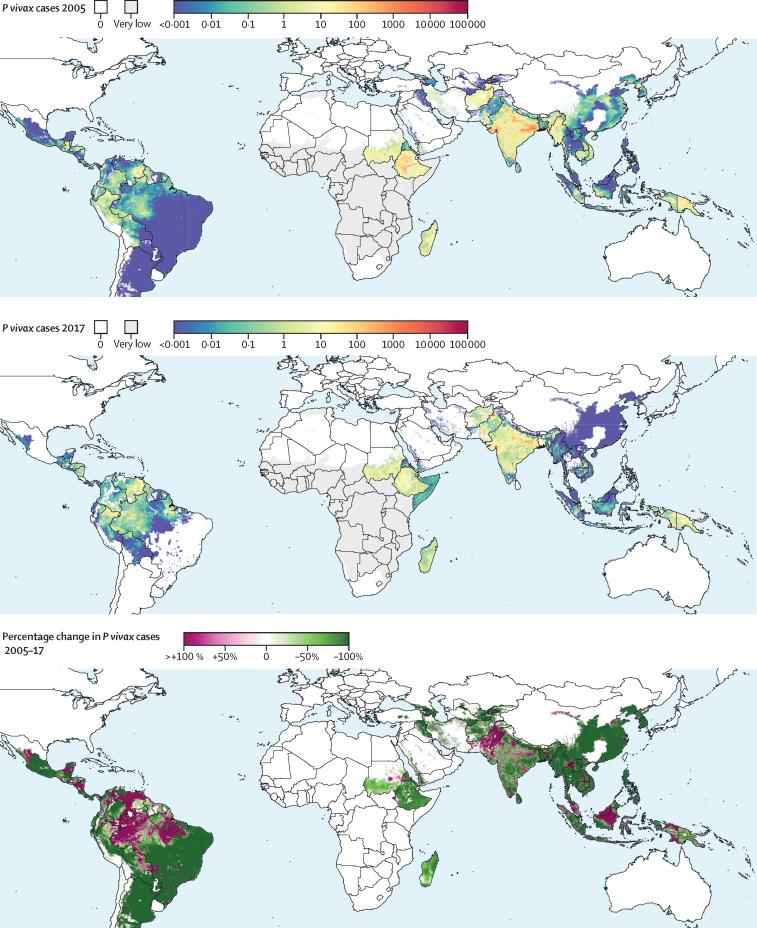
We present the first high-resolution maps of P vivax burden. These results are combined with those for P falciparum (published separately) to form the malaria estimates for the Global Burden of Disease 2017 study. The burden of P vivax malaria decreased by 41·6%, from 24·5 million cases (95% uncertainty interval 22·5-27·0) in 2000 to 14·3 million cases (13·7-15·0) in 2017. The Americas had a reduction of 56·8% (47·6-67·0) in total cases since 2000, while South-East Asia recorded declines of 50·5% (50·3-50·6) and the Western Pacific regions recorded declines of 51·3% (48·0-55·4). Europe achieved zero P vivax cases during the study period. Nonetheless, rates of decline have stalled in the past five years for many countries, with particular increases noted in regions affected by political and economic instability.
INTERPRETATION
Our study highlights important spatial and temporal patterns in the clinical burden and prevalence of P vivax. Amid substantial progress worldwide, plateauing gains and areas of increased burden signal the potential for challenges that are greater than expected on the road to malaria elimination. These results support global monitoring systems and can inform the optimisation of diagnosis and treatment where P vivax has most impact.
FUNDING
Bill & Melinda Gates Foundation and the Wellcome Trust.
背景
间日疟原虫在全球范围内对健康造成了重大影响,但迄今为止,很少有努力对其全球分布范围和时间趋势进行量化。鉴于正确诊断和治疗间日疟原虫所面临的挑战,国家疟疾规划——特别是那些追求消除疟疾策略的规划——需要对间日疟原虫的流行程度和疾病影响进行最新评估。本研究提供了 2000 年至 2017 年间日疟原虫临床负担的全球首张地图。
方法
在这项时空建模研究中,我们对已知偏倚的常规疟疾监测数据进行了调整,并利用社会经济指标来生成间日疟原虫临床负担的时间序列。这些数据为贝叶斯地理空间模型提供了信息,该模型生成了间日疟原虫临床发病率和感染率随时间的精细预测。在撒哈拉以南非洲地区,由于没有常规监测间日疟原虫,我们将预测的恶性疟原虫表面与国家间间日疟原虫与恶性疟原虫的比值相结合。这些结果与非洲以外的基于监测的结果相结合,生成了全球地图。
结果
我们展示了第一张高分辨率的间日疟原虫负担地图。这些结果与恶性疟原虫的结果(单独发布)相结合,构成了 2017 年全球疾病负担研究中的疟疾估计。间日疟原虫疟疾负担下降了 41.6%,从 2000 年的 2450 万例(95%不确定性区间为 2250-2700)降至 2017 年的 1430 万例(1370-1500)。自 2000 年以来,美洲的总病例数减少了 56.8%(476-670),而东南亚地区下降了 50.5%(503-506),西太平洋地区下降了 51.3%(480-554)。欧洲在研究期间没有发现间日疟原虫病例。尽管如此,在过去五年中,许多国家的下降速度已经停滞,在受政治和经济不稳定影响的地区尤其出现了增加。
解释
我们的研究强调了间日疟原虫临床负担和流行的重要时空模式。在全球范围内取得了重大进展的同时,收益的停滞不前和负担增加的地区表明,在消除疟疾的道路上,面临的挑战可能比预期的更大。这些结果支持了全球监测系统,并可以为间日疟原虫影响最大的地区的诊断和治疗优化提供信息。
资金
比尔和梅琳达·盖茨基金会和惠康信托基金会。


 Zotero 插件