
2013-2017 年中国大气[公式:见文本]和[公式:见文本]相关死亡率降低的排放控制、气象因素、人口增长和基准死亡率变化的估计贡献。
Estimated Contributions of Emissions Controls, Meteorological Factors, Population Growth, and Changes in Baseline Mortality to Reductions in Ambient [Formula: see text] and [Formula: see text]-Related Mortality in China, 2013-2017.
机构信息
State Key Joint Laboratory of Environmental Simulation and Pollution Control, School of Environment, Tsinghua University, Beijing, China.
State Environmental Protection Key Laboratory of Sources and Control of Air Pollution Complex, Beijing, China.
出版信息
Environ Health Perspect. 2019 Jun;127(6):067009. doi: 10.1289/EHP4157. Epub 2019 Jun 24.
BACKGROUND
In 2013, China released the Air Pollution Prevention and Control Action Plan (Action Plan), which set the roadmap for national air pollution control actions for the period of 2013 to 2017. A decrease in the fine particulate matter with aerodynamic diameter [Formula: see text] ([Formula: see text]) concentration may lead to a substantial benefit for human health.
OBJECTIVE
We aimed to quantify the relative contributions four factors: emission reductions, changed meteorology, population growth, and a change in baseline mortality rates to the reduced [Formula: see text]-related mortality ([Formula: see text]-mortality) during the 2013-2017 period and evaluate the importance of emission controls for human health protection in China.
METHODS
The integrated exposure-response function was adopted to estimate the chronic health effects of [Formula: see text]. The annual [Formula: see text] concentrations were estimated from chemical transport model simulations combined with surface observations for 2013 and 2017. Relative contributions to [Formula: see text]-mortality from emission reductions and the three factors were individually quantified through scenario analysis.
RESULTS
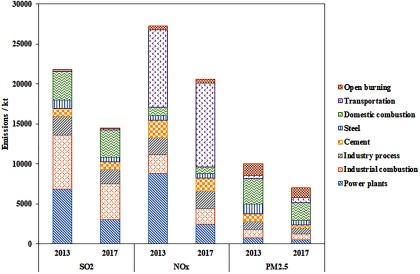
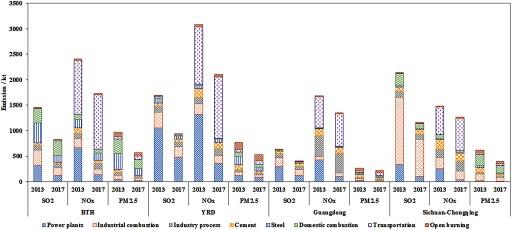
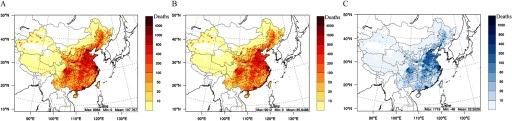
The estimated total [Formula: see text]-mortality in China was 1.389 million [95% confidence interval (CI): 1.005 million, 1.631 million] in 2013 but was substantially reduced to 1.102 million (95% CI: 0.755 million, 1.337 million) in 2017. Emission controls contributed 88.7% to this reduction in [Formula: see text]-mortality, while changed meteorology, the change in baseline mortality rates, and population growth during 2013-2017 contributed 9.6, 3.8, and [Formula: see text], respectively.
CONCLUSIONS
The implementation of the Action Plan has significantly reduced the [Formula: see text] concentration in regions of China where population density is high, dominating the decline in [Formula: see text]-mortality during 2013-2017. However, the health burden of [Formula: see text] pollution in China is still extremely high compared with that in other developed countries. An aggressive air pollution control strategy should be implemented in densely populated areas to further reduce the health burden. https://doi.org/10.1289/EHP4157.
背景
2013 年,中国发布了《大气污染防治行动计划》(行动计划),为 2013 年至 2017 年期间的国家大气污染控制行动制定了路线图。细颗粒物([Formula: see text])浓度的降低可能会对人类健康带来实质性的益处。
目的
我们旨在量化四个因素的相对贡献:减排、气象变化、人口增长和基线死亡率的变化,以解释 2013-2017 年期间[Formula: see text]相关死亡率([Formula: see text]-mortality)降低的原因,并评估排放控制措施对中国人类健康保护的重要性。
方法
采用综合暴露-反应函数来估计[Formula: see text]对慢性健康的影响。通过化学输送模型模拟与地表观测相结合,估算 2013 年和 2017 年的[Formula: see text]年浓度。通过情景分析分别量化减排和三个因素对[Formula: see text]-mortality 的相对贡献。
结果
2013 年,中国估计的总[Formula: see text]-mortality 为 138.9 万人(95%置信区间:100.5 万人,163.1 万人),但在 2017 年大幅下降至 110.2 万人(95%置信区间:75.5 万人,133.7 万人)。排放控制措施对[Formula: see text]-mortality 的降低贡献了 88.7%,而气象变化、基线死亡率变化和 2013-2017 年期间的人口增长分别贡献了 9.6%、3.8%和[Formula: see text]。
结论
行动计划的实施显著降低了中国人口密度高的地区的[Formula: see text]浓度,主导了 2013-2017 年期间[Formula: see text]-mortality 的下降。然而,与其他发达国家相比,中国的[Formula: see text]污染对健康的负担仍然极高。在人口密集地区应实施积极的空气污染控制战略,以进一步降低健康负担。https://doi.org/10.1289/EHP4157.




 Zotero 插件