
慢性乙型肝炎病毒感染可改变合并感染间日疟原虫疟疾患者的全身免疫激活特征。
Chronic hepatitis B virus infection drives changes in systemic immune activation profile in patients coinfected with Plasmodium vivax malaria.
机构信息
Instituto Gonçalo Moniz, Fundação Oswaldo Cruz (FIOCRUZ), Salvador, Brazil.
Faculdade de Tecnologia e Ciências (FTC), Salvador, Brazil.
出版信息
PLoS Negl Trop Dis. 2019 Jun 24;13(6):e0007535. doi: 10.1371/journal.pntd.0007535. eCollection 2019 Jun.
BACKGROUND
Plasmodium vivax and Hepatitis B virus (HBV) are globally outspread in similar geographic regions. The concurrence of both infections and its association with some degree of protection against symptomatic and/or severe vivax malaria has been already described. Nevertheless, data on how host response to both pathogens undermines the natural progression of the malarial infection are scarce. Here, a large cohort of vivax malaria and HBV patients is retrospectively analyzed in an attempt to depict how inflammatory characteristics could be potentially related to the protection to severe malaria in coinfection.
METHODS
A retrospective analysis of a databank containing 601 individuals from the Brazilian Amazon, including 179 symptomatic P. vivax monoinfected patients, 145 individuals with asymptomatic P. vivax monoinfection, 28 P. vivax-HBV coinfected patients, 29 HBV monoinfected subjects and 165 healthy controls, was performed. Data on plasma levels of multiple chemokines, cytokines, acute phase proteins, hepatic enzymes, bilirubin and creatinine were analyzed to describe and compare biochemical profiles associated to each type of infection.
RESULTS
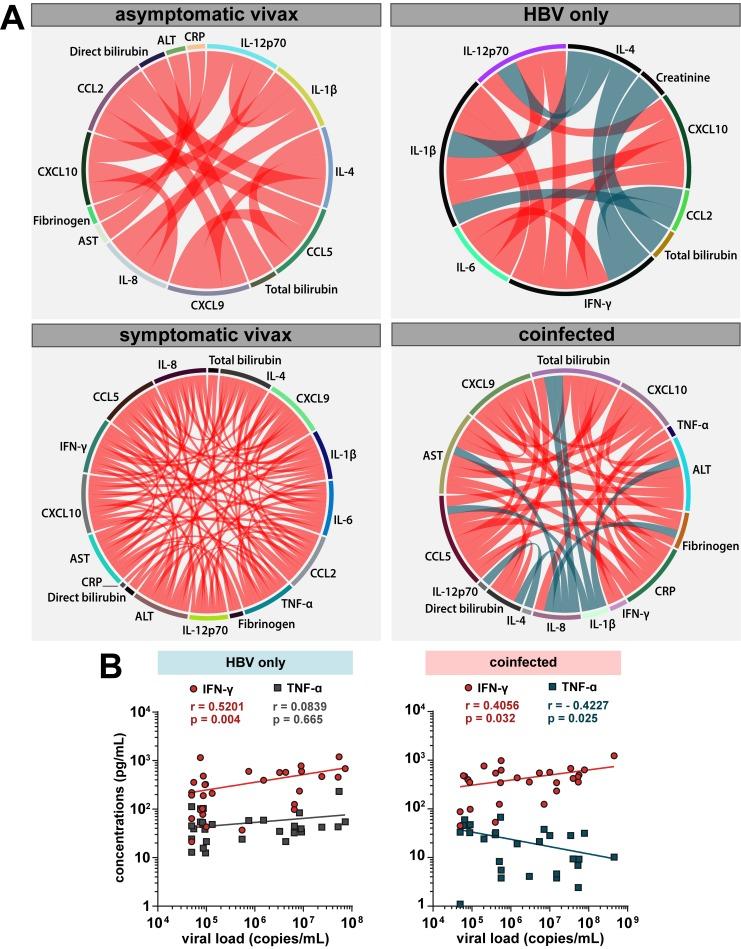
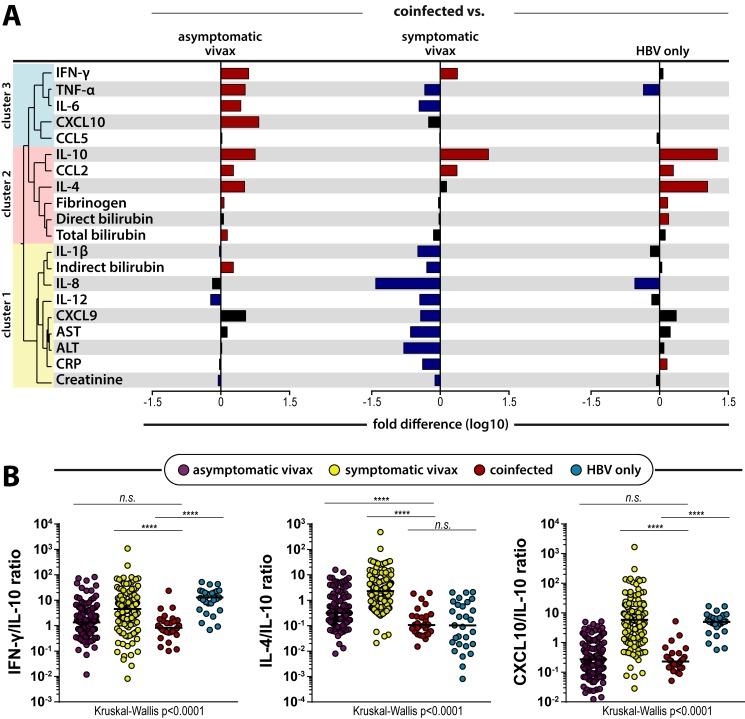
Coinfected individuals predominantly presented asymptomatic malaria, referred increased number of previous malaria episodes than symptomatic vivax-monoinfected patients, and were predominantly younger than asymptomatic vivax-monoinfected individuals. Coinfection was hallmarked by substantially elevated concentrations of interleukin (IL)-10 and heightened levels of C-C motif chemokine ligand (CCL)2. Correlation matrices showed that coinfected individuals presented a distinct biomarker profile when compared to asymptomatic or symptomatic P. vivax patients, or HBV-monoinfected individuals. Parasitemia could distinguish coinfected from symptomatic or asymptomatic P. vivax-monoinfected patients. HBV viremia was associated to distinct inflammatory profiles in HBV-monoinfected and coinfected patients.
CONCLUSION
The findings demonstrate a distinct inflammatory profile in coinfected patients, with characteristics associated with immune responses to both pathogens. These host responses to P. vivax and HBV, in conjunction, could be potentially associated, if not mainly responsible, for the protection against symptomatic vivax malaria.
背景
间日疟原虫和乙型肝炎病毒(HBV)在全球范围内分布于相似的地理区域。这两种感染的同时存在及其与一定程度的间日疟原虫症状性和/或重症疟疾保护作用的关联已经被描述过。然而,宿主对这两种病原体的反应如何削弱疟疾感染的自然进程的数据仍然很少。在这里,我们回顾性分析了一个大型间日疟原虫和 HBV 患者队列,试图描述炎症特征如何可能与合并感染时对重症疟疾的保护作用有关。
方法
对巴西亚马逊地区的一个包含 601 人的数据库进行回顾性分析,其中包括 179 例有症状的间日疟原虫单感染患者、145 例无症状的间日疟原虫单感染患者、28 例间日疟原虫-HBV 合并感染患者、29 例 HBV 单感染患者和 165 例健康对照者。分析了多种趋化因子、细胞因子、急性期蛋白、肝酶、胆红素和肌酐的血浆水平,以描述和比较与每种类型感染相关的生化特征。
结果
合并感染的个体主要表现为无症状疟疾,比有症状的间日疟原虫单感染患者报告的既往疟疾发作次数更多,且主要比无症状的间日疟原虫单感染患者更年轻。合并感染的特点是白细胞介素(IL)-10 浓度显著升高和 C-C 基序趋化因子配体(CCL)2 水平升高。相关矩阵显示,与无症状或有症状的间日疟原虫单感染患者或 HBV 单感染患者相比,合并感染的个体具有明显不同的生物标志物特征。寄生虫血症可将合并感染与有症状或无症状的间日疟原虫单感染患者区分开来。HBV 病毒血症与 HBV 单感染和合并感染患者的不同炎症特征相关。
结论
研究结果表明,合并感染患者存在独特的炎症特征,这些特征与对这两种病原体的免疫反应有关。这些宿主对间日疟原虫和 HBV 的反应,如果不是主要原因的话,可能与间日疟原虫症状性疟疾的保护作用有关。

 Zotero 插件